In a significant order addressing procedural compliance under the Narcotic Drugs and Psychotropic Substances Act, 1985 (NDPS Act), the Rajasthan High Court suspended the sentence of two convicts, emphasizing that the prosecution's failure to draw separate samples from each seized bag of contraband renders the conviction vulnerable. The judgment underscores the mandatory nature of sampling procedures under Section 52A of the NDPS Act and sets a precedent for strict adherence to statutory protocols in drug-related offenses.
Background & Facts
The Dispute
The applicants, Arvind and Chetan, were convicted by the Special Judge (NDPS Act Cases), Udaipur, in Special Session Case No. 12/2016 vide judgment dated 28.01.2026. The prosecution alleged that on an unspecified date, the SHO, Police Station Bekariya, intercepted a white-coloured Toyota car during a routine nakabandi (checkpost) within his jurisdiction. Following the prescribed procedure under the NDPS Act, the vehicle was searched, and four plastic bags containing 93.300 kilograms of poppy husk (poppy straw) were recovered.
Key Facts
The vehicle was intercepted during a routine nakabandi by the SHO, Police Station Bekariya.
93.300 kilograms of poppy husk were recovered from four plastic bags.
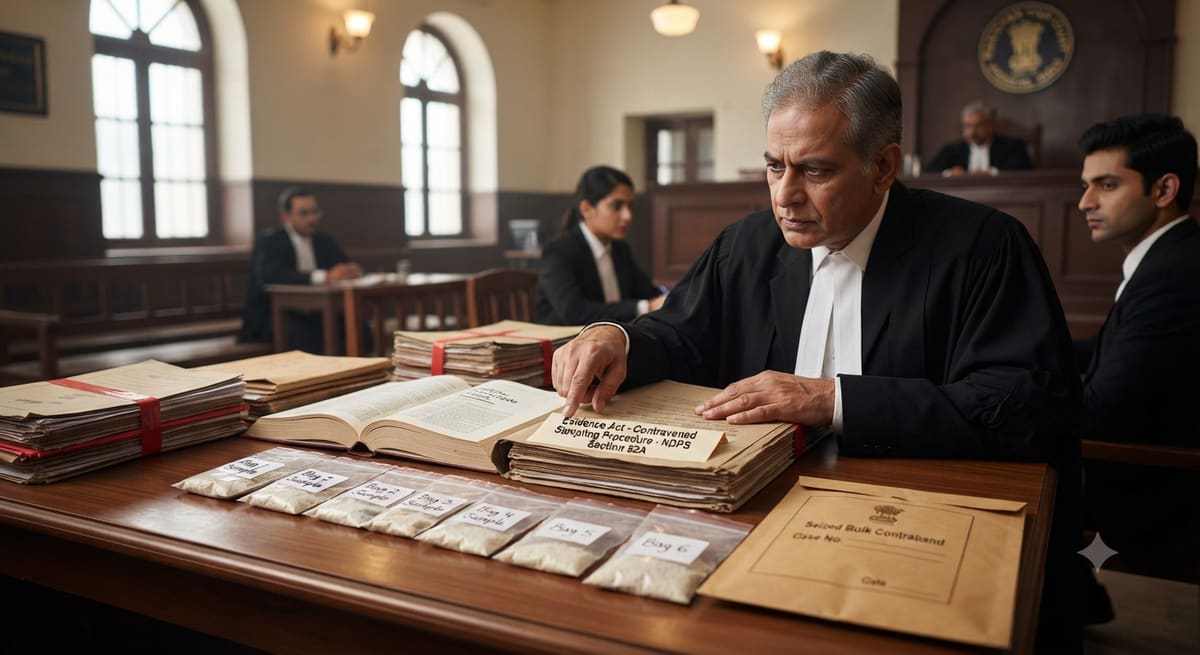
The Seizure Officer admitted during deposition that samples from all four bags were mixed together and placed in a single packet for forwarding to the Forensic Science Laboratory (FSL).
The applicants were convicted under the NDPS Act and sentenced to imprisonment.
The applicants had no prior criminal antecedents and had already undergone incarceration for more than one year and five months.
Procedural History
Unspecified Date: Vehicle intercepted and contraband recovered.
Unspecified Date: Trial commenced before the Special Judge (NDPS Act Cases), Udaipur.
28.01.2026: Conviction and sentence awarded in Special Session Case No. 12/2016.
Unspecified Date: Appeal filed before the Rajasthan High Court.
13.07.2026: S.B. Criminal Misc. Suspension of Sentence Application (Appeal) No. 221/2026 filed seeking suspension of sentence during pendency of appeal.
The Parties' Positions
For the Petitioners
The sampling procedure adopted by the prosecution was in violation of the mandatory procedure under the NDPS Act, as separate samples were not drawn from each of the four bags.
The procedure was contrary to the law laid down in Net Ram v. State of Rajasthan, reported in (2014) 1 Cr.L.R. (Raj.) 163, rendering the conviction vulnerable.
The appeal raises substantial, arguable, and debatable questions requiring detailed consideration.
The petitioners have no criminal antecedents and are unlikely to abscond.
The pendency of criminal appeals before the High Court is heavy, and the appeal is not likely to be heard soon.
For the Respondent
The Public Prosecutor vehemently opposed the application for suspension of sentence.
Relief Sought
The petitioners sought suspension of their sentence during the pendency of the appeal under Section 430 of the Bharatiya Nagarik Suraksha Sanhita, 2023 (BNSS), corresponding to Section 389 of the Code of Criminal Procedure, 1973 (CrPC).
The Legal Issue
The central question was whether the conviction under the NDPS Act could stand when the prosecution failed to comply with the mandatory sampling procedure prescribed under Section 52A of the NDPS Act, specifically by mixing samples from multiple bags of contraband instead of drawing separate representative samples.
Arguments Presented
For the Petitioners
The Seizure Officer admitted that samples from all four bags were mixed together, violating the mandatory procedure under Section 52A of the NDPS Act.
The procedure was contrary to the law laid down in Net Ram v. State of Rajasthan, which mandates separate sampling for each seized package.
The conviction is rendered vulnerable due to this procedural lapse.
The appeal raises substantial legal questions that warrant suspension of sentence.
The petitioners have no criminal antecedents and pose no flight risk.
For the Respondent
The Public Prosecutor opposed the suspension of sentence without elaborating on the merits of the sampling procedure.
The Court's Analysis
The Court critically examined the procedural compliance under the NDPS Act, particularly focusing on the sampling methodology adopted by the prosecution. The Court noted that the Seizure Officer admitted during his deposition that samples from all four plastic bags were mixed together and forwarded in a single packet to the FSL. This procedure was held to be in direct violation of the mandatory requirements under Section 52A of the NDPS Act, which prescribes that separate representative samples must be drawn from each seized package.
The Court relied on the precedent set in Net Ram v. State of Rajasthan, where it was held that:
"The procedure for drawing samples under the NDPS Act is not merely directory but mandatory. Failure to draw separate samples from each package of contraband vitiates the entire seizure and renders the conviction unsustainable."
The Court observed that the prosecution's lapse in adhering to the prescribed procedure created a substantial doubt regarding the integrity of the evidence, thereby rendering the conviction vulnerable. While the Court acknowledged that the final merits of the appeal would be considered during the detailed hearing, it held that the procedural violation was sufficient grounds to suspend the sentence during the pendency of the appeal.
The Court also considered the petitioners' conduct, noting that they had no criminal antecedents and had already undergone significant incarceration. The heavy pendency of criminal appeals before the High Court was an additional factor in granting interim relief.
The Verdict
The Rajasthan High Court allowed the application for suspension of sentence under Section 430 BNSS (389 CrPC). The Court ordered that the sentence awarded by the Special Judge (NDPS Act Cases), Udaipur, vide judgment dated 28.01.2026 in Special Session Case No. 12/2016, shall remain suspended till the final disposal of the appeal. The petitioners were directed to be released on bail, subject to the following conditions:
Each petitioner must execute a personal bond in the sum of Rs. 1,00,000.
Each petitioner must furnish two sureties of Rs. 50,000 each.
The petitioners must appear before the trial Court in January of every year till the appeal is decided.
If the petitioners or sureties change their place of residence, they must inform the trial Court and High Court counsel in writing.
The trial Court shall maintain a separate file for the attendance record of the petitioners, which shall not be counted for statistical purposes.
In case of non-appearance, the trial Court shall report the matter to the High Court for cancellation of bail.
What This Means For Similar Cases
Mandatory Sampling Procedure Under NDPS Act Is Non-Negotiable
The judgment reinforces that Section 52A of the NDPS Act prescribes a mandatory procedure for drawing and preserving samples from seized contraband.
Mixing samples from multiple packages is a fatal procedural lapse that can vitiate the entire prosecution case.
Practitioners must scrutinize the seizure and sampling records in NDPS cases to identify similar violations, which can form the basis for challenging convictions.
Suspension of Sentence Can Be Granted Even in Serious Offenses
The Court demonstrated that suspension of sentence under Section 430 BNSS (389 CrPC) is not precluded even in serious offenses like those under the NDPS Act, provided there are substantial legal infirmities in the prosecution case.
Procedural violations, even if not fatal at the trial stage, can be strong grounds for interim relief during appeal.
The pendency of appeals and the conduct of the accused (e.g., no criminal antecedents) are relevant factors in granting suspension of sentence.
Trial Courts Must Maintain Strict Compliance Records
The judgment underscores the importance of maintaining meticulous records of procedural compliance, including sampling, seizure, and custody of contraband.
Trial Courts are now expressly directed to maintain a separate file for attendance records of accused released on suspension of sentence, ensuring better monitoring.
Non-compliance with bail conditions can lead to immediate cancellation of bail, emphasizing the need for strict adherence to court directions.