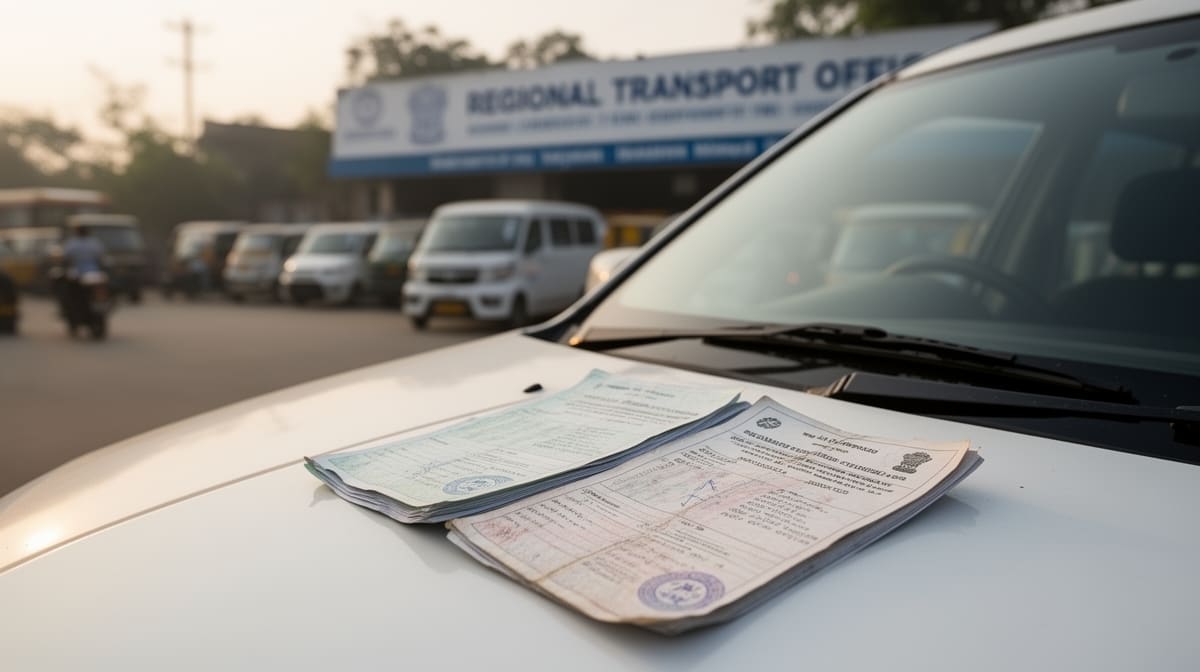
The Punjab and Haryana High Court has reaffirmed that the registered owner of a motor vehicle remains legally liable for compensation in accident claims, even after selling the vehicle, if the transfer is not formally recorded with the registering authority. This decision reinforces the protective intent of the Motor Vehicles Act, ensuring victims and their families are not left without recourse due to unregistered private transactions.
Background & Facts
The Dispute
The appellant, Devender Kumar, challenged a compensation award of Rs. 14,59,200 passed by the Motor Accident Claims Tribunal, Yamuna Nagar, which held him liable for the death of Purshotam in a motor accident on 24.08.2017. The appellant claimed he had sold the offending motorcycle - registered as HR-04-9359 - to Harjit Singh on 20.08.2008 and had obtained a No Objection Certificate (NOC) from the Licensing Authority on 20.03.2008. He argued that since he was not in physical possession or control of the vehicle at the time of the accident, liability could not be fastened upon him.
Procedural History
- 2017: Claim petition filed under Section 166 of the Motor Vehicles Act by the deceased’s legal heirs.
- 2024: Motor Accident Claims Tribunal awarded compensation, holding the appellant liable as registered owner.
- 2025: Appeal filed before the Punjab and Haryana High Court challenging the award.
- 2026: High Court dismissed the appeal, upholding the Tribunal’s finding.
Relief Sought
The appellant sought modification or setting aside of the compensation award to the extent it held him liable, arguing that the true owner at the time of the accident was Harjit Singh, and that liability should rest with him.
The Legal Issue
The central question was whether the registered owner of a motor vehicle remains liable for compensation under Section 166 of the Motor Vehicles Act, 1988, even after selling the vehicle, if the transfer of ownership has not been formally recorded with the registering authority.
Arguments Presented
For the Appellant
The appellant contended that liability should not attach to him because:
- He had sold the vehicle in 2008 and transferred possession to Harjit Singh.
- An affidavit from Harjit Singh and an NOC from the Licensing Authority supported the sale.
- He had no physical control or use of the vehicle at the time of the accident.
- Under the Sale of Goods Act, 1930, title passed upon delivery and payment, absolving him of liability.
For the Respondent/State
The respondents argued that:
- The appellant remained the registered owner as per RTO records at the time of the accident.
- Harjit Singh had denied purchasing the vehicle in his written statement before the Tribunal.
- No application for transfer of ownership had been filed with the RTO, rendering the sale ineffective for statutory purposes.
- The purpose of Section 2(30) is to protect victims, not to create loopholes for owners to evade liability.
The Court's Analysis
The Court examined the definition of 'owner' under Section 2(30) of the Motor Vehicles Act, 1988, which explicitly states that the person in whose name the vehicle is registered is the owner for all purposes under the Act. The Court emphasized that this statutory definition overrides common law principles of transfer of title.
"The principle underlying the provisions of Section 2(30) is that the victim of a motor accident or, in the case of a death, the legal heirs of the deceased victim should not be left in a state of uncertainty. A claimant for compensation ought not to be burdened with following a trail of successive transfers, which are not registered with the registering authority."
The Court relied on the three-Judge Bench decision in Naveen Kumar v. Vijay Kumar, which held that even if a vehicle is sold and delivered, the registered owner remains liable if the transfer is not recorded. The Court distinguished the Sale of Goods Act, noting that while private transfers may be valid between parties, they do not extinguish statutory liability under the Motor Vehicles Act.
The Court also noted the appellant’s failure to apply for cancellation of registration over nine years, despite claiming to have sold the vehicle. The absence of any official record of transfer rendered his claim legally untenable. The judgments in M/s Rhee Pharmaceuticals v. Sukhdeep Kaur and Savinder Singh v. Binder Singh were cited to reinforce that the Act prioritizes victim protection over technical defenses.
The Verdict
The appellant’s appeal was dismissed. The Court held that the registered owner remains strictly liable for compensation under the Motor Vehicles Act if the transfer of ownership is not recorded with the registering authority, regardless of actual possession or private agreements. The compensation award of Rs. 14,59,200 was upheld.
What This Means For Similar Cases
Registered Ownership Is Controlling
- Practitioners must treat RTO records as conclusive for liability under Section 2(30), irrespective of private sale deeds or affidavits.
- Claimants need not prove actual possession or control - registration alone suffices to fix liability.
Transfer Must Be Officially Recorded
- Lawyers advising vehicle sellers must insist on immediate RTO transfer procedures.
- Failure to register transfer exposes the seller to lifelong liability for accidents, even decades after sale.
- Applications for transfer must be filed within 30 days of sale under Section 50(1) to avoid liability.
No Relief Through Third-Party Affidavits
- Affidavits from alleged purchasers are insufficient to rebut registered ownership.
- Courts will not entertain claims of sale unless accompanied by RTO-verified transfer documents.
- The burden lies entirely on the seller to prove compliance with statutory transfer requirements.