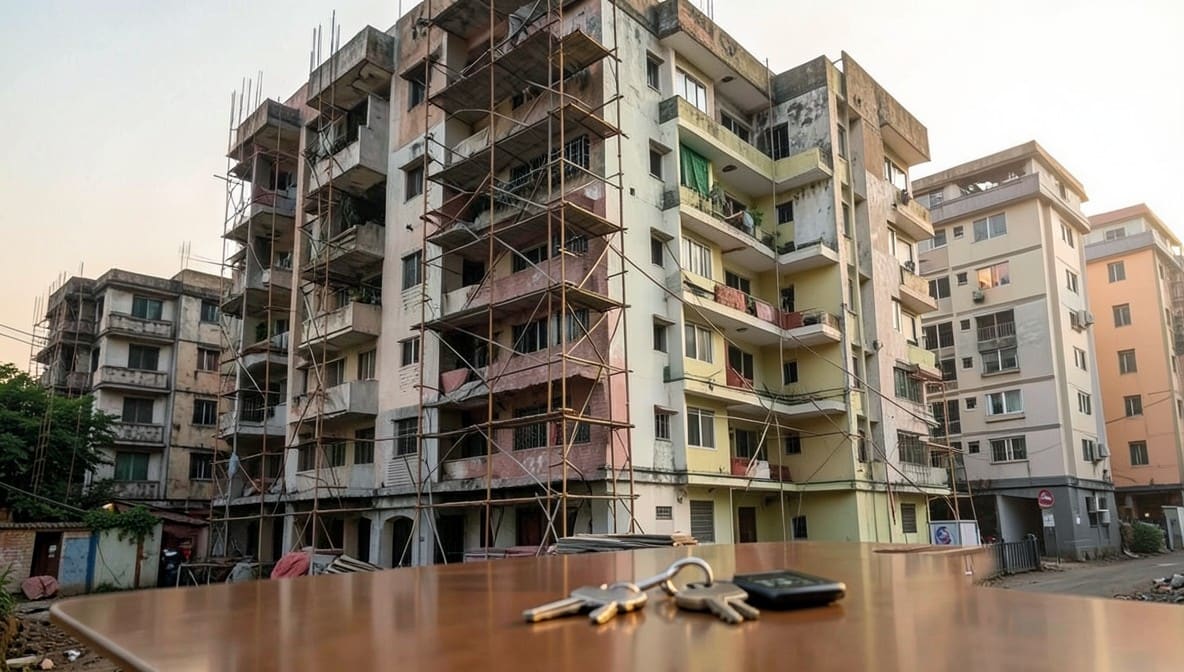
The Bombay High Court has delivered a pivotal ruling affirming that legitimate third-party buyers of flats, who have executed registered sale agreements with the property owner, cannot be deprived of possession merely because the developer asserts a lien under a Joint Development Agreement. The judgment clarifies that interim arbitral orders cannot override established property rights created in good faith, even when the underlying financial disputes remain unresolved.
Background & Facts
The Dispute
The core conflict arises from a Joint Development Agreement (JDA) dated August 20, 2009, between Mohammed Ali M. Sali (the Owner) and Rajaram Chavan Real Estate Private Limited (the Developer). The JDA allocated 7,500 square feet of developed area for tenant rehabilitation and granted the Owner 50% of the free sale component. The Developer was entitled to a lien on the Owner’s free sale component to secure outstanding construction costs, with a specified rate of Rs. 5,000 per square foot for recovery in case of default.
Procedural History
- 2013: Developer issued an Allocation Confirmation Letter identifying 16 flats (Subject Flats) as belonging to the Owner’s entitlement and two flats (Lien Flats) as restricted from sale.
- 2013 - 2014: Owner executed registered Agreements for Sale with Flat Purchasers for the Subject Flats, with possession to be delivered upon full payment.
- 2016: Developer issued an OC Confirmation Letter assuring the Owner that the Occupation Certificate would be issued within 15 days, implicitly acknowledging the Flat Purchasers’ interests.
- 2017: Owner filed Section 9 Petition seeking possession; Flat Purchasers sought to intervene but were barred as non-parties to the arbitration agreement.
- 2017: Consent order (2017 S.9 Order) directed maintenance of status quo on Subject Flats pending arbitration.
- 2019: Arbitral Tribunal issued First Impugned Order dismissing Owner’s request for possession, citing unquantified liability.
- 2022: Arbitral Tribunal issued Second Impugned Order rejecting a fresh Section 17 application, holding no change in circumstances.
- 2023: Flat Purchasers filed Commercial Suit; Single Judge granted possession as agent of Court Receiver; Division Bench upheld the order.
- 2023: Flat Purchasers filed Section 37 Petitions challenging the Impugned Orders.
Relief Sought
The Flat Purchasers seek possession of the Subject Flats as agents of the Court Receiver, pending final arbitration. The Owner seeks release of the Subject Flats from the Developer’s lien. The Developer opposes any interference, asserting its contractual lien rights.
The Legal Issue
The central question was whether Section 17 of the Arbitration and Conciliation Act, 1996 permits an arbitral tribunal to impose a blanket lien over property already sold to third parties through registered agreements, and whether such third parties have locus to challenge such orders under Section 37 despite not being parties to the arbitration agreement.
Arguments Presented
For the Petitioner (Flat Purchasers)
The Flat Purchasers relied on Prabhat Steel Traders v. Excel Metal Processors and Girish Mulchand Mehta v. Mahesh S. Mehta to argue that third parties with validly created property rights are entitled to challenge interim arbitral orders under Section 37 when such orders directly impair their interests. They emphasized that the Allocation Confirmation Letter and OC Confirmation Letter explicitly authorized the Owner to sell the Subject Flats, and the Developer never challenged the registered sale agreements. They contended that the Developer’s claim is purely monetary and cannot justify withholding possession from bona fide buyers.
For the Respondent (Developer)
The Developer argued that the 2017 S.9 Order imposed a binding status quo, and the Impugned Orders merely upheld it. It contended that the Flat Purchasers, as non-parties to the arbitration, lack standing under Section 37. It relied on clauses in the JDA to assert that the Owner’s default in bearing tenant rehabilitation costs entitles the Developer to a lien over the entire free sale component, including the Subject Flats. It further claimed that the Commercial Suit orders were irrelevant to the Section 37 proceedings and that the arbitral tribunal was justified in deferring possession until final adjudication.
The Court's Analysis
The Court undertook a rigorous examination of the contractual framework, conduct of the parties, and judicial precedents. It held that Section 37 is not confined to parties to the arbitration agreement but extends to third parties whose rights are directly and adversely affected by Section 17 orders. The Court affirmed that the principle of natural justice and the doctrine of equitable restraint require that no interlocutory order may impair vested third-party rights without hearing them.
"The Developer had consciously restricted his lien to the identified Lien Flats. The Developer had unequivocally communicated the right of the Owner to alienate the Subject Flats. This was done."
The Court found the Impugned Orders perverse because they ignored the Allocation Confirmation Letter of 2013, which explicitly demarcated the Subject Flats as saleable, and the OC Confirmation Letter of 2016, which acknowledged the Flat Purchasers’ expectations. The Developer’s failure to challenge the registered sale agreements for nearly a decade, coupled with its own letter confirming bank encumbrances on Subject Flat No. 104, constituted ante litem motam conduct that carried decisive probative value.
The Court distinguished between a monetary claim and a proprietary lien, holding that the Developer’s right to recover Rs. 5,000 per square foot was a liquidated damages mechanism, not a proprietary charge over all free sale flats. To impose a blanket lien over all Subject Flats, despite their prior sale and the Developer’s tacit consent, was an impermissible expansion of contractual rights.
The Court further noted that the three judicial findings - the FP Section 9 Disposal Order, the Commercial Suit Order, and the CS Appellate Order - consistently recognized the legitimacy of the Flat Purchasers’ claims. The arbitral tribunal’s failure to engage with these findings rendered its order legally untenable.
The Verdict
The Flat Purchasers succeeded. The Court held that registered sale agreements create enforceable rights that cannot be overridden by interim arbitral orders based on unquantified monetary claims. The Developer’s lien cannot extend to flats already sold to third parties with its knowledge and acquiescence. The Court directed the Developer to deliver possession of the Subject Flats to the Court Receiver, who shall hand them over to the Flat Purchasers as agents, subject to deposit of the balance consideration.
What This Means For Similar Cases
Third-Party Buyers Have Standing Under Section 37
- Practitioners must now argue that non-parties to arbitration who hold registered property rights can challenge Section 17 orders under Section 37 if those orders directly impair their interests.
- Courts must consider whether the third party’s rights were created before the dispute arose and whether the arbitral tribunal ignored material evidence of consent or acquiescence.
Lien Cannot Override Registered Sales
- A contractual lien under a JDA cannot be interpreted to encumber property already sold to third parties via registered agreements, especially when the developer has acknowledged such sales.
- Developers must specify lien coverage with precision; blanket liens over entire free sale components will be struck down if they conflict with documented allocations.
Conduct Before Litigation Is Decisive
-
Correspondence and conduct ante litem motam - such as confirmation letters, bank notices, and acknowledgments - carry greater evidentiary weight than post-litigation assertions.
-
Practitioners should prioritize gathering and highlighting pre-litigation documents to establish tacit consent or waiver of lien rights.
-
Flat Purchasers must deposit balance consideration with the Court Receiver to preserve the developer’s claim.
-
Arbitral tribunals must explicitly address third-party rights in interim orders; failure to do so invites Section 37 intervention.
-
Courts will not permit developers to use arbitration as a tool to hold third-party buyers hostage to unresolved financial disputes.