The Bombay High Court has reaffirmed that under Section 16(1)(n) of the Maharashtra Rent Control Act, 1999, a tenant claiming reasonable cause for non-use of premises bears the burden of proving such cause with credible, consistent, and documented evidence. The judgment underscores that mere oral testimony, unsupported by medical records or contemporaneous documentation, is insufficient to override concurrent findings of fact by lower courts.
Background & Facts
The Dispute
The dispute arose over the eviction of a tenant from a 10ft x 15ft room in Tambe Chawl, Joshi Baug, Kalyan, owned by Chandrakant Narayan Tambe and others. The original tenant, Yashwant Sonawane, died in 1992, and his wife, Smt. Vimal Sonawane, became the tenant by succession. The landlords alleged that from September 1992, the tenant had ceased using the premises, keeping it locked and residing elsewhere. A notice dated 15 December 2001 terminating the tenancy was returned unclaimed. The landlords filed Regular Civil Suit No. 227 of 2002 seeking eviction on three grounds: default in rent, bonafide requirement, and non-use.
Key Facts
- The suit premises were a single room in a chawl, Municipal Ali No. 53, House No. 253, Kalyan
- The tenant, Smt. Vimal Sonawane, was the widow of the original tenant
- The suit was filed on 15 June 2002; the relevant period for non-use under Section 16(1)(n) was 15 December 2001 to 14 June 2002
- The tenant did not reside in the premises from September 1992 onwards
- The tenant’s son, Harishchandra Yashwant Sonawane, admitted in evidence that his mother resided with him at Karunpushp Society from November 2001 to September 2003
- The tenant did not appear as a witness
- The tenant’s witnesses included five persons: DW1 (son), DW2 (neighbour), DW3 (doctor), DW4 (neighbour), DW5 (neighbour)
- No electricity bills for the relevant period were produced before the Trial Court
- The tenant claimed she was suffering from cardiac ailments and arthritis, requiring care at her son’s residence
Procedural History
- 15 June 2002: Regular Civil Suit No. 227 of 2002 filed by landlords
- 19 September 2002: Ex-parte decree passed by Trial Court
- March 2002: Tenant applied to set aside ex-parte decree; application allowed; possession restored
- 29 December 2009: Trial Court decreed eviction on ground of non-use under Section 16(1)(n) of MRC Act, rejecting other grounds
- 2010: Tenant filed Civil Appeal No. 21 of 2010 before District Judge, Kalyan
- 2010: Tenant passed away; legal heirs brought on record
- 5 December 2022: Appellate Court confirmed eviction decree
- 18 March 2026: Civil Revision Application No. 128 of 2023 reserved
- 27 March 2026: Judgment pronounced
The Parties' Positions
For the Applicants (Tenant’s Legal Heirs)
- Argued that the tenant’s absence was due to medical necessity, supported by testimony of five witnesses
- Claimed the tenant was suffering from cardiac ailments and arthritis
- Contended that the burden to prove non-use lay with the landlords, not the tenant
- Sought to introduce electricity bills under Order XLI Rule 27 CPC as additional evidence
- Asserted that occasional stays at son’s house for medical care did not constitute continuous non-use
For the Respondents (Landlords)
- Maintained that the tenant had abandoned the premises since 1992
- Highlighted absence of documentary proof of use or medical treatment
- Pointed to contradictions between witness testimonies and the doctor’s evidence
- Argued that the tenant’s failure to examine herself and produce medical records undermined her claim
- Emphasized that the Trial and Appellate Courts had independently and concurrently evaluated the evidence
Relief Sought
The Applicants sought setting aside of the eviction decree dated 5 December 2022, restoration of possession, and dismissal of the landlords’ suit. They also sought permission to lead additional evidence of electricity bills.
The Legal Issue
The central question was whether the tenant, having admitted non-residence in the suit premises, discharged the burden of proving a "reasonable cause" for such non-use under Section 16(1)(n) of the Maharashtra Rent Control Act, 1999, and whether the concurrent findings of the Trial and Appellate Courts rejecting that claim were perverse or legally unsustainable.
Arguments Presented
For the Appellant/Petitioner
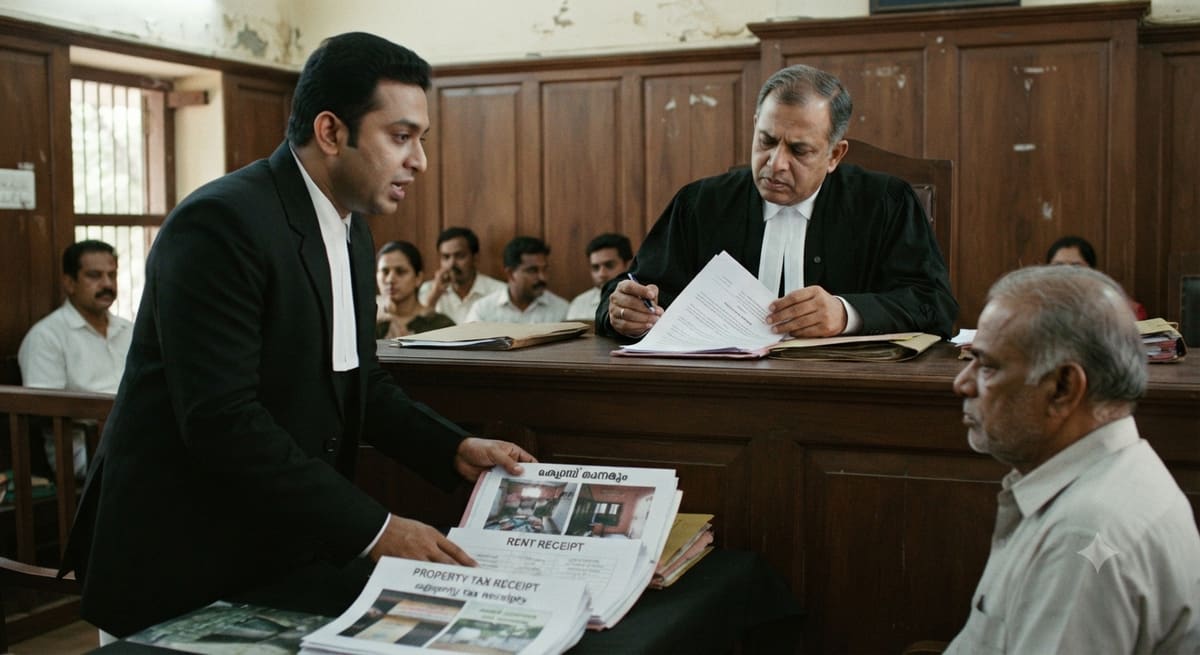
The Applicants contended that the burden to prove non-use lay with the landlords, and once the tenant raised a claim of reasonable cause due to medical necessity, the onus shifted back to the landlords to disprove it. They relied on the testimony of five witnesses, including the tenant’s son and treating physician, to establish that the tenant’s absence was temporary and medically compelled. They argued that the Trial Court erred in placing the burden on the tenant to prove use, and that the Appellate Court failed to appreciate the medical context. They further sought to introduce electricity bills under Order XLI Rule 27 CPC to demonstrate actual use during the relevant period.
For the Respondent/State
The Respondents countered that the tenant’s own witness admitted she resided elsewhere from November 2001 to September 2003. They emphasized that the tenant never appeared as a witness, and no medical records, prescriptions, or hospital documents were produced. The doctor’s testimony was inconsistent with other witnesses’ accounts of her condition, and no contemporaneous documentation supported the claim of cardiac illness. The Respondents argued that the concurrent findings of two courts, after detailed appreciation of evidence, could not be disturbed in revision, and that the belated production of electricity bills was an attempt to circumvent procedural fairness.
The Court's Analysis
The Court examined the statutory framework under Section 16(1)(n) of the Maharashtra Rent Control Act, which permits eviction if the tenant has not used the premises for six months preceding the suit, unless a reasonable cause is shown. The Court noted that the tenant’s own son, DW1, admitted in evidence that his mother resided with him during the relevant period. This admission effectively discharged the landlords’ initial burden of proving non-use.
"Once absence from the suit premises is admitted, the burden of proving reasonable cause shifted on the Defendant."
The Court then assessed the tenant’s claim of reasonable cause based on medical necessity. It found the evidence riddled with contradictions: DW2, DW4, and DW5 claimed the tenant suffered from cardiac ailments, but the doctor, DW3, did not mention cardiac issues and maintained no medical records. The doctor’s testimony about severe arthritis was inconsistent with the son’s account of her mobility. The Court observed:
"Either Harishchandra (DW1) is suppressing facts from the Court or Dr. Shirish Dani (DW.3) has been told to depose these facts to gain sympathy of the Court so as to bring the case of defendant under 'reasonable cause'."
The Court further noted the absence of any pleading regarding medical treatment, prescriptions, or hospital records. It held that arthritis, common in elderly persons, could not by itself constitute a reasonable cause without corroborative documentation. The Court emphasized that the tenant’s failure to examine herself was fatal to her case.
Regarding the application for additional evidence under Order XLI Rule 27 CPC, the Court held that electricity bills, even if genuine, could not conclusively prove use of the premises. Minimal consumption could reflect mere lighting or standby use, not habitation. The Court declined to permit the additional evidence, stating:
"Attempt to produce electricity bills at this belated stage would be an exercise in futility."
The Court reiterated that in revision jurisdiction, it cannot re-appreciate evidence where two courts have independently and consistently arrived at the same conclusion. No perversity or jurisdictional error was found.
The Verdict
The Civil Revision Application was dismissed. The eviction decree dated 5 December 2022, passed by the Appellate Court, was upheld. The tenant’s legal heirs were ordered to vacate the suit premises. The Interim Applications No. 2177 and 2178 of 2023 were disposed of as infructuous. No monetary relief was granted to either party.
What This Means For Similar Cases
Reasonable Cause Must Be Documented, Not Just Alleged
- Practitioners must advise tenants that oral testimony alone, without medical records, prescriptions, or hospital discharge summaries, will not suffice to establish reasonable cause under Section 16(1)(n)
- Courts will scrutinize inconsistencies between witness accounts and documentary evidence
- The absence of the tenant as a witness is a critical disadvantage in eviction proceedings
Burden of Proof Shifts Once Non-Use Is Admitted
- Landlords need only establish non-residence; the tenant must then prove a legitimate reason
- Failure to produce contemporaneous documents (e.g., medical records, utility bills, correspondence) will be viewed as suppression of evidence
- Belated attempts to introduce documents under Order XLI Rule 27 CPC are unlikely to succeed if the omission was due to negligence, not inadvertence
Concurrent Findings Are Nearly Immune to Revision
- Bombay HC reaffirmed that revisional jurisdiction is not a forum for re-appreciation of evidence
- Where two courts have independently evaluated oral and documentary evidence and reached the same conclusion, interference is barred unless perversity or illegality is shown
- Practitioners should focus on procedural fairness and evidentiary gaps in trial courts, not rely on revision as a second chance