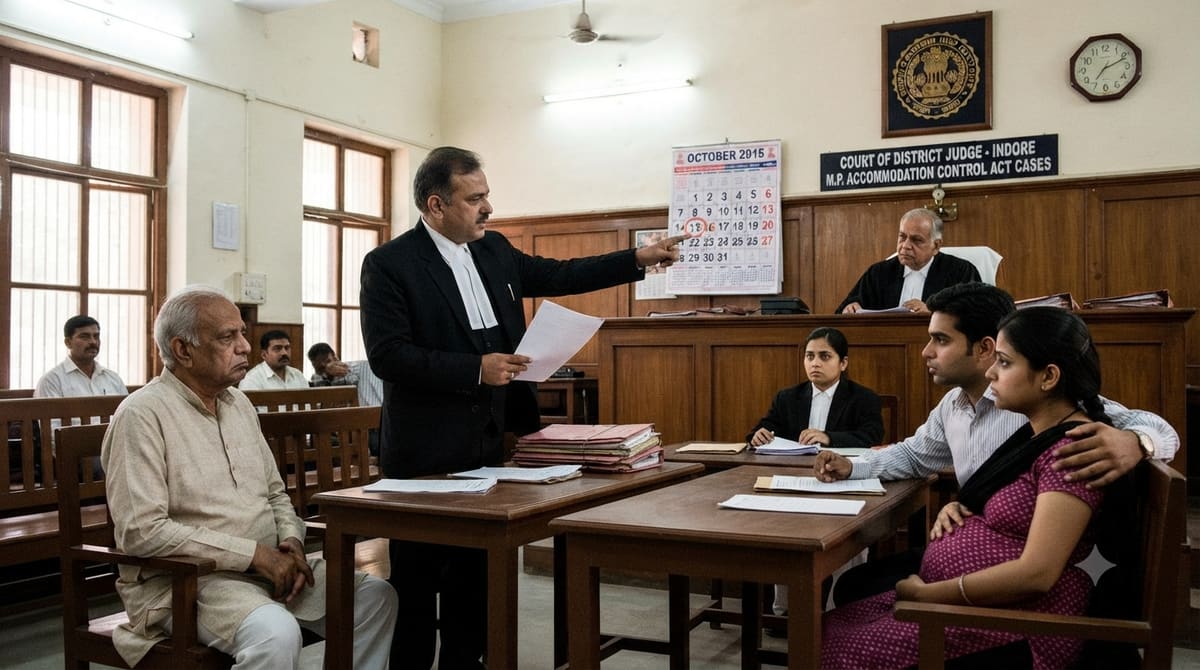
The Bombay High Court has clarified that a retired government employee’s bonafide need for residential accommodation under Section 23 of the Maharashtra Rent Control Act, 1999, is not negated merely because the landlord holds interest in joint family properties, provided no independent property exists in the landlord’s name within the locality of the tenanted premises.
Background & Facts
The Dispute
The dispute centers on the eviction of the petitioner, Jayant Baburao Wani, from a 640 sq. ft. shop located on CTS No. 524 in Raver, Jalgaon. The property was originally let out by the father of respondent no. 1, Satish Ramchandra Wani, to the petitioner’s father in 1963 at a monthly rent of Rs. 15/-. After the death of respondent no. 1’s father in 1988, the petitioner’s father continued paying rent directly to respondent no. 1, thereby recognizing him as the landlord. Upon the death of the petitioner’s father, the petitioner took over the grocery business and continued occupying the premises as tenant.
Key Facts
- The tenancy began in 1963 when the petitioner’s father was given possession of the shop
- Respondent no. 1’s father died on 1988, after which rent was paid to respondent no. 1
- Rent payments continued until 31.01.1993
- From 01.02.1993 to 31.08.2008, the petitioner ceased paying rent
- Respondent no. 1 retired from Maharashtra State Electricity Board (MSEB) on 31.10.2007
- On 05.08.2008, respondent no. 1 served a legal notice demanding possession and arrears of rent
- The petitioner sent a money order for rent in August 2008, which respondent no. 1 refused to accept
- The petitioner admitted in his written statement (paragraph 17) that respondent no. 1 is the owner of the premises and inherited the property
- Respondent no. 1 owns a residential house in Jalgaon city, but no independent property in Raver
- Properties listed in Exhibits 74, 75, and 76 are held in the name of the joint family, not individually by respondent no. 1
- The petitioner owns a property near the tenanted shop, but it is not suitable for his grocery business
Procedural History
- 1963: Initial tenancy established
- 1988: Death of respondent no. 1’s father; rent payments transferred to respondent no. 1
- 31.01.1993: Last rent payment made by petitioner’s father
- 01.02.1993: Commencement of rent default
- 31.10.2007: Respondent no. 1 retires from MSEB
- 05.08.2008: Legal notice issued by respondent no. 1
- 2008: Application No. 12/2008 filed under Section 23 of the Maharashtra Rent Control Act, 1999
- 27.06.2024: Competent Authority, Rent Control Court, Nashik, passes eviction decree
- 30.12.2024: Additional Divisional Commissioner, Nashik Division, upholds eviction order via Revision Application No. 406/2024
- 10.11.2023: Bombay High Court, in Writ Petition No. 4804/2018, dismissed jurisdictional challenge and directed Competent Authority to decide the matter within six months
- 2025: Writ Petition No. 4046/2025 filed before Bombay High Court (Aurangabad Bench)
- 16.03.2026: Judgment pronounced
The Parties' Positions
Petitioner’s Position:
- Argued that Section 23 is inapplicable because respondent no. 1 acquired ownership after retirement, not during service
- Contended that respondent no. 1 has alternate accommodation (residential house in Jalgaon and joint family properties)
- Claimed no evidence of partition or individual allotment of the shop to respondent no. 1
- Relied on Commander A. R. Ravindra v. Jangannath B. Jagtap and Satish Kumar Banwarilal Sharma v. Major Virendra D. Ganju to argue that Section 23 requires acquisition of property during service
Respondent’s Position:
- Maintained that he is the undisputed owner by inheritance and has been recognized as landlord since 1988
- Asserted that he has no independent property in Raver, his native place
- Stated that joint family properties cannot be considered as alternate accommodation for the purpose of Section 23
- Emphasized that the petitioner’s jurisdictional objection was previously waived in Writ Petition No. 4804/2018
Relief Sought
The petitioner sought quashing of the eviction order dated 30.12.2024 and restoration of possession of the shop. He also sought a declaration that Section 23 is inapplicable to respondent no. 1 due to the timing of property acquisition and existence of alternate accommodation.
The Legal Issue
Can a retired employee of a public sector undertaking invoke Section 23 of the Maharashtra Rent Control Act, 1999, to seek eviction of a long-standing tenant for bonafide personal use, when the landlord owns no independent property in the locality of the tenanted premises, despite holding interest in joint family properties and having a residential house elsewhere?
Arguments Presented
For the Petitioner
The petitioner’s counsel relied on Commander A. R. Ravindra v. Jangannath B. Jagtap and Satish Kumar Banwarilal Sharma v. Major Virendra D. Ganju, arguing that Section 23 (mirroring Section 13(A)(1) of the 1947 Act) applies only if the landlord acquires the property during service. He contended that since respondent no. 1 inherited the property in 1988, long before retirement in 2007, the provision cannot be invoked. He further argued that the existence of joint family properties and a residential house in Jalgaon negates bonafide requirement. He emphasized that the petitioner has occupied the shop for over 40 years and has no alternative space to run his grocery business.
For the Respondent
The respondent’s counsel countered that the petitioner had already waived the jurisdictional objection in Writ Petition No. 4804/2018, where the High Court explicitly accepted that MSEB is a public sector undertaking. He argued that the landlord’s ownership is undisputed and that joint family properties cannot be treated as personal accommodation under Section 23. He cited Winifred Ross v. Ivy Fonseca to support the proposition that the landlord’s need must be assessed based on personal, not familial, accommodation. He stressed that the tenant cannot dictate the landlord’s choice of residence and that the Competent Authority’s findings on bonafide requirement were concurrent and factual.
The Court's Analysis
The Court examined the factual matrix and legal precedents with precision. It noted that the petitioner had admitted in his written statement that respondent no. 1 is the owner of the premises by inheritance, and had consistently paid rent to him since 1988. This admission, coupled with the uninterrupted landlord-tenant relationship, rendered the petitioner’s challenge to ownership baseless.
"The petitioner had accepted in Writ Petition No. 4804/2018 that respondent no. 1 is an employee of MSEB, which is a Public Sector Undertaking. Such acceptance operates as an estoppel and precludes him from raising the same objection in the present petition."
The Court distinguished the cited precedents. In Commander A. R. Ravindra, the landlord had purchased the property from a relative after retirement and sought eviction under Section 13(A)(1) of the 1947 Act - a scenario the Court found malafide. In Satish Kumar Banwarilal Sharma, the landlord acquired the property after retirement. Here, however, respondent no. 1 inherited the property in 1988, prior to retirement, and the tenancy continued. The Court held that inheritance is not acquisition in the sense contemplated by the precedents; it is succession to an existing title.
Regarding bonafide requirement, the Court emphasized that Section 23 does not require the landlord to have no property whatsoever, but rather no suitable accommodation in the locality of the tenanted premises. The respondent’s residential house in Jalgaon was outside Raver, his native place. The joint family properties were not held in his individual name and could not be claimed as his personal residence.
"The fact that the landlord owns a house in Jalgaon does not negate his bonafide need for a residence in Raver, his native place, particularly when he has no independent property there."
The Court upheld the concurrent findings of the Competent Authority and the Revisional Authority, noting that the petitioner’s arguments were factual disputes, not jurisdictional errors warranting writ intervention.
The Verdict
The writ petition was dismissed. The Court upheld the eviction order dated 30.12.2024, confirming that respondent no. 1 is entitled to possession of the shop under Section 23 of the Maharashtra Rent Control Act, 1999. The petitioner was directed to deliver possession within 30 days of the judgment and pay arrears of rent at Rs. 15 per month from 01.02.1993 until delivery of possession. No costs were awarded.
What This Means For Similar Cases
Bonafide Requirement Is Local, Not Absolute
- Practitioners must now argue that a landlord’s bonafide need under Section 23 is assessed based on the absence of suitable accommodation in the locality of the tenanted premises, not nationwide
- Ownership of a house in a different city or district does not defeat a claim if the landlord seeks to reside in his native town
- Joint family properties held in the name of others cannot be treated as the landlord’s personal accommodation unless proven otherwise
Inheritance Does Not Invalidate Section 23 Claims
- A landlord who inherits property before retirement may still invoke Section 23 upon retirement, provided the tenancy continues and the property is needed for personal use
- The key is not when the property was acquired, but whether the landlord has a genuine need for it post-retirement in the locality of the tenancy
- This overrules the misconception that Section 23 applies only to properties purchased during service
Jurisdictional Objections Are Waivable
- A party who concedes a legal position in an earlier proceeding (e.g., that MSEB is a PSU) cannot later re-agitate the same issue in a subsequent writ petition
- Courts will apply the doctrine of estoppel to prevent litigants from taking contradictory positions
- Practitioners must carefully assess all prior admissions before raising jurisdictional objections