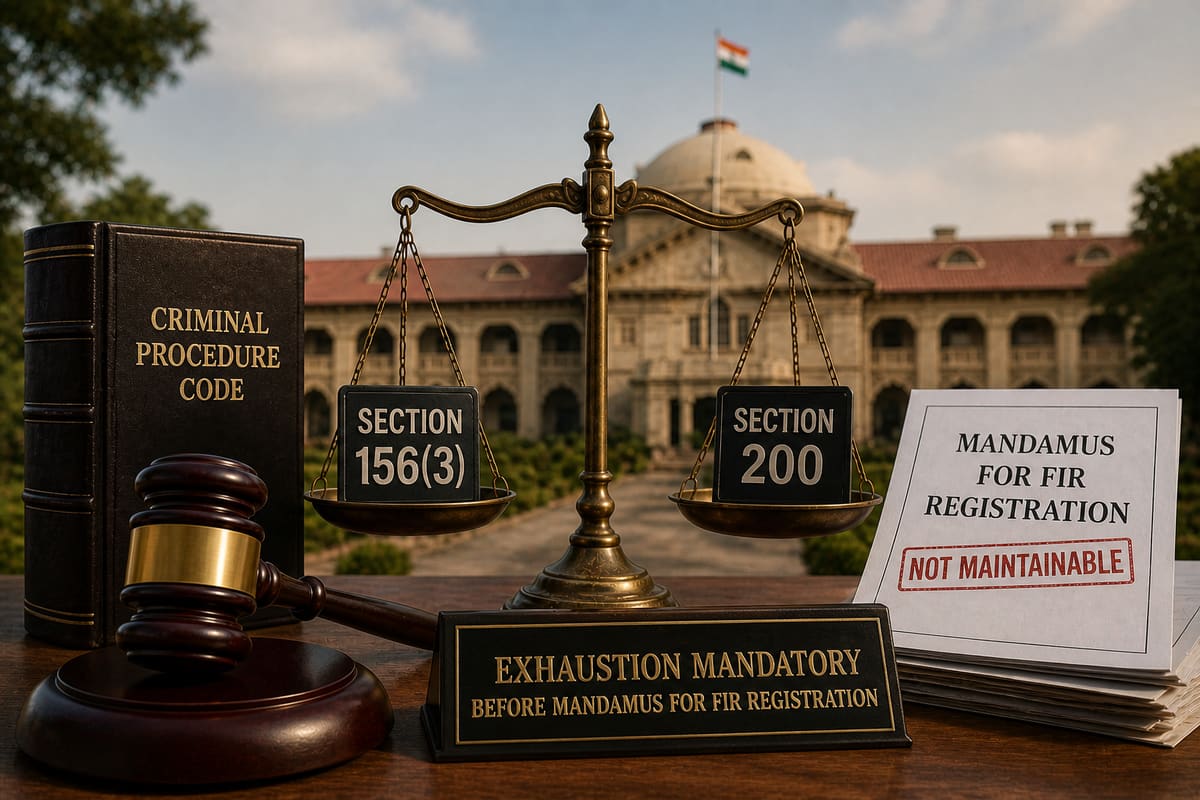
The Himachal Pradesh High Court has clarified a critical distinction in criminal procedure: procedural lapses under Section 154 CrPC do not constitute jurisdictional errors when a Magistrate orders FIR registration under Section 156(3) CrPC. This judgment restores an FIR quashed by a revisional court, emphasizing that genuine complainants must not be denied investigation merely due to technical non-compliance with pre-filing formalities.
Background & Facts
The Dispute
The petitioner, Sanyogita Devi, filed a complaint through her General Power of Attorney (Smt. Uma Bakshi) alleging that her husband, Nirmal Singh (respondent No.1), fraudulently availed medical treatment under the Ex-Servicemen Contributory Health Scheme (ECHS) for another woman (Archana Sharma), falsely representing her as the petitioner. The petitioner, residing in the U.S. since 27.9.2019, claimed that the accused embezzled government funds and committed cheating under Section 420 IPC by submitting bills under her name.
Key Facts
- 16.2.1995: Marriage between petitioner and accused solemnized.
- 27.9.2019: Petitioner left for the U.S. and has not returned.
- 19.4.2021: Accused admitted Archana Sharma to Vivekananda Hospital, Palampur, under the petitioner’s name, using ECHS reservation No. 157826 and in-patient No. 210400430.
- 2021-2022: Petitioner’s sister filed complaints with Police Station Palampur, Home Minister, Director-General of Police (DGP), and Station Commander, but no action was taken.
- 19.4.2023: Petitioner’s Power of Attorney sent a communication to the DGP, which was forwarded to the Superintendent of Police (SP), Kangra (Annexure P-12).
- 3.4.2023: SP conducted an enquiry and concluded that the matter was a matrimonial dispute pending before the Family Court, Chandigarh, and no police investigation was required.
Procedural History
- 16.8.2024: Petitioner filed an application under Section 156(3) CrPC before the Additional Chief Judicial Magistrate (ACJM), Palampur. The Magistrate directed the Station House Officer (SHO) to register an FIR and investigate (Annexure P-2).
- 23.8.2024: FIR No. 89/2024 registered under Section 420 IPC at Police Station Palampur.
- 28.3.2025: Police filed a final report under Section 173 CrPC (now Section 193 BNSS) in the court of Judicial Magistrate First Class (JMFC), which took cognizance and issued summons on 23.6.2025 (Annexure P-4).
- 16.10.2024: Accused filed Cr. Revision No. 24/2024 before the Additional Sessions Judge (ASJ), Palampur, challenging the Magistrate’s order dated 16.8.2024.
- 28.5.2025: Revisional court allowed the revision petition, setting aside the Magistrate’s order and quashing the FIR and resultant proceedings (Annexure P-1).
- July 2025: Present petition (CrMMO No. 831/2025) filed under Section 528 BNSS before the High Court of Himachal Pradesh.
Relief Sought
The petitioner sought:
- Quashing of the revisional court’s order dated 28.5.2025.
- Restoration of the Magistrate’s order dated 16.8.2024 directing FIR registration.
- Reinstatement of the criminal proceedings against the accused.
The Legal Issue
The central question was whether a revisional court can quash an order passed under Section 156(3) CrPC on the ground that the complainant failed to comply with Section 154(1) and (3) CrPC (reporting to police authorities before approaching the Magistrate), and if such non-compliance constitutes a jurisdictional error or merely a procedural lapse.
Arguments Presented
For the Petitioner
- Non-compliance with Section 154(1) and (3) CrPC is a procedural lapse, not a jurisdictional error, citing Anurag Bhatnagar v. State (NCT of Delhi) (2025 SCC OnLine SC 1514).
- The Magistrate’s order under Section 156(3) CrPC was valid as the complaint disclosed a cognizable offence under Section 420 IPC, supported by an affidavit.
- The ECHS Department had already suspended the accused’s card and recovered the embezzled amount, indicating prima facie guilt.
- Reliance on Priyanka Srivastava v. State of U.P. ((2015) 6 SCC 287) to argue that the affidavit requirement was substantially complied with, even if filed by the Power of Attorney.
- Cited Arun P. Gidh v. Chandraprakash Singh (2024 SCC OnLine Bom 1028) to argue that revision is not an efficacious remedy after FIR registration.
For the Respondents
- The complainant failed to substantially comply with Section 154(1) and (3) CrPC, as the communication to the DGP did not constitute a valid report to the SHO or SP.
- The affidavit requirement under Priyanka Srivastava was not met, as the affidavit was filed by the Power of Attorney, not the complainant.
- The revisional court had jurisdiction to interfere with the Magistrate’s order, as it suffered from a jurisdictional error.
- Cited Arun P. Gidh to argue that the revisional court could stay proceedings if the order under Section 156(3) CrPC was illegal.
The Court's Analysis
The Court examined the scope of revisional power under Section 397 CrPC (now Section 528 BNSS) and the procedural requirements for filing an application under Section 156(3) CrPC. Key observations:
-
Procedural Lapse vs. Jurisdictional Error
"In view of latest judgments passed by Hon'ble Apex Court in Anurag Bhatnagar, not taking recourse to S.154(1) and (3) by the complainant is merely a procedural lapse and not a ‘jurisdictional’ irregularity." The Court held that the revisional court erred in treating the complainant’s failure to approach the SHO or SP as a jurisdictional error, rather than a procedural irregularity.
-
Affidavit Requirement Under Priyanka Srivastava The Court noted that while Priyanka Srivastava mandates an affidavit by the complainant, the Power of Attorney’s affidavit in this case was sufficient, relying on Vishwa Mitter v. O.P. Poddar ((1983) 4 SCC 701), which permits complaints through authorized representatives.
-
Stage of Intervention by Revisional Court The Court relied on Arun P. Gidh to clarify the limits of revisional power:
"If the FIR is yet not registered, an interim order passed by the revisional court, staying effect and operation of the impugned order under Section 156(3), will have full play... However, where the investigation culminates into lodging of the chargesheet and/or cognizance has been taken by the jurisdictional court, the interim order or final order passed by the revisional court setting aside the order passed by the Magistrate under Section 156(3), will not have the effect of quashing the resultant prosecution." In this case, the FIR was registered but no chargesheet was filed nor cognizance taken before the revisional court’s order. Thus, the revisional court had power to intervene, but its decision to quash the FIR was legally unsustainable.
-
Prima Facie Commission of Offence The Court observed that the complaint disclosed a cognizable offence under Section 420 IPC, as the accused:
- Fraudulently availed medical treatment for another woman under the petitioner’s name.
- Submitted bills to the ECHS Department, which recovered the amount and suspended his card. These facts established a prima facie case, justifying the Magistrate’s order under Section 156(3) CrPC.
The Verdict
The Court allowed the petition, setting aside the revisional court’s order dated 28.5.2025. The Magistrate’s order dated 16.8.2024 directing FIR registration was restored, and the discharge of the accused was quashed. The proceedings were directed to proceed from the stage of discharge, with the parties required to appear before the Judicial Magistrate, Palampur on 5.8.2026.
What This Means For Similar Cases
Procedural Compliance Is Not Jurisdictional
- Magistrates cannot reject Section 156(3) CrPC applications solely on the ground that the complainant failed to approach the SHO or SP under Section 154(1) and (3) CrPC. Such non-compliance is a procedural lapse, not a jurisdictional error.
- Revisional courts must distinguish between procedural irregularities and jurisdictional errors when reviewing Section 156(3) CrPC orders. Quashing an FIR on technical grounds without examining the merits of the complaint may deny justice to genuine victims.
Affidavit Requirement: Substance Over Form
- While Priyanka Srivastava mandates an affidavit by the complainant, courts should adopt a pragmatic approach where the affidavit is filed by an authorized representative (e.g., Power of Attorney).
- The key consideration is whether the affidavit certifies the truth of the complaint, not merely who files it.
Stage of Intervention Determines Outcome
- Before FIR registration: Revisional courts can stay proceedings if the Section 156(3) CrPC order suffers from a jurisdictional error (e.g., no cognizable offence disclosed).
- After FIR registration but before chargesheet/challan: Revisional courts can stay further investigation if the order is illegal, but cannot quash the FIR unless the investigation is complete.
- After chargesheet/challan or cognizance: Revisional courts cannot quash the prosecution merely by setting aside the Section 156(3) CrPC order. The trial court retains jurisdiction to proceed with the case.
Practical Takeaways for Practitioners
- Complainants must ensure substantial compliance with Section 154(1) and (3) CrPC to avoid procedural objections, even if courts may overlook minor lapses.
- Defense counsel challenging Section 156(3) CrPC orders must demonstrate jurisdictional errors (e.g., no cognizable offence, legal bar) rather than mere procedural non-compliance.
- Magistrates should verify the affidavit’s authenticity but avoid hyper-technical interpretations that defeat the purpose of Section 156(3) CrPC.
- Prosecution must expedite investigation to prevent revisional courts from intervening at the pre-chargesheet stage.