The Madras High Court has clarified that arbitral tribunals cannot compel the renewal or continuation of a determinable contract, even where termination is found to be procedurally flawed. This judgment reinforces the statutory bar under Section 14(d) of the Specific Relief Act, 1963, and redefines the boundaries of judicial review under Section 34 of the Arbitration and Conciliation Act.
Background & Facts
The Dispute
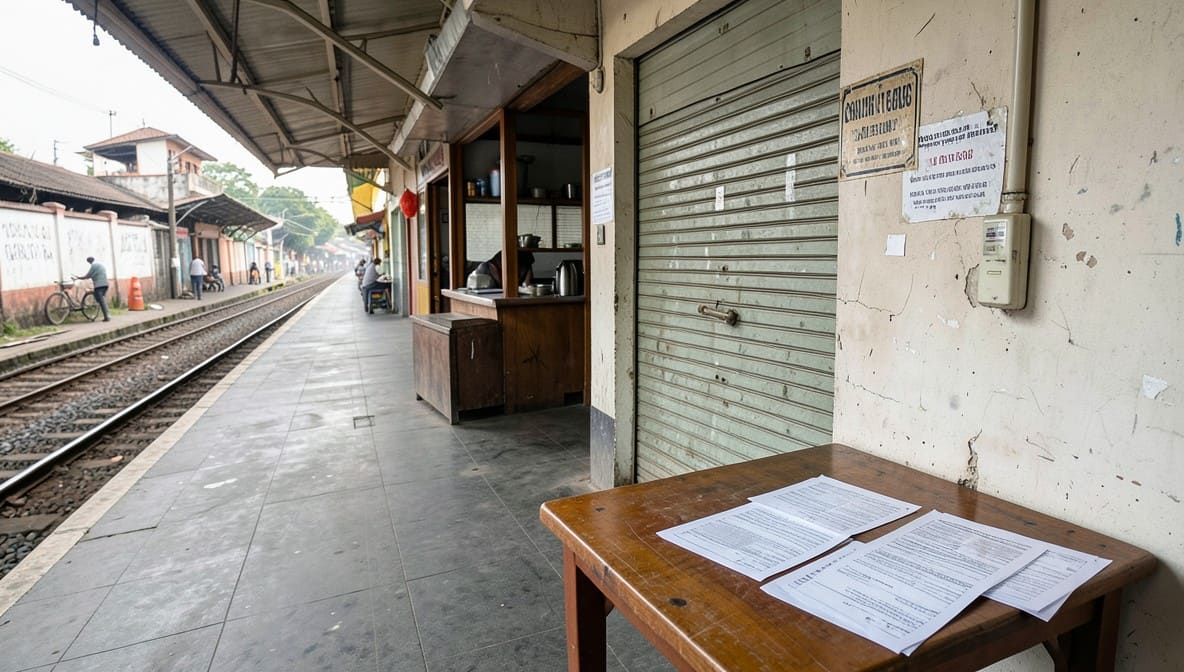
The dispute arose from a licence agreement between the Southern Railway and Mrs. G. Bharathi, a member of the Scheduled Tribe community, for the operation of Catering Stall No. SMU-5 at Platform No. 2A/3 of Chennai Central Railway Station. The Railway Administration invited bids under a scheme reserved for Scheduled Tribe beneficiaries. The respondent’s bid was accepted, and a licence was granted for a fixed term of five years, from 04.03.2015 to 03.03.2020.
Key Facts
- The total licence fee for five years was Rs. 46,50,000, payable annually.
- The respondent paid a provisional licence fee of Rs. 93,000 and a security deposit equivalent to 10% of the total fee.
- The Master Licence Agreement explicitly stated that the licence was granted on a "right of user on leave and licence basis" (Clause 6.5), creating no interest in property.
- The agreement contained Article 15, listing multiple grounds for termination, including failure to maintain hygiene, persistent passenger complaints, and non-compliance with service standards.
- Article 17.4 permitted either party to terminate the agreement without assigning any reason upon six months’ prior written notice.
- The respondent commenced operations in March 2015.
- Between 2015 and 2017, the Railway conducted multiple inspections and issued show cause notices (Ex. R25 dated 03.01.2017) citing violations such as unauthorised use of space, sale of unstamped food packets, lack of medical certificates for staff, and poor hygiene.
- The respondent submitted responses (Ex. R28) admitting some irregularities and seeking leniency, citing her illiteracy and willingness to rectify.
- The stall was closed voluntarily by the respondent in March 2017.
- The Railway terminated the licence by order dated 22.08.2017.
Procedural History
- 04.03.2015: Licence granted for five years.
- March 2017: Stall closed by respondent.
- 03.01.2017: Show cause notice issued by Railway (Ex. R25).
- 22.08.2017: Licence terminated by Railway.
- 2018: Respondent invoked arbitration clause under the agreement.
- 07.01.2019: Sole Arbitrator passed award holding termination unjustified and directing renewal of licence for three additional years.
- 2019: Railway filed O.P. No. 584 of 2019 under Section 34 of the Arbitration and Conciliation Act, 1996, seeking to set aside the award.
- 06.03.2020: Learned Single Judge dismissed the petition, holding no patent illegality or public policy violation.
- 11.03.2026: Original Side Appeal reserved.
- 18.03.2026: Judgment pronounced.
The Parties' Positions
- Appellant (Southern Railway): Argued that the contract was determinable, and the arbitrator exceeded jurisdiction by ordering renewal, which is barred by Section 14(d) of the Specific Relief Act, 1963. Also contended that the award ignored material documentary evidence of breaches.
- Respondent (Mrs. G. Bharathi): Contended that the arbitrator properly appreciated evidence and that the challenge under Section 34 was an impermissible re-appreciation of facts.
Relief Sought
The appellant sought setting aside of the arbitral award dated 07.01.2019 and the order of the Single Judge dated 06.03.2020. The respondent sought dismissal of the appeal and confirmation of the award.
The Legal Issue
The central question was whether an arbitral tribunal can grant relief directing renewal of a determinable licence agreement under Section 14(d) of the Specific Relief Act, 1963, and whether such a direction constitutes patent illegality under Section 34(2A) of the Arbitration and Conciliation Act, 1996.
Arguments Presented
For the Appellant
The appellant, represented by Mr. V. Radhakrishnan, Senior Counsel, argued that the Master Licence Agreement was inherently determinable under Clause 17.4, which allowed termination without cause upon six months’ notice. The agreement conferred only a personal right of user, not a property interest, making it a licence under Section 52 of the Easement Act. Citing Indian Oil Corporation Ltd. v. Amritsar Gas Service and K. Lubnaa v. Beevi, the appellant contended that Section 14(d) of the Specific Relief Act explicitly prohibits specific performance of determinable contracts. The arbitrator’s direction to renew the licence for three years was therefore ultra vires, legally unsustainable, and contrary to public policy. The failure to consider Exs. R1 to R30, which documented repeated breaches, rendered the award perverse and patently illegal.
For the Respondent
The respondent, represented by Mr. V. Raghavachari, Senior Advocate, argued that the arbitrator had thoroughly examined all evidence, including inspection reports and the respondent’s explanations, and reached a plausible factual conclusion. The challenge under Section 34 was an attempt to re-litigate merits, which is impermissible. Reliance was placed on Punjab State Civil Supplies Corporation Ltd. v. Sanman Rice Mills and Azizur Rehman Gulam v. Radio Restaurant to emphasize the narrow scope of judicial review. The appellant’s plea regarding Section 14(d) was raised for the first time on appeal and should be disallowed.
The Court's Analysis
The Court acknowledged the limited scope of judicial review under Section 34 but held that the challenge raised by the appellant was not an attempt to re-appreciate evidence, but a pure question of law concerning statutory prohibition. The Court observed that the Master Licence Agreement clearly permitted termination without cause under Article 17.4, making it a determinable contract. Clause 6.5 explicitly stated that the licence conferred only a "right of user on leave and licence basis," confirming the absence of any proprietary interest.
"The presence of such a clause makes it clear that the contract is determinable at the instance of either party."
The Court further noted that the arbitrator’s direction to renew the licence for three years effectively compelled continuation of a contractual relationship that had already been lawfully terminated under the agreement’s own terms. This was not merely an error of fact but a violation of Section 14(d) of the Specific Relief Act, 1963, which bars specific enforcement of determinable contracts.
The Court relied on Indian Oil Corporation Ltd. v. Amritsar Gas Service, where the Supreme Court held that even if breach is established, specific performance cannot be granted where the contract is determinable. The arbitrator’s award, by ordering renewal, directly contravened this settled principle.
"When an arbitral tribunal grants a relief which is expressly barred by statutory provisions, the award would suffer from patent illegality appearing on the face of the award and would fall within the scope of interference under Section 34(2A)..."
The Court rejected the respondent’s argument that the Section 14(d) plea was raised for the first time on appeal. It held that where the factual foundation is undisputed - as here, with the agreement terms clearly on record - a pure question of law can be examined at any stage, citing K. Lubnaa v. Beevi and Yeswant Deorao Deshmukh v. Walchand Ramchand Kothari.
The Court also noted that the arbitrator’s failure to consider the Railway’s documentary evidence (Exs. R7, R9, R11, R13, R15, R18, R20) further compounded the illegality, rendering the award irrational and perverse.
The Verdict
The appeal was allowed. The order dated 06.03.2020 of the learned Single Judge dismissing the petition under Section 34 was set aside. The arbitral award dated 07.01.2019 was also set aside. The direction for renewal of the licence for three years was held to be legally unsustainable and contrary to Section 14(d) of the Specific Relief Act, 1963. There shall be no order as to costs.
What This Means For Similar Cases
Determinable Contracts Cannot Be Renewed by Arbitral Order
- Practitioners must now argue that any arbitral direction compelling continuation or renewal of a licence, distributorship, or service agreement with a termination clause is void under Section 14(d) of the Specific Relief Act.
- Even if termination is found to be procedurally flawed, the remedy is limited to damages, not reinstatement.
Section 34 Review Extends to Statutory Illegality
- Challenges under Section 34 are not confined to procedural irregularities or factual misappreciation.
- A pure question of law - such as violation of a statutory bar - can be raised even if not pleaded before the arbitrator, provided the factual matrix is on record.
Documentary Evidence Must Be Addressed
- Arbitrators must explicitly consider all material documentary evidence. Selective appreciation leading to irrational findings may render an award patently illegal.
- Parties must ensure all relevant exhibits are formally marked and referenced in submissions to avoid claims of non-consideration.