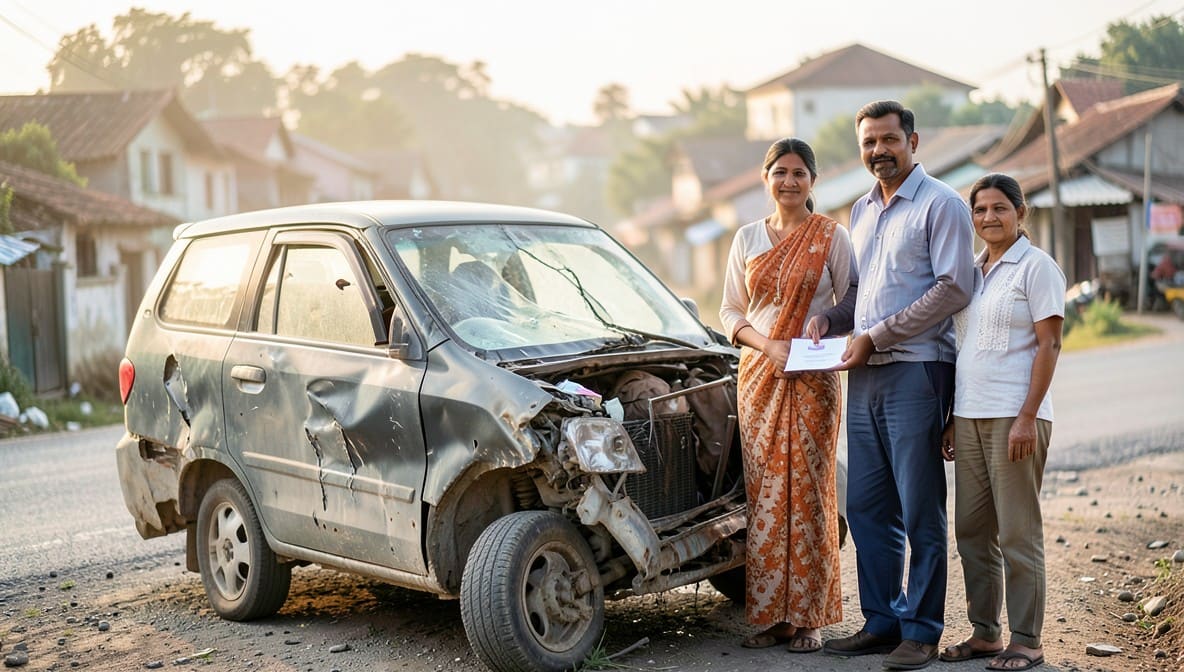
The Bombay High Court (Aurangabad Bench) delivered a significant judgment clarifying the liability of insurers in motor accident claims where the driver lacks a valid license. The Court held that while the insurer must satisfy the compensation award, it retains the right to recover the amount from the vehicle owner under Section 149(2) of the Motor Vehicles Act, 1988.
Background & Facts
The Accident and Claim
On 06.09.1999, a fatal accident occurred when a truck (Registration No. MH-20/B-1559) collided with a minidoor (Registration No. MH-20-W-974) near Aurangabad. Sohel, a passenger in the minidoor, succumbed to his injuries. The legal representatives of Sohel (respondents 2-5) filed M.A.C.P. No. 498 of 1999 before the Motor Accident Claims Tribunal, Aurangabad, seeking compensation of Rs. 3,29,500 from the owners, drivers, and insurers of both vehicles. Both vehicles were insured with The New India Assurance Co. Ltd. (appellant).
Key Facts
- The truck driver, Ashok s/o Bhaurao Khomne (respondent no. 6), held a driving license issued on 17.03.1993, valid until 17.09.1998.
- The license was renewed on 05.10.1999, effective until 04.10.2002.
- The accident occurred on 06.09.1999, when the license was not valid (grace period for renewal expired on 16.10.1998).
- The Tribunal recorded that the truck driver had no valid license on the date of the accident but held the insurer liable, terming the breach as 'technical.'
- The Tribunal awarded Rs. 1,89,000 with 9% interest p.a., to be recovered from the truck's owner, driver, and insurer.
Procedural History
- 27.09.2002: Tribunal passed the award in M.A.C.P. No. 498 of 1999.
- 2003: First Appeal No. 1344 of 2003 filed by the insurer challenging the Tribunal’s order.
- 2026: Cross-Objection No. 213 of 2026 filed by the claimants seeking enhancement of compensation.
- 10.07.2026: Judgment reserved by the High Court.
- 24.07.2026: Judgment pronounced by Justice S. G. Chapalgaonkar.
Relief Sought
- Insurer (Appellant): Sought exoneration from liability due to the truck driver’s invalid license, citing breach of policy conditions under Section 149(2) of the Motor Vehicles Act, 1988.
- Claimants (Respondents): Sought enhancement of compensation, arguing the Tribunal erred in applying the multiplier based on the claimant’s age instead of the deceased’s age and failed to account for future prospects.
The Legal Issue
The primary legal questions were:
- Whether the insurer could be exonerated from liability due to the truck driver’s lack of a valid license on the date of the accident.
- Whether the compensation awarded by the Tribunal required enhancement, particularly regarding the multiplier and future prospects.
Arguments Presented
For the Appellant (Insurer)
- Argued that the truck driver’s license was invalid on 06.09.1999, constituting a breach of policy conditions under Section 149(2) of the Motor Vehicles Act, 1988.
- Relied on the evidence of RW-1 Kisan Sagar, who confirmed the license’s validity period and renewal date.
- Cited Ram Babu Tiwari v. United India Insurance Co. Ltd. (2008) 8 SCC 165, where the Supreme Court held that a driver without a valid license at the time of the accident disentitles the insurer from indemnifying the insured.
For the Respondents (Claimants)
- Contended that the Tribunal’s finding of sole negligence against the truck driver justified the award.
- Argued that the Tribunal erred in assessing compensation by using the claimant’s age (respondent no. 2) instead of the deceased’s age (22 years) for the multiplier.
- Sought enhancement of compensation, including future prospects (40% of income) and higher amounts for non-pecuniary heads like loss of love and affection.
The Court's Analysis
The Court examined the validity of the truck driver’s license and the insurer’s liability under Section 149(2) of the Motor Vehicles Act, 1988. It noted that the license had expired on 17.09.1998 and was renewed only on 05.10.1999, after the accident. The grace period for renewal (30 days) had lapsed on 16.10.1998, meaning the driver was unlicensed on 06.09.1999.
"It is beyond any doubt or dispute that only in the event an application for renewal of licence is filed within a period 30 days from the date of expiry thereof, the same would be renewed automatically which means that even if an accident had taken place within the aforementioned period, the driver may be held to be possessing a valid licence. The proviso appended to Sub-section (1) of Section 15, however, clearly states that the driving licence shall be renewed with effect from the date of its renewal in the event the application for renewal of a licence is made more than 30 days after the date of its expiry."
The Court relied on Ram Babu Tiwari and Bhuwan Singh v. Oriental Insurance Company Limited (2009) 5 SCC 136 to hold that the absence of a valid license was not a 'technical breach' but a substantive one. However, it clarified that while the insurer must satisfy the award, it could recover the amount from the vehicle owner under Section 149(2) of the Motor Vehicles Act, 1988.
On compensation, the Court corrected the Tribunal’s error in applying the multiplier based on the claimant’s age instead of the deceased’s age (22 years). It applied a multiplier of 18 and added 40% for future prospects, as the deceased was a bachelor with a dependent mother.
The Verdict
The High Court partly allowed the appeal and cross-objection. It enhanced the compensation to Rs. 3,17,400 (Rs. Three Lakh Seventeen Thousand Four Hundred only) with 6% interest p.a. on the enhanced amount. The insurer, truck driver (respondent no. 6), and truck owner (respondent no. 7) were held jointly and severally liable. The insurer was directed to deposit the compensation within 10 weeks, with the right to recover the amount from the truck owner. Costs of the appeal and cross-objection were imposed on the insurer.
What This Means For Similar Cases
Insurer Liability Is Not Absolute
- Insurers must satisfy compensation awards even if the driver lacks a valid license, but they can recover the amount from the vehicle owner under Section 149(2) of the Motor Vehicles Act, 1988.
- Courts will not treat the absence of a valid license as a 'technical breach' if the grace period for renewal has lapsed.
Compensation Calculation Must Be Precise
- Multipliers must be based on the deceased’s age, not the claimant’s age.
- Future prospects (40% of income) must be added for victims under 40 years.
- Non-pecuniary heads like loss of love and affection (Rs. 10,000) and funeral expenses (Rs. 5,000) should be explicitly quantified.
Evidence of License Validity Is Critical
- Insurers must produce documentary evidence (e.g., RW-1’s testimony) to prove the driver’s license was invalid at the time of the accident.
- Owners must demonstrate due diligence in verifying the driver’s license status to avoid adverse inferences.