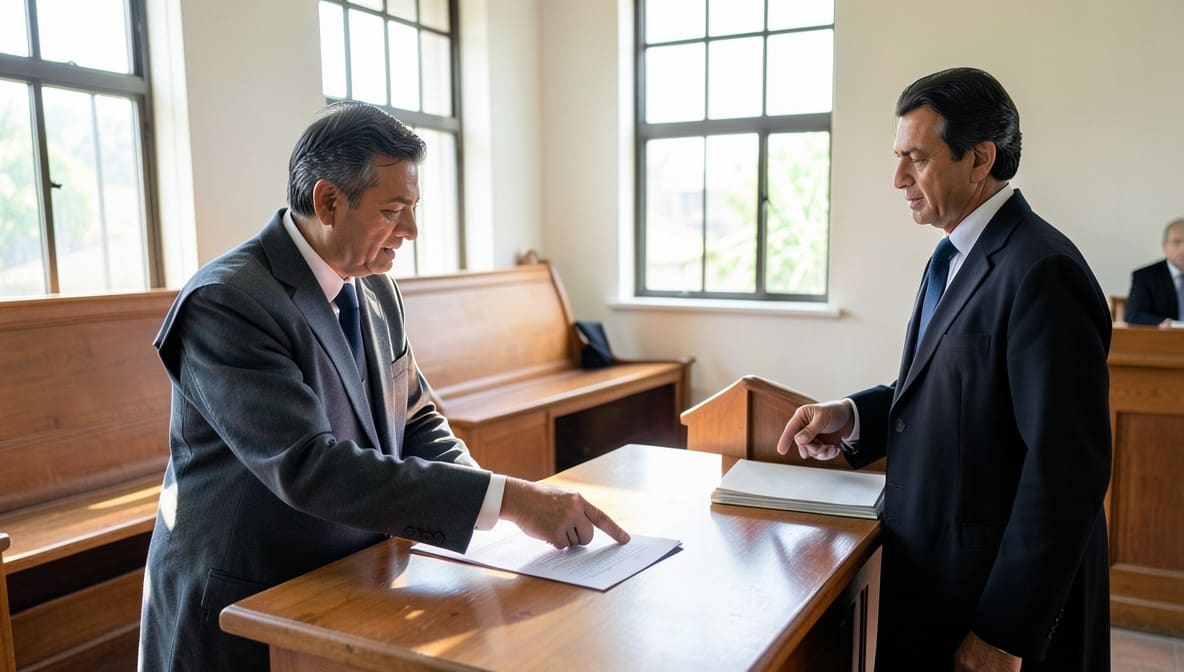
The Gauhati High Court has clarified a critical procedural right in criminal trials: an accused may cross-examine a hostile defence witness using prior written statements recorded by police, even when that witness was originally listed by the prosecution. This ruling reinforces the accused’s right to challenge inconsistent testimony under the Indian Evidence Act, ensuring fair trial protections are not undermined by technical misinterpretations of witness roles.
Background & Facts
The Dispute
The petitioner, Dibendu Jyoti Kar, was facing trial in Sessions Case No. 08/2013 before the Additional District & Sessions Judge (FTC), Cachar, for an alleged criminal offence. During the investigation, the prosecution recorded a statement from Dulal Paul under Section 161 of the CrPC and listed him as a prosecution witness in the charge sheet. However, the prosecution did not examine Dulal Paul during trial. The petitioner, seeking to support his defence, called Dulal Paul as a defence witness.
Key Facts
- Dulal Paul was recorded as a prosecution witness in the charge sheet filed on 15.06.2013
- He was not examined by the prosecution at any stage of the trial
- The petitioner called him as a defence witness on 05.11.2013
- During examination-in-chief, Dulal Paul’s testimony contradicted his earlier recorded statement
- The petitioner immediately applied under Section 154 of the Indian Evidence Act, 1872, seeking permission to cross-examine Dulal Paul using his prior statement
Procedural History
- 15.06.2013: Charge sheet filed by prosecution, listing Dulal Paul as prosecution witness
- 05.11.2013: Petitioner called Dulal Paul as defence witness
- 07.11.2013: Trial court rejected petitioner’s application under Section 154 IEA, holding that a witness originally listed by prosecution cannot be contradicted by his prior statement when called by the defence
- 07.11.2013: Impugned order passed by Additional District & Sessions Judge (FTC), Silchar
- 24.03.2026: Hearing before Gauhati High Court
- 07.04.2026: Judgment delivered by Justice Parthivjyoti Saikia
The Parties' Positions
For the Petitioner: Argued that Section 145 of the Indian Evidence Act permits cross-examination of any witness, regardless of which party called them, using prior written statements. Relied on Tehsildar Singh v. State of U.P. to assert that the proviso to Section 162 CrPC explicitly allows the accused to use prior statements to contradict witnesses under Section 145 IEA. Also invoked Section 155(3) IEA, which permits impeachment of a witness’s credit by showing prior inconsistent statements.
For the Respondent: Contended that once a witness is called by the defence, he cannot be contradicted by his prior statement recorded under Section 161 CrPC. Argued that Section 162 CrPC bars the use of such statements for contradiction unless the witness is called by the prosecution. Relied on a narrow reading of Section 154 IEA to claim that only the prosecution may impeach its own witness.
Relief Sought
The petitioner sought quashing of the trial court’s order dated 07.11.2013 and a direction permitting him to cross-examine Dulal Paul using his prior recorded statement under Section 145 of the Indian Evidence Act.
The Legal Issue
Can an accused person cross-examine a defence witness who has become hostile, using his prior statement recorded by the police under Section 161 CrPC, under Section 145 of the Indian Evidence Act?
Arguments Presented
For the Petitioner
The petitioner’s counsel, Mr. A.M. Bora, relied on Tehsildar Singh v. State of U.P. to argue that Section 145 IEA permits cross-examination of any witness as to prior written statements, irrespective of which party called them. He emphasized that the proviso to Section 162 CrPC explicitly enables the accused to use such statements to contradict a witness in the manner provided by Section 145. He further cited Section 155(3) IEA, which allows a party to impeach the credit of a witness by proving prior inconsistent statements, even if that witness was called by that party. The submission was that the trial court’s interpretation violated the spirit of fair trial and the accused’s right to present a defence.
For the Respondent
The State, represented by Mr. D.P. Goswami, contended that Section 162 CrPC prohibits the use of police statements for contradiction unless the witness is examined by the prosecution. The respondent argued that once a witness is called by the defence, he becomes the defence’s witness and cannot be contradicted by prior statements recorded during investigation. The counsel relied on a restrictive reading of Section 154 IEA, asserting that only the prosecution may seek to cross-examine its own witness under that provision.
The Court's Analysis
The Court undertook a detailed examination of Sections 145 and 155(3) of the Indian Evidence Act and the proviso to Section 162 of the CrPC. It rejected the trial court’s reasoning that a witness originally listed by the prosecution cannot be contradicted when called by the defence. The Court held that the identity of the calling party is irrelevant under Section 145 IEA, which speaks in universal terms: "A witness may be cross-examined as to previous statements made by him in writing..."
"The proviso to Section 162 of the CrPC enables the accused to make use of statements already recorded in order to contradict a witness in the manner provided by Section 145 of the Indian Evidence Act."
The Court emphasized that Section 145 has two limbs: one permitting cross-examination without showing the statement, and the other permitting contradiction after drawing attention to the relevant portion. The Court noted that the Supreme Court in Tehsildar Singh had explicitly held that the accused is not barred from using prior statements to contradict a witness, even if that witness is called by the defence.
The Court further held that Section 155(3) IEA reinforces this position, as it permits any party, including the defence, to impeach the credit of a witness by proving prior inconsistent statements. The trial court’s refusal to allow such cross-examination effectively denied the accused the opportunity to challenge unreliable testimony, violating the principles of natural justice and fair trial.
The Verdict
The petition succeeded. The Gauhati High Court set aside the order dated 07.11.2013 passed by the Additional District & Sessions Judge (FTC), Cachar. The petitioner is entitled to cross-examine the defence witness Dulal Paul using his prior statement recorded under Section 161 CrPC, in accordance with Section 145 of the Indian Evidence Act. The interim order previously granted stands vacated. The trial court is directed to permit such cross-examination at the earliest opportunity.
What This Means For Similar Cases
Cross-Examination Rights Extend to Defence Witnesses
- Practitioners may now confidently apply for cross-examination of hostile defence witnesses using prior police statements under Section 145 IEA
- The party calling the witness is irrelevant - the right to contradict arises from inconsistency, not ownership of the witness
- Trial courts must not deny such applications on the ground that the witness was originally listed by the prosecution
Prior Statements Are Admissible for Impeachment, Not Substantive Proof
- Police statements under Section 161 CrPC cannot be used as substantive evidence but are admissible solely to impeach credibility
- Defence counsel must ensure the witness is given an opportunity to explain the inconsistency before the statement is formally introduced
- The procedure under Section 145 IEA must be strictly followed: attention must be drawn to the specific portion of the statement intended for contradiction
Procedural Clarity in Hostile Witness Handling
- The judgment eliminates confusion between Sections 154 and 145 IEA - Section 154 applies only to the prosecution seeking to cross-examine its own witness; Section 145 applies universally
- Defence counsel should routinely file applications under Section 145 IEA when a defence witness turns hostile, regardless of prior listing
- This ruling strengthens the accused’s right to a full defence under Article 21 of the Constitution