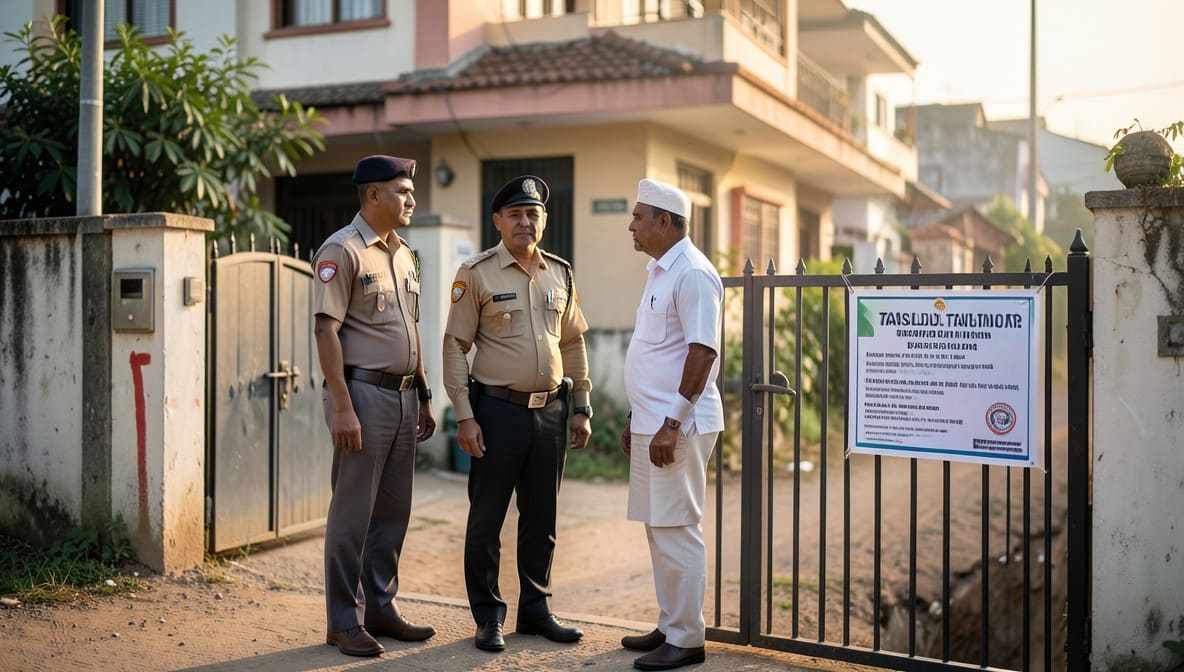
The Bombay High Court has reaffirmed that the enforcement of possession orders under Section 14 of the SARFAESI Act is a statutory duty, not a discretionary act. The Court intervened after a secured creditor faced repeated obstruction in executing a 2010 possession order, emphasizing that public officials cannot impose additional procedural hurdles on banks seeking recovery of secured assets.
Background & Facts
The Dispute
The petitioner, Kotak Mahindra Bank Ltd., is a secured creditor that initiated proceedings under Section 14 of the Securitisation and Reconstruction of Financial Assets and Enforcement of Security Interest Act, 2002, to take physical possession of a mortgaged property. A possession order was passed by the competent Magistrate on 03.03.2010. Despite the order being over 16 years old, physical possession has not been taken due to inaction by designated executive officers.
Key Facts
- The secured asset is a residential property mortgaged to the Bank under a loan agreement
- The possession order was issued under Section 14 of the SARFAESI Act on 03.03.2010
- The Bank filed this writ petition to enforce the order after multiple failed attempts
- A date of 13.03.2026 was fixed for physical possession, but it was not executed
- A second attempt was scheduled for 20.03.2026, which also failed
- The Tahsildar (Respondent No. 3) and Police (Respondent No. 4) claimed they required further hearings with occupants, contrary to statutory mandate
- The Circle Officer, though not legally authorized to act, was observed attempting to interfere in execution
Procedural History
- 03.03.2010: Competent Magistrate passed order under Section 14 of SARFAESI Act for possession of secured asset
- 13.03.2026: Attempt to take physical possession failed due to inaction by Tahsildar and police
- 20.03.2026: Second attempt failed; occupants allegedly obstructed, but no legal basis for delay was established
- 24.03.2026: Writ Petition No. 2839 of 2026 heard by Bombay High Court
The Parties' Positions
For the Petitioner (Kotak Mahindra Bank Ltd.):
- Argued that Section 14 imposes a mandatory, non-discretionary duty on Magistrates and executive officers to execute possession orders
- Cited NKGSB Cooperative Bank Ltd. v. Subir Chakravarty and Balkrishna Rama Tarle v. Phoenix Arc Pvt. Ltd. to establish that Magistrates perform only ministerial functions
- Highlighted that the Supreme Court in India Infoline Home Finance Ltd. v. Nageswara Rao Perikala held that the District Magistrate cannot be functus officio due to delay
- Asserted that occupants have no right to be heard again after a valid Section 14 order is passed
For the Respondents (State of Maharashtra, Tahsildar, Police):
- Did not contest the validity of the 2010 order
- Suggested that occupants should be given additional opportunity to be heard
- Implied that police force was insufficient or that procedural caution was required
- Offered no legal justification for non-execution beyond administrative hesitation
Relief Sought
The Bank sought:
- Immediate enforcement of the 03.03.2010 possession order
- Direction to the Tahsildar and Police to take physical possession without further delay
- Clarification that no additional hearings or approvals are required under Section 14
- Penalties for non-compliance
The Legal Issue
The central question was whether the Tahsildar and police, as executive officers, are legally bound to execute a possession order under Section 14 of the SARFAESI Act without requiring further hearings or imposing procedural delays, and whether their inaction renders the Magistrate’s order ineffective.
Arguments Presented
For the Petitioner
The Bank relied on NKGSB Cooperative Bank Ltd. v. Subir Chakravarty and Balkrishna Rama Tarle v. Phoenix Arc Pvt. Ltd. to establish that the Magistrate’s role under Section 14 is purely ministerial. It cited the Supreme Court’s recent observation in India Infoline Home Finance Ltd. v. Nageswara Rao Perikala that the District Magistrate is under a statutory obligation to ensure execution, and that the secured creditor cannot be forced to "run from pillar to post." The Bank argued that any attempt by the Tahsildar to conduct fresh hearings or demand additional documentation is ultra vires the Act and violates the legislative intent of expeditious recovery.
For the Respondent
The State did not dispute the legal position but offered no substantive defense for the delay. The Tahsildar and Police implied that occupants should be heard again, suggesting a misunderstanding of the statutory framework. No legal authority was cited to justify this position.
The Court's Analysis
The Court examined the statutory scheme of Section 14 of the SARFAESI Act and the binding precedents of the Supreme Court. It held that the Magistrate’s order under Section 14 is final and binding upon execution officers. The Court emphasized that the Act was enacted to remove delays in recovery by financial institutions and to prevent obstruction by defaulting borrowers.
"The CJM is under a statutory obligation to ensure that the warrant of possession is executed, and the secured creditor is not required to run from pillar to post. The inability to take possession within the prescribed time-limit does not render the District Magistrate functus officio."
The Court rejected the notion that the Tahsildar could sub-delegate authority or impose additional conditions. It clarified that the Circle Officer’s involvement was legally impermissible and that the Tahsildar alone is responsible for execution. The Court further held that occupants have no right to resist possession after a valid Section 14 order, and that police must assist with proportionate force if necessary.
The Court noted that the delay of over 16 years undermines the very purpose of the SARFAESI Act and constitutes a failure of public duty by the State authorities.
The Verdict
The Bank succeeded. The Court directed the Tahsildar of Ambernath to take physical possession of the secured asset on 02.04.2026 with the assistance of the Senior Inspector of Police, Badlapur (West), who must deploy sufficient police force, including lady constables. Reasonable, proportionate, and necessary force may be used to overcome obstruction. The Tahsildar is directed to personally execute the order. If the directions are not complied with, the Tahsildar and Senior Inspector shall personally appear before the Court on the next listing date of 06.04.2026.
What This Means For Similar Cases
Execution of SARFAESI Orders Is Non-Negotiable
- Practitioners must immediately move courts when possession orders under Section 14 are not executed, even after years of delay
- No additional notice, hearing, or consent from occupants is required post-order
- Tahsildars and police cannot claim lack of resources as a defense - failure to act is a breach of statutory duty
Police Must Act as Enforcers, Not Arbiters
- Police are duty-bound to assist in possession under Section 14(2) and cannot refuse on grounds of "potential violence" or "need for mediation"
- Deployment of adequate force, including female constables for sensitive premises, is mandatory
- Non-cooperation by police can now be challenged via writ petition with personal accountability for officers
Delay Does Not Nullify the Order
- A Section 14 order remains valid and executable indefinitely
- The Magistrate is not functus officio even after years of inaction
- Banks may seek contempt proceedings against executive officers for wilful non-compliance