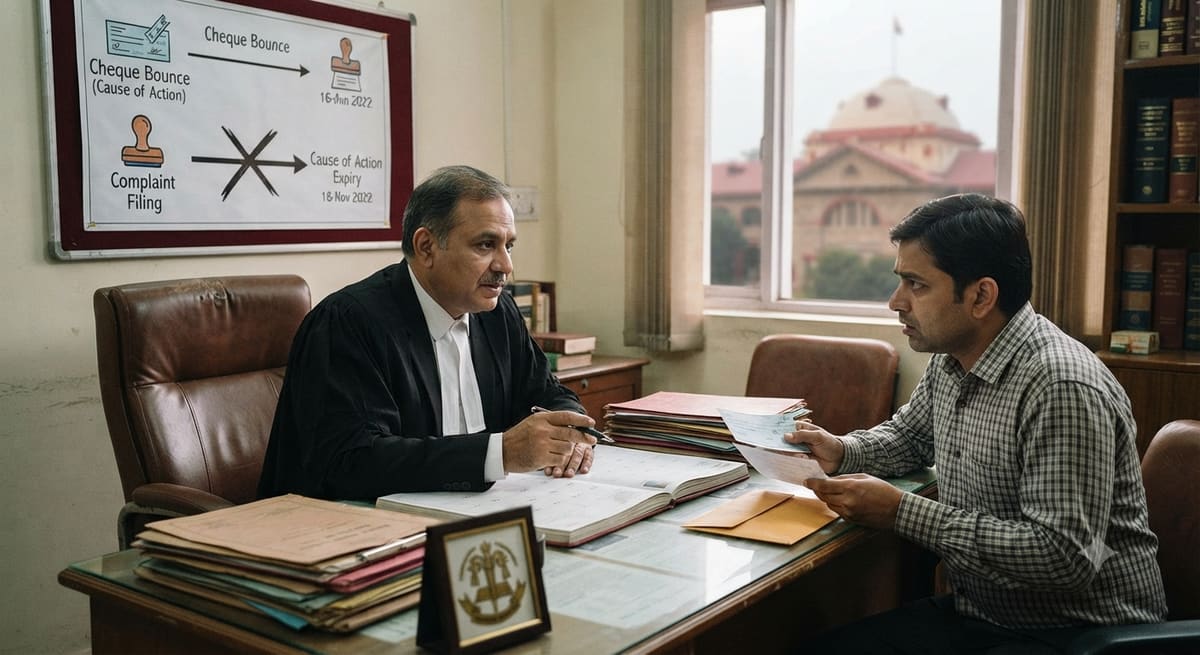
A critical clarification has emerged from the Allahabad High Court on the treatment of minor clerical errors in complaints filed under the Negotiable Instruments Act. The Court has firmly held that procedural inaccuracies, when unaccompanied by prejudice or fraud, cannot be used to defeat a legitimate claim where documentary evidence confirms the true facts. This ruling reinforces the principle that substance must prevail over form in statutory prosecutions.
Background & Facts
The Dispute
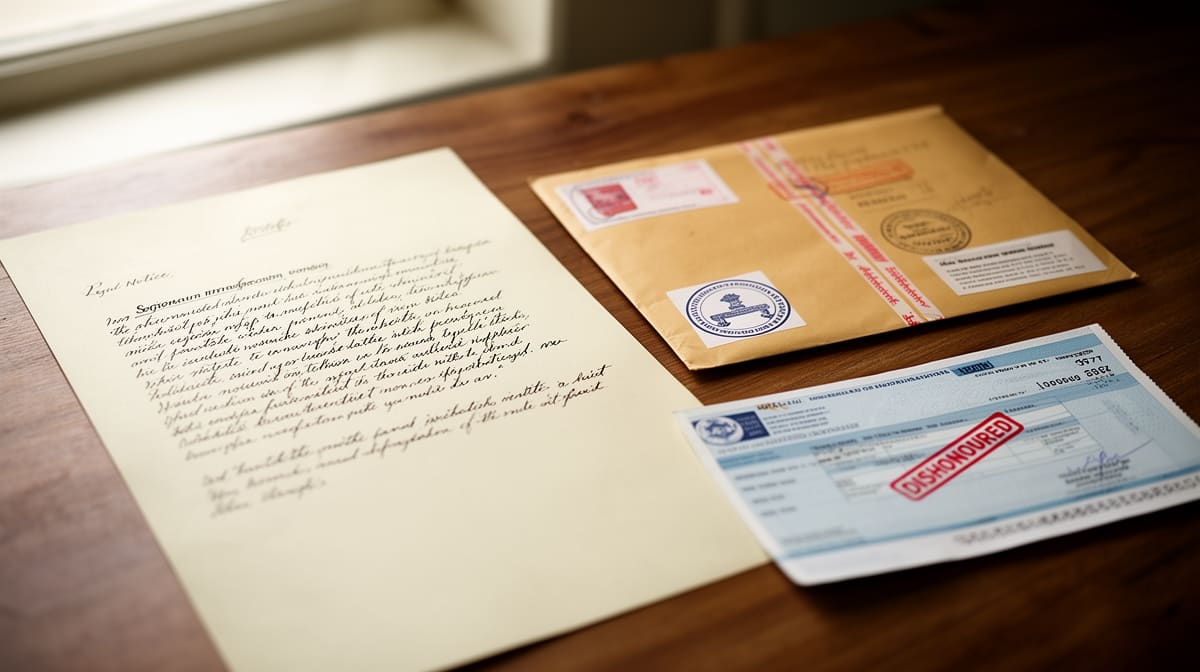
The petitioner, Nilay Upadhyay, filed a criminal complaint under Section 138 of the Negotiable Instruments Act, 1881 against Shivendra Mishra in Complaint Case No. 15120/2023, alleging dishonour of a cheque issued as payment for a debt. The complaint alleged that a demand notice was issued on 14.06.2023, followed by the cheque’s dishonour on 10.07.2023. The complaint was duly taken cognizance of under Section 204 of the CrPC on 18.08.2023, and summons were issued to the accused.
Key Facts
- The cheque was presented on 05.07.2023 and returned unpaid on 10.07.2023 with the reason "sufficient funds not available"
- The demand notice was dispatched via registered post on 14.06.2023 and received by the accused on 16.06.2023 (evidenced by postal receipt and acknowledgment)
- The complaint petition erroneously stated the date of the demand notice as 11.07.2023 due to a typographical error
- The accused filed Criminal Revision No. 37 of 2025 challenging the summoning order, arguing the complaint was premature because the 30-day notice period under Section 138 NI Act had not elapsed from the erroneously stated date of 11.07.2023
- The Sessions Judge, Bhadohi, accepted this argument and set aside the summoning order dated 18.08.2023, holding the complaint was filed before the expiry of the statutory notice period
Procedural History
- 14.06.2023: Demand notice issued and received by accused on 16.06.2023
- 10.07.2023: Cheque dishonoured by bank
- 18.08.2023: Magistrate passed order under Section 204 CrPC summoning the accused in Complaint Case No. 15120/2023
- 03.06.2025: Sessions Judge allowed Criminal Revision No. 37 of 2025, quashing the summoning order on grounds of premature filing
- 27.05.2026: Present writ petition under Article 227 filed before the Allahabad High Court
Relief Sought
The petitioner sought setting aside of the order dated 03.06.2025 passed in Criminal Revision No. 37 of 2025, restoration of the summoning order dated 18.08.2023, and permission to amend the complaint to correct the date of the demand notice from 11.07.2023 to 14.06.2023.
The Legal Issue
The central question was whether a typographical error in the complaint, misstating the date of the demand notice under Section 138 NI Act, renders the entire complaint invalid and premature, when the actual date is clearly established by documentary evidence.
Arguments Presented
For the Petitioner
Learned counsel argued that the error was purely clerical and inadvertent, supported by the original demand notice, postal receipts, and acknowledgment slips. He relied on the principle that courts must look at the substance of the complaint rather than technical defects, especially when no prejudice is caused to the accused. He cited K. Srinivasan v. M. Sivakumar to emphasize that minor errors in pleadings should not defeat substantive rights when the truth is evident from records.
For the Respondent
The State, through the Additional Government Advocate, contended that the complaint was defective on its face since the date of the demand notice was a mandatory ingredient under Section 138 NI Act. He argued that the Sessions Judge was correct in holding that the complaint was filed before the expiry of the 30-day period, as per the date stated in the complaint, and that amendment cannot be permitted after the complaint has been quashed.
The Court's Analysis
The Court examined the record and found that the demand notice dated 14.06.2023 was undisputedly issued and received. The accused had not disputed receipt of the notice, nor did he claim any prejudice from the misstatement in the complaint. The Court observed that the error was not an attempt to mislead or conceal facts, but a simple typographical oversight.
"No party should suffer on account of a clerical or typographical mistake occurring in pleadings, particularly when the relevant documentary evidence supports the correct factual position."
The Court distinguished this case from those involving deliberate misrepresentation or where the error affects jurisdiction or limitation in a material way. It held that Section 138 NI Act requires proof of issuance of notice and dishonour of cheque - both of which were established. The date misstatement was a pleading defect, not a substantive failure.
The Court further noted that Section 319 CrPC and Order VI Rule 17 CPC (applicable by analogy) permit amendment of pleadings to correct errors, even after summoning, provided justice so requires. The Sessions Judge’s decision to quash the entire proceeding on this ground was disproportionate and contrary to the spirit of procedural justice.
The Verdict
The Allahabad High Court set aside the order dated 03.06.2025 passed in Criminal Revision No. 37 of 2025. The petitioner is permitted to file an amendment application before the trial court to correct the date of the demand notice from 11.07.2023 to 14.06.2023. The trial court shall decide the amendment application within one month from the date of this judgment. If allowed, the order dated 18.08.2023 summoning the accused shall be rectified accordingly. The petition is disposed of with these directions.
What This Means For Similar Cases
Clerical Errors Are Not Fatal to Section 138 Proceedings
- Practitioners may now confidently seek amendment of pleadings to correct inadvertent date errors in NI Act complaints
- Courts must examine documentary evidence (not just pleadings) to determine whether the statutory notice period was complied with
- Quashing of summoning orders on technical grounds alone is now disfavored
Documentary Evidence Overrides Pleading Inaccuracies
- Postal receipts, acknowledgment slips, and bank records will carry greater weight than the literal wording of a complaint
- Accused cannot claim prejudice if they received the notice on the correct date and responded to it
- Courts must apply the doctrine of substantial compliance, not strict compliance, in procedural matters under Section 138 NI Act
Amendment as a Remedy, Not a Bar
- The High Court’s direction to permit amendment reinforces that procedural justice must serve substantive rights
- Trial courts must act expeditiously on amendment applications - delays may now be challenged under Article 227
- This precedent applies equally to complaints under other statutes where notice periods are critical (e.g., RERA, Consumer Protection Act)