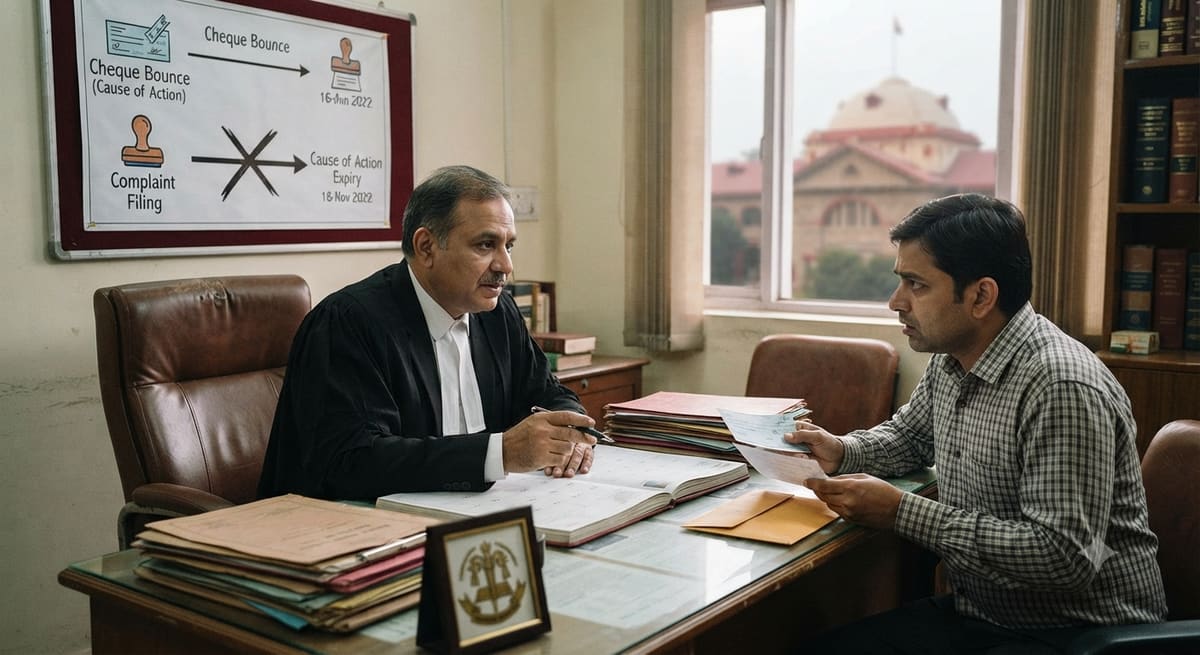
The Allahabad High Court has reaffirmed that objections to limitation under Section 138 of the Negotiable Instruments Act cannot be raised for the first time in a petition under Article 227 if they were not previously urged before the revisional court. This ruling reinforces procedural discipline in criminal complaints and underscores the limited scope of supervisory jurisdiction.
Background & Facts
The Dispute
The petitioner, Pravez Tyagi, is the accused in a criminal complaint filed by Majid Ali under Section 138 of the Negotiable Instruments Act, 1881, arising from the dishonour of a cheque. The complaint was filed in Complaint Case No. 14149 of 2024 before the Additional Court, Muzaffar Nagar. The petitioner challenged the summoning order dated 07.10.2024 and the subsequent order dated 29.09.2025 dismissing his criminal revision, seeking their quashing on grounds of limitation.
Key Facts
- The cheque in question was presented for payment and dishonoured, triggering the statutory notice mechanism under Section 138 NI Act
- The complainant alleged issuance of a statutory notice under Section 138, demanding payment within 15 days, and subsequent non-payment
- The complaint was filed on an unspecified date, but the petitioner contends it was filed beyond the limitation period prescribed under the proviso to Section 138
- The complaint does not explicitly state the date of service of the statutory notice or the date on which the cause of action accrued
- The petitioner did not raise the limitation objection during the proceedings before the Additional Court or in the criminal revision before the Additional District and Sessions Judge
Procedural History
- Date of cheque dishonour: Not specified in judgment, but implied to have occurred prior to issuance of notice
- Date of statutory notice: Not disclosed in complaint, but asserted by complainant
- Date of cause of action: Not stated in complaint; presumed to be 30 days after dishonour plus 15 days for notice period
- 07.10.2024: Summoning order issued by Presiding Officer, Additional Court, Muzaffar Nagar in Complaint Case No. 14149 of 2024
- 2024: Criminal Revision No. 520 of 2024 filed by petitioner before Additional District and Sessions Judge, Muzaffar Nagar challenging the summoning order
- 29.09.2025: Additional District and Sessions Judge dismissed Criminal Revision No. 520 of 2024 without addressing limitation
- 15.12.2025: Writ petition under Article 227 filed before Allahabad High Court (No. 15459 of 2025)
- 06.05.2026: Judgment delivered by Hon’ble Justice Anil Kumar-X
Relief Sought
The petitioner sought quashing of the summoning order dated 07.10.2024 and the revisional order dated 29.09.2025, on the ground that the complaint was ex facie time-barred due to non-disclosure of the date of service of notice and accrual of cause of action, rendering the proceedings void ab initio.
The Legal Issue
The central question was whether a petitioner can raise an objection to limitation under the proviso to Section 138 of the Negotiable Instruments Act for the first time in a petition under Article 227 of the Constitution, when the same objection was not raised before the revisional court.
Arguments Presented
For the Petitioner
The petitioner’s counsel argued that the complaint was defective on its face for failing to disclose the date of service of the statutory notice and the date on which the cause of action arose. He contended that limitation is a condition precedent to taking cognizance under Section 138, and the absence of these essential facts renders the complaint legally unsustainable. He relied on the principle that courts cannot proceed on a complaint that is ex facie time-barred, as it amounts to an abuse of process. He further submitted that the revisional court erred in not examining this fundamental defect.
For the Respondent
The learned Additional Government Advocate contended that at the stage of summoning, the court is only required to determine whether a prima facie case is made out based on the complaint and accompanying documents. The objection to limitation, he argued, pertains to evidence and factual disputes that must be resolved during trial. He emphasized that once the issuance of notice and non-payment are asserted, the statutory presumption under Section 139 arises, and the burden shifts to the accused. He further submitted that the petitioner had waived the limitation objection by not raising it earlier.
The Court's Analysis
The Court observed that the petitioner had not raised the objection of limitation before the revisional court in Criminal Revision No. 520 of 2024. It held that the failure to raise such a fundamental objection at the earliest opportunity precludes the petitioner from raising it for the first time in an Article 227 petition. The Court relied on settled principles of procedural fairness and the doctrine of waiver.
"It is settled law that once the basic ingredients of Section 138 of the Negotiable Instruments Act are prima facie made out, a statutory presumption under Section 139 of the Act arises in favour of the complainant that the cheque was issued towards discharge of a legally enforceable debt or liability, and the burden shifts upon the accused to rebut the said presumption during trial."
The Court further cited Renuka v. State of Maharashtra and Anr, 2026 INSC 327, where the Supreme Court held that pre-trial quashing of a complaint under Section 138 is impermissible once the foundational ingredients are satisfied and the statutory presumption under Section 139 comes into operation. The Court emphasized that the stage of summoning is not meant for adjudicating evidentiary disputes or technical defects that can be addressed during trial.
The Court noted that the complaint, though lacking explicit dates, sufficiently alleged issuance of notice and non-payment within the statutory period. Such omissions, while potentially relevant for evidence, do not invalidate the complaint at the threshold stage. The revisional court’s failure to address limitation was not an error of law warranting interference under Article 227, particularly since the petitioner had not pressed the point earlier.
The Verdict
The petition was dismissed. The Court upheld both the summoning order dated 07.10.2024 and the revisional order dated 29.09.2025. The proceedings under Section 138 NI Act shall continue before the trial court. The petitioner is at liberty to raise the limitation objection during trial, where evidence may be adduced to establish or rebut the date of service of notice and accrual of cause of action.
What This Means For Similar Cases
Limitation Objections Must Be Raised Early
- Practitioners must raise limitation objections under Section 138 NI Act at the earliest opportunity - during the initial challenge to the summoning order or in revision before the Sessions Judge
- Failure to do so constitutes waiver and bars raising the objection later in Article 227 petitions
- Courts will not entertain belated technical objections that could have been addressed in lower forums
Article 227 Is Not a Second Appeal
- Article 227 jurisdiction is supervisory, not appellate
- Courts will not entertain new grounds of challenge that were not ventilated before subordinate courts
- Petitioners cannot use Article 227 to circumvent procedural defaults or evidentiary burdens
Statutory Presumption Prevails at Threshold
- A complaint alleging issuance of notice and non-payment suffices to trigger Section 139 presumption
- Absence of specific dates does not render the complaint void at the summoning stage
- Accused must rebut the presumption during trial with evidence, not through procedural objections at threshold