The Himachal Pradesh High Court has clarified that an acquittal under Section 138 of the Negotiable Instruments Act cannot rest on a handwriting expert’s report that was never formally examined in court. This ruling reinforces the foundational principle that documentary evidence must be subjected to judicial scrutiny through witness examination to be legally admissible.
Background & Facts
The Dispute
The complainant, Lalit Kumar Sharma, filed a criminal complaint against the accused, Mast Ram Thakur and Dinanath, alleging the dishonour of a cheque issued as security for a loan. The complaint was filed under Section 138 of the Negotiable Instruments Act, 1881. The accused denied receiving the cheque and claimed the signature on the receipt (Ex. DW2/A) was forged.
Key Facts
- The complainant alleged that a cheque for Rs. 5,00,000 was issued by the accused on 10.08.2022 and presented for payment on 15.10.2022, which was returned unpaid on 20.10.2022.
- A legal notice under Section 138 was sent on 05.11.2022 and received by the accused on 12.11.2022.
- The accused failed to make payment within 15 days of the notice.
- The complainant filed the complaint on 18.01.2023.
- During trial, the prosecution produced a receipt (Ex. DW2/A) allegedly signed by the accused, stating that the complainant had received the cheque from Dushyant Kumar.
- The receipt contained no date, amount, or signature of the accused Dinanath.
- The trial court directed the submission of the receipt to a handwriting expert for comparison with the admitted signature of the complainant.
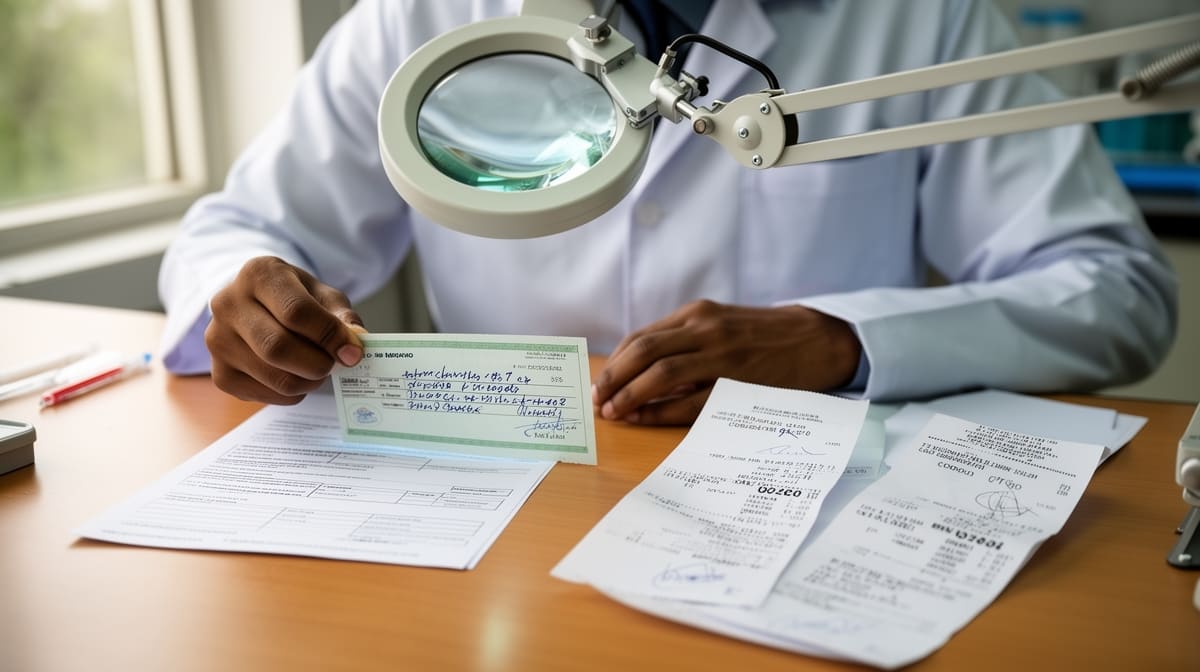
- The handwriting expert submitted a report dated 22.11.2024 concluding that the handwriting on the receipt matched the complainant’s.
- The expert was never summoned, examined, or cross-examined before the trial court.
- The trial court acquitted the accused on 21.12.2024, relying on the expert report to conclude that the complainant had fabricated the receipt.
Procedural History
- 10.08.2022: Cheque issued by accused
- 15.10.2022: Cheque presented for payment
- 20.10.2022: Cheque dishonoured
- 05.11.2022: Legal notice sent under Section 138 NI Act
- 12.11.2022: Notice received by accused
- 18.01.2023: Criminal complaint filed before Additional Chief Judicial Magistrate, Sundernagar
- 22.11.2024: Handwriting expert report submitted to court
- 21.12.2024: Trial court acquits accused, relying on unexamined expert report
- 25.01.2025: Application filed seeking leave to appeal before High Court (Cr. MP(M) No. 930 of 2025)
- 30.04.2026: Application heard and reserved
- 05.06.2026: Leave to appeal granted
Relief Sought
The complainant seeks leave to file a criminal appeal against the acquittal order dated 21.12.2024, arguing that the trial court erred in relying on an unexamined expert report and that substantial questions of law arise.
The Legal Issue
The central question was whether reliance on a handwriting expert’s report, without examining the expert in court, can form the basis for acquittal under Section 138 of the Negotiable Instruments Act.
Arguments Presented
For the Appellant/Petitioner
Mr. Surinder Verma, counsel for the complainant, argued that the trial court’s acquittal was legally unsustainable because the handwriting expert’s report was never formally admitted or examined. He cited State of Maharashtra v. Dr. Praful B. Desai to assert that expert opinions must be tested through cross-examination to be probative. He contended that the trial court’s reliance on an unexamined report violated the principles of natural justice and the evidentiary requirements under the Indian Evidence Act, 1872.
For the Respondent/State
Mr. R.K. Sharma, Senior Advocate, argued that the trial court had taken a reasonable view based on the receipt’s deficiencies - absence of date, amount, and accused’s signature - and that the expert report merely corroborated this. He submitted that the complainant failed to prove the advancement of the loan, and the acquittal was justified on the ground of insufficient evidence, independent of the expert report.
The Court's Analysis
The High Court observed that while the trial court was entitled to evaluate evidence, it could not base its conclusion on a document whose authenticity was determined by an expert whose report was never formally placed before the court as evidence. The court emphasized that under Section 45 of the Indian Evidence Act, expert opinions are admissible only when the expert is examined as a witness and subjected to cross-examination.
"The report of the handwriting expert, though placed on record, was never examined, nor was the expert summoned. To rely on such a report to discredit the complainant’s case is to substitute judicial reasoning with untested opinion."
The court further noted that the receipt itself was materially defective - lacking date, amount, and the accused’s signature - and that the trial court’s conclusion that the complainant had fabricated the document was speculative. The court held that the trial court’s reasoning created a prima facie error of law, as it effectively allowed an unexamined report to discharge the prosecution’s burden of proof.
The court concluded that the appeal raised arguable points of law and fact, particularly regarding the admissibility of expert evidence and the standard of proof under Section 138. The acquittal, therefore, could not be allowed to stand without appellate scrutiny.
The Verdict
The High Court allowed the application for leave to appeal and granted permission to file Criminal Appeal (ST No. 1775 of 2025). The appeal is now registered. The court directed that a copy of the appeal be supplied to the respondent’s counsel, and the matter be listed for hearing in due course.
What This Means For Similar Cases
Expert Reports Must Be Examined to Be Admissible
- Practitioners must ensure that any expert report relied upon in Section 138 cases is formally tendered and the expert is examined as a witness
- Unexamined reports, even if filed, cannot be used to discredit prosecution evidence or support acquittal
- Defence counsel cannot rely on unexamined expert reports as a substitute for cross-examination
Acquittal Based on Defective Documentation Requires Careful Scrutiny
- Courts must distinguish between genuine deficiencies in documents and fabricated evidence
- A receipt lacking date or signature does not automatically prove forgery - the burden remains on the accused to prove falsity
- Trial courts must avoid drawing speculative inferences from incomplete documents
Leave to Appeal Is Granted Where Legal Error Is Prima Facie
- Courts will grant leave to appeal where the trial court’s reasoning involves a clear misapplication of evidentiary rules
- The threshold for "arguable points" is low in criminal appeals under Section 138 - sufficient if a legal error is apparent on record
- This ruling reinforces appellate courts’ role in correcting procedural irregularities that affect substantive justice