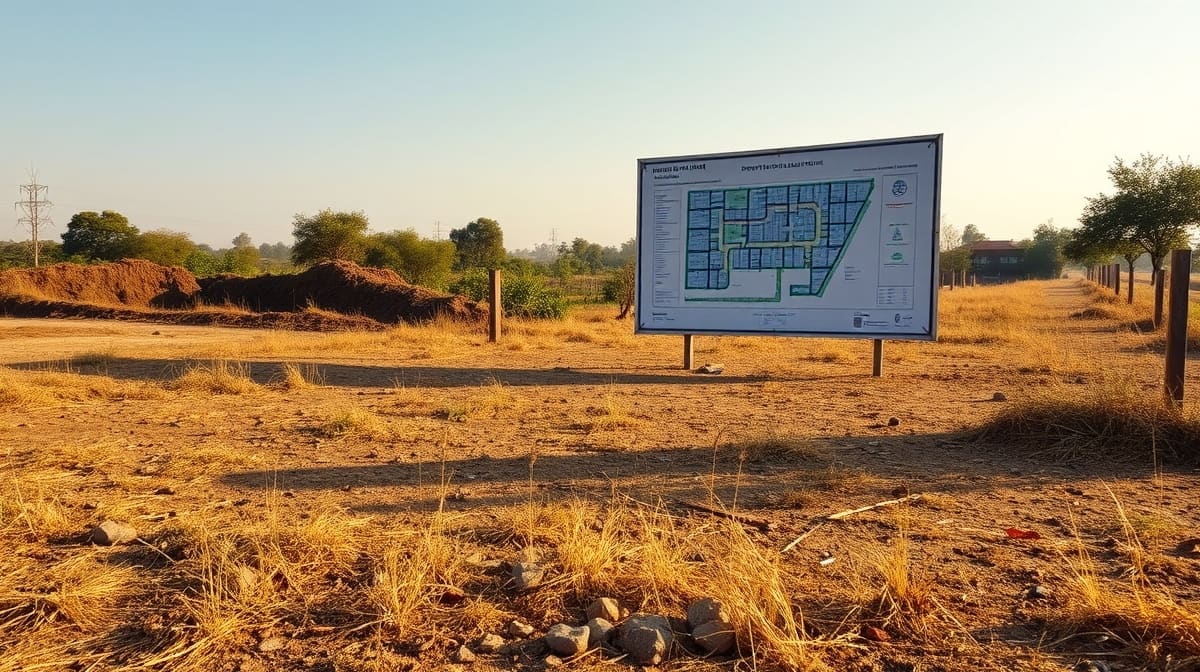
The Bombay High Court’s judgment in this PIL clarifies a critical ambiguity in urban land management: statutory lapse of public reservations under the Maharashtra Regional and Town Planning Act, 1966, does not require perfect procedural service if the planning authority has institutional knowledge and acts upon the notice. This decision reinforces the legislative intent to prevent indefinite sterilization of private land while safeguarding public interest through revised development plans.
Background & Facts
The Dispute
The petitioners, two farmers from Hingoli, challenged a 2015 communication from the State’s Urban Development Department declaring that land reservations for public amenities - including a stadium, schools, health centre, and open spaces - had lapsed under Section 127 of the MRTP Act. The land, originally owned by the National Textile Corporation, had been reserved under the 1994 Revised Development Plan. In 2008, Respondent No. 5, M/s Nidhi Mercantile Limited, issued a purchase notice under Section 127 seeking acquisition. The Hingoli Municipal Council initially denied receipt of the notice, but later records show it was forwarded by the State Government and placed before the Council’s General Body, which resolved that acquisition was unaffordable and no steps were taken.
Procedural History
- 1994: Revised Development Plan notified, reserving subject lands for public amenities.
- 1996: Non-agricultural permission granted with layout showing reserved open spaces.
- 2008: Respondent No. 5 issued purchase notice under Section 127 MRTP Act.
- 2010: Respondent No. 5 submitted representation to State Government with notice and reminder.
- 2012: Municipal Council’s General Body met, acknowledged notice, cited financial incapacity, resolved to seek grants.
- 2014: Respondent No. 5 filed Writ Petition No. 2083/2014 seeking declaration of lapse; withdrawn with liberty to pursue alternate remedies.
- 2015: State issued communication declaring reservation lapsed.
- 2019: Second Revised Development Plan came into force, re-reserving public amenities on alternative plots.
Relief Sought
The petitioners sought quashing of the 2015 communication and directions to maintain reservation on the original land. Alternatively, they sought a direction to the State to decide their 2016 representation.
The Legal Issue
The central question was whether service of a purchase notice under Section 127 of the MRTP Act is satisfied when the notice is forwarded by the State Government to the planning authority, placed before its governing body, and acted upon, despite the authority’s initial denial of receipt. Further, whether the absence of formal acquisition steps within six months triggers automatic lapse, and whether public interest demands retention of reservation on the original parcel.
Arguments Presented
For the Petitioner
The petitioners contended that the purchase notice dated 04.02.2008 was never validly served on the Municipal Council, as the Council consistently denied receipt in earlier proceedings. They argued that Section 127 requires strict compliance with service norms, and lapse cannot be inferred from administrative inaction or internal deliberations. They emphasized that public land reserved for amenities cannot be de-reserved by executive fiat, and shifting reservations to other plots does not satisfy the public interest objective.
For the Respondent
Respondent No. 5 and the State argued that the notice was received through the governmental channel, forwarded to the Municipal Council, and acted upon by its General Body, which deliberated on acquisition cost and resolved not to proceed. They relied on Girnar Traders, Shrirampur Municipal Council, and Perfect Machine Tools to assert that service is satisfied in substance when the competent authority has actual knowledge and institutional engagement. They further contended that “steps” under Section 127 require concrete action toward acquisition, not mere resolutions or financial excuses.
The Court's Analysis
The Court began by rejecting the notion that Section 127 requires an affirmative order of de-reservation. It emphasized that lapse is automatic by operation of law upon failure to acquire within six months of valid notice. The impugned communication was merely an intimation of a statutory consequence, not an exercise of discretionary power.
"The law is settled that a valid notice under Section 127 of the MRTP Act is a condition precedent for lapse. However, the present record does not permit the controversy to be decided by isolating the municipal council’s initial denial and ignoring subsequent admissions and conduct."
The Court distinguished between formal service and substantive compliance. Citing Perfect Machine Tools Company Limited v. State of Maharashtra, it held that when a notice is received by the State, forwarded to the planning authority, and placed before its governing body for deliberation, the requirement of service is fulfilled. The Council’s subsequent resolutions acknowledging the notice and citing financial inability to acquire constituted institutional acceptance.
The Court further clarified that “steps” under Section 127 mean tangible actions leading to a declaration under the Land Acquisition Act, not internal discussions or requests for grants. The Council’s inaction, despite awareness, triggered automatic lapse.
Regarding public interest, the Court noted that urban planning is dynamic. The Second Revised Development Plan (effective 10.02.2019) had already provided equivalent reservations for public amenities on other lands. Judicial intervention to freeze land on the original parcel would undermine the statutory balance between protecting public purpose and preventing indefinite land sterilization.
The Court also dismissed allegations of mala fides, finding no evidence of arbitrariness or bad faith. The State had sought reports, the Council had deliberated, and the lapse was a consequence of prolonged inaction - precisely the mischief Section 127 was designed to remedy.
The Verdict
The petitioners lost. The Court held that service of the purchase notice under Section 127 of the MRTP Act was satisfied in substance through governmental channel and institutional action, and that the absence of statutory acquisition steps within six months resulted in automatic lapse. The subsequent Second Revised Development Plan adequately protected public amenities, rendering the petitioners’ demand for retention on the original land legally untenable. The PIL was dismissed.
What This Means For Similar Cases
Notice Served Through Government Channel Is Valid
- Practitioners must now treat notice delivered via state machinery to a planning authority as valid if the authority’s records show it was received and acted upon.
- A planning authority cannot later deny service based on initial procedural objections if its own resolutions confirm knowledge and deliberation.
- Legal challenges based solely on technical defects in notice delivery will fail if institutional conduct demonstrates actual awareness.
Lapse Is Automatic; No Formal Order Required
- No administrative order is needed to de-reserve land; lapse occurs by operation of law upon expiry of six months without acquisition steps.
- Any communication from the State or planning authority merely records the legal consequence, not creates it.
- Practitioners should focus on proving whether acquisition steps were initiated - not whether a de-reservation order was issued.
Revised Plans Override Original Reservations
-
Once a revised development plan is notified under the MRTP Act, public amenities may be relocated without violating public interest.
-
Courts will not interfere with planning decisions if the revised plan provides equivalent public amenities elsewhere.
-
PILs seeking to preserve original reservations on specific plots will be dismissed if statutory lapse has occurred and planning authorities have complied with revision procedures.
-
Practitioners must verify whether a second revised plan exists before challenging lapse.
-
Public interest arguments must be tied to the existence of equivalent amenities in the current plan - not emotional attachment to original land.
-
Financial incapacity to acquire is not a legal defense; it confirms inaction and triggers lapse.