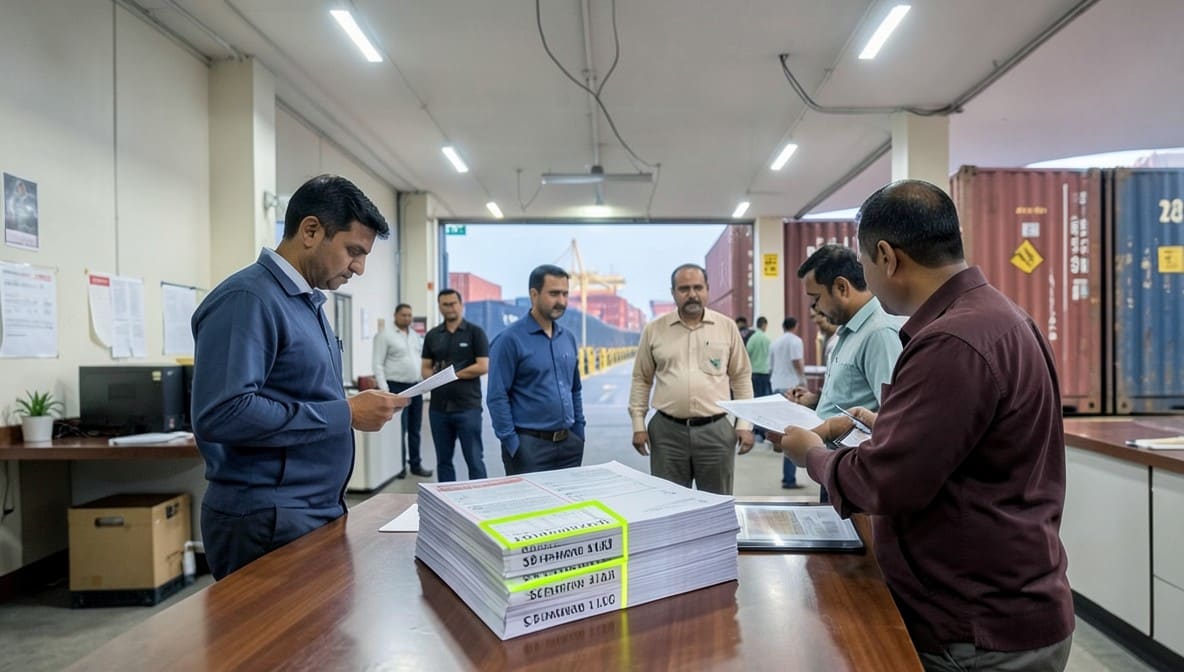
The Madras High Court's judgment in Commissioner of Customs v. M/s APP Enterprises reaffirms the Revenue's authority to recover customs duty and impose penalties when importers violate conditions of duty exemption notifications. The Court set aside the CESTAT's order, restoring the Commissioner's findings that the importers wilfully suppressed material facts, misdeclared scheme codes, and failed to comply with export obligations under Notification No. 32/97. This ruling underscores the strict compliance required for duty concessions and the limited scope of appellate review in matters involving fraudulent intent.
Background & Facts
The Dispute
The case involves M/s APP Enterprises, a Delhi-based partnership firm engaged in the job work of converting imported areca nuts/betel nuts into 'Betel Nut Tannin' for export. The firm availed duty-free import concessions under Notification No. 32/97 dated 01.04.1997, which permits duty-free imports for job work exports under specific conditions. The dispute arose when the Customs Department alleged diversion of imported goods for local consumption (manufacture of pan masala/gutka) instead of fulfilling export obligations.
Key Facts
- Import Details: M/s APP Enterprises imported approximately 1,500 metric tons of areca nuts/betel nuts under Notification No. 32/97, claiming duty exemption for job work exports.
- Notification Conditions: The notification stipulates:
- Goods must be imported for execution of an export order placed by the supplier.
- Resultant products must be re-exported to the supplier within six months.
- Wastage disposal must comply with norms prescribed by the Assistant Commissioner.
- Goods must be used solely for export obligation and not diverted for other purposes.
- Investigation Trigger: Based on intelligence, the Directorate of Revenue Intelligence (DRI) initiated an investigation into past imports, suspecting diversion of goods for local consumption.
- Provisional Release: A fresh consignment of 1,500 MT arrived at Chennai Port on 25.10.2005. The Commissioner of Customs (Imports) ordered provisional release pending investigation, subject to a 25% bank guarantee for differential duty and a personal bond (P.D. Bond).
- Show Cause Notice: On 12.03.2007, the Commissioner issued a show cause notice to M/s APP Enterprises and its partners, alleging:
- Non-compliance with Notification No. 32/97 conditions.
- Diversion of imported goods for local consumption.
- Wilful suppression of facts and misdeclaration of scheme codes in shipping bills.
- Overpricing of exported 'Betel Nut Tannin' and false claims of wastage.
- Importers' Response: The importers replied on 20.03.2007, denying allegations and asserting compliance with notification conditions.
Procedural History
- 05.03.2008: Commissioner of Customs (Seaport - Export) passed Order-in-Original No. 7268/2008, holding:
- The importers failed to fulfil export obligations under Notification No. 32/97.
- Goods were liable for confiscation under Sections 111(d) and 111(o) of the Customs Act, 1962.
- Imposed:
- Recovery of duty foregone: Rs. 71,72,187.
- Enforcement of bank guarantees totalling Rs. 46,57,500.
- Redemption fine of Rs. 10,00,000 in lieu of confiscation.
- Penalty of Rs. 5,00,000 on M/s APP Enterprises under Section 112(a).
- Penalty of Rs. 3,00,000 each on partners Vinod Agarwal and Dwarka Prasad Parekh.
- Appeals Before CESTAT:
- Importers filed appeals C/150/2008, C/151/2008, and C/152/2008.
- Revenue filed appeal C/200/2008 and miscellaneous application C/MISC/236/2008.
- 19.08.2008: CESTAT passed Final Orders Nos. 900 - 903/2008, allowing importers' appeals and dismissing the Revenue's appeal. Key findings:
- No evidence of diversion of waste material to the local market.
- Revenue failed to establish non-compliance with notification conditions.
- Documentary evidence showed export of 'Betel Nut Tannin'.
- Wrong scheme code declaration treated as a bona fide mistake.
- 28.03.2014: Revenue filed C.M.A. Nos. 1224 - 1227 of 2010 before the Madras High Court, challenging CESTAT's orders.
Relief Sought
The Revenue sought:
- Setting aside Final Orders Nos. 900 - 903/2008 passed by CESTAT.
- Restoration of Order-in-Original No. 7268/2008 dated 05.03.2008.
- Confirmation of duty recovery, penalties, and confiscation.
The Legal Issue
The central question was whether the burden of proof lay on the Revenue to demonstrate that the importers failed to comply with Notification No. 32/97, particularly:
- Whether the importers diverted imported goods for local consumption instead of fulfilling export obligations.
- Whether the misdeclaration of scheme codes in shipping bills (using Scheme Code 99 instead of Scheme Code 20) was a bona fide mistake or a wilful act to evade customs scrutiny.
- Whether the Tribunal erred in exonerating the importers without proper examination of incriminating evidence.
Arguments Presented
For the Appellant/Revenue
- Non-Compliance with Notification: The importers violated conditions (i) - (iv) of Notification No. 32/97 by:
- Failing to re-export resultant products within six months.
- Diverting goods for local consumption (manufacture of pan masala/gutka).
- Misdeclaring scheme codes to evade Electronic Data Interchange (EDI) scrutiny.
- Fraudulent Intent: The Revenue relied on investigation findings:
- Overpricing of exported 'Betel Nut Tannin'.
- False claims of wastage and over-projection of tannin content.
- Wilful suppression of facts and discrepancies in job work orders.
- Wrongful raising of export invoices with identical numbers but different data.
- Scheme Code Misdeclaration: Filing shipping bills under Scheme Code 99 (Free Shipping) instead of Scheme Code 20 (Job Work Exports) was a deliberate act to bypass EDI scrutiny, enabling duty evasion.
- Tribunal's Error: CESTAT failed to consider:
- The Commissioner's detailed findings in the Order-in-Original.
- Incriminating evidence of fraudulent intent.
- The absence of even a single shipping bill with the correct scheme code.
For the Respondent/Importers
- Compliance with Notification: The importers contended:
- They obtained permission from the jurisdictional Assistant Commissioner for waste disposal.
- Documentary evidence proved export of 'Betel Nut Tannin'.
- No evidence of diversion to the local market.
- Bona Fide Mistake: The misdeclaration of scheme codes was an inadvertent error by the Customs House Agent, not a wilful act.
- Tribunal's Findings: CESTAT correctly held:
- The Revenue failed to establish non-compliance with notification conditions.
- The Order-in-Original was inconsistent with the show cause notice.
- The importers followed prescribed procedures for waste disposal and export.
The Court's Analysis
The High Court critically examined the CESTAT's order and the Commissioner's findings, focusing on:
1. Burden of Proof and Compliance with Notification No. 32/97
The Court observed that Notification No. 32/97 imposes strict conditions for duty exemption, including:
- Re-export of resultant products within six months.
- Disposal of wastage as per prescribed norms.
- Sole use of goods for export obligation.
The importers' defence relied heavily on:
- Certificates issued by authorities regarding stuffing and stock ledger verification.
- Permission for waste disposal granted by the Assistant Commissioner.
However, the Court noted that the Commissioner's Order-in-Original meticulously examined:
- Stock ledgers, warehousing certificates, and wastage disposal records.
- Discrepancies in job work orders, import/export invoices, and declarations.
- Overpricing of exported goods and false claims of wastage.
"The importer had failed to mention proper export scheme code at the time of filing the shipping bills in order to show that, the material exported is of no foreign exchange involved category, thereby taking advantage of export under a different scheme."
The Court held that the Tribunal's finding - that the Revenue failed to establish non-compliance - was perverse, given the overwhelming evidence of fraudulent intent.
2. Scheme Code Misdeclaration: Bona Fide Mistake vs. Wilful Suppression
The Court emphasized the significance of scheme codes in customs clearance:
- Scheme Code 20 is designated for job work exports, subject to EDI scrutiny.
- Scheme Code 99 is for free shipping (No Foreign Exchange Involved), bypassing EDI checks.
The importers filed all shipping bills under Scheme Code 99, which the Commissioner found to be a wilful act to:
- Evade EDI scrutiny.
- Facilitate duty evasion.
- Deceive the customs system.
The Court rejected the Tribunal's conclusion that this was a bona fide mistake, noting:
- The Commissioner's specific finding that the importers did not produce a single transaction with the correct scheme code.
- A perpetual mistake (across all shipping bills) could not be inadvertent.
- The oblique motive behind the misdeclaration was evident from the Order-in-Original.
"Any prudent person would conclude that if it is an inadvertent mistake, it could be in one incident and not a perpetual mistake."
3. Tribunal's Superficial Examination and Perverse Findings
The Court criticised the CESTAT's approach for:
- Ignoring incriminating evidence of fraudulent intent.
- Failing to examine the Order-in-Original vis-à-vis the show cause notice, both of which ran to over 30 pages.
- Being carried away by the importers' submissions without scrutinising the Commissioner's detailed reasoning.
- Casually dismissing the scheme code misdeclaration as a bona fide mistake.
"It is unfortunate that the Tribunal, despite a clear findings and reasoning given by the Commissioner of Customs in the order-in-original, by superficial examination of records and by being carried away by the submissions made by the importer, had arrived at the erroneous conclusion."
The Court held that the Tribunal's order was perverse and liable to be set aside.
The Verdict
The Madras High Court allowed the Civil Miscellaneous Appeals (C.M.A. Nos. 1224 - 1227 of 2010) filed by the Revenue, setting aside CESTAT's Final Orders Nos. 900 - 903/2008 dated 19.08.2008. The Order-in-Original No. 7268/2008 dated 05.03.2008 passed by the Commissioner of Customs was restored in full, including:
- Recovery of duty foregone: Rs. 71,72,187 under Section 28(2) of the Customs Act, 1962.
- Enforcement of bank guarantees: Totalling Rs. 46,57,500.
- Redemption fine: Rs. 10,00,000 in lieu of confiscation under Section 125.
- Penalties:
- Rs. 5,00,000 on M/s APP Enterprises under Section 112(a).
- Rs. 3,00,000 each on partners Vinod Agarwal and Dwarka Prasad Parekh.
The Court answered the question of law framed in the Revenue's favour, holding that the burden was on the importers to prove compliance with Notification No. 32/97, and the Revenue was not required to demonstrate diversion when overwhelming evidence of fraudulent intent existed.
What This Means For Similar Cases
Strict Compliance with Customs Notifications Is Non-Negotiable
- Duty Exemption Conditions: Importers availing concessions under notifications like Notification No. 32/97 must strictly comply with all conditions, including:
- Re-export timelines.
- Wastage disposal norms.
- Sole use of goods for export obligation.
- Non-Compliance Consequences: Failure to comply may result in:
- Duty recovery under Section 28(2).
- Confiscation under Sections 111(d) and 111(o).
- Penalties under Section 112(a).
- Redemption fines under Section 125.
Scheme Code Declaration: A Critical Compliance Requirement
- Correct Scheme Code: Importers must declare the appropriate scheme code (e.g., Scheme Code 20 for job work exports) to ensure EDI scrutiny.
- Wilful Misdeclaration: Using incorrect codes (e.g., Scheme Code 99) to bypass scrutiny may be treated as fraudulent intent, leading to:
- Duty recovery.
- Penalties.
- Confiscation.
- Bona Fide Mistake Defence: Courts may reject this defence if:
- The mistake is perpetual (across multiple transactions).
- There is no single instance of correct declaration.
- The oblique motive is evident from investigation findings.
Limited Scope of Appellate Review in Fraud Cases
- Tribunal's Role: Appellate bodies like CESTAT must scrutinise incriminating evidence and not casually dismiss findings of fraudulent intent.
- Commissioner's Findings: Courts are reluctant to interfere with the Commissioner's Order-in-Original when:
- It is based on detailed investigation.
- It examines stock records, invoices, and compliance documents.
- It establishes wilful suppression or misdeclaration.
- Perverse Orders: Appellate orders that ignore incriminating evidence or superficially examine records may be set aside by higher courts.
Burden of Proof Shifts to Importers in Fraud Allegations
- Initial Burden: The Revenue must allege non-compliance with notification conditions.
- Shifting Burden: Once prima facie evidence of fraudulent intent exists (e.g., misdeclaration, discrepancies), the burden shifts to the importer to prove:
- Compliance with notification conditions.
- Bona fide nature of mistakes.
- Absence of diversion or duty evasion.
- Failure to Discharge Burden: Importers risk duty recovery, penalties, and confiscation if they fail to rebut allegations with cogent evidence.