The Customs, Excise and Service Tax Appellate Tribunal (CESTAT), Chennai Regional Bench, has set aside a demand of Rs. 39,99,079 along with interest and penalty under the Cenvat Credit Rules, 2004 and the Central Excise Act, 1944. The Tribunal held that the extended period of limitation could not be invoked as the department was already aware of the facts surrounding the loss of goods due to industrial violence and arson. The appeal was allowed on the ground of limitation, rendering further adjudication on merits unnecessary.
Background & Facts
The Dispute
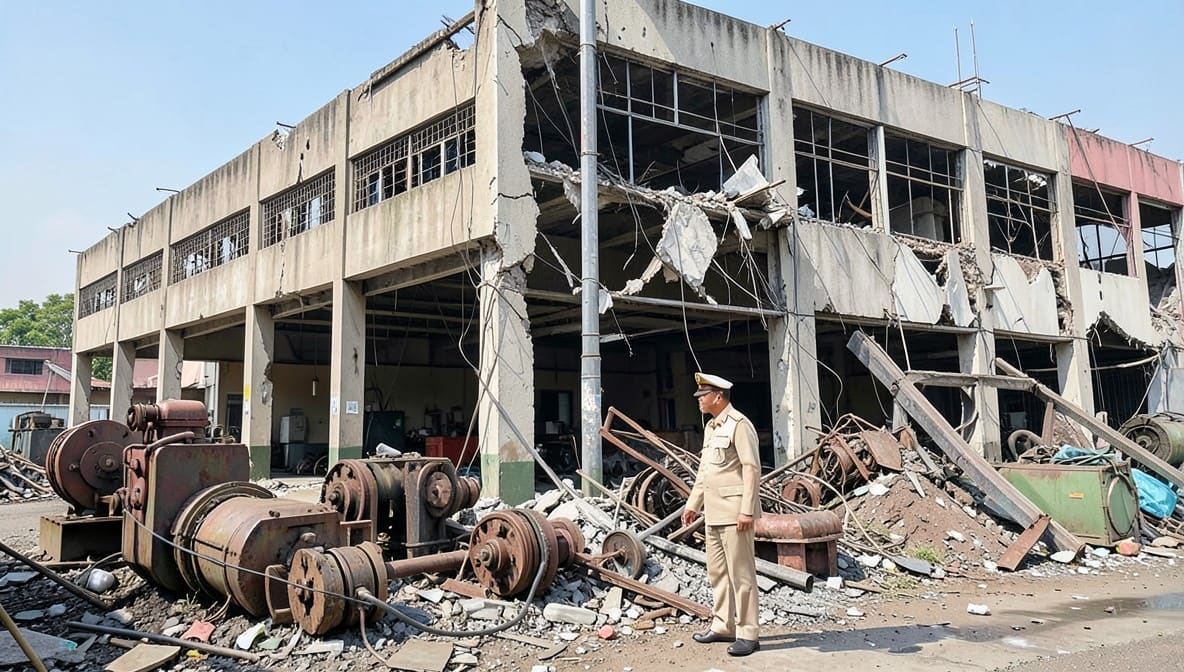
The appellant, M/s. Regency Ceramics Limited, a manufacturer of ceramic tiles, faced an industrial violence incident on 27.01.2012 at its factory in Yanam. The incident resulted in the destruction of machinery, vehicles, raw materials, and finished stocks. The appellant reported the incident and provided details of the loss to the jurisdictional authorities. The department issued multiple letters seeking details and conducted a physical verification of the damaged stock on 13.09.2012. Subsequently, a show cause notice (SCN) dated 08.02.2013 was issued proposing to demand duty on the finished goods lost in the arson. This SCN was adjudicated vide Order-in-Original (OIO) No.22/2013 dated 22.08.2013, which was appealed against by the appellant.
Key Facts
- The appellant is a registered manufacturer of ceramic tiles under heading 69089090 and 69079090 of the Central Excise Tariff Act, 1985.
- The incident of industrial violence and arson occurred on 27.01.2012, resulting in loss of finished goods, inputs, capital goods, and records.
- The appellant reported the incident and provided details of the loss to the department via letters dated 08.09.2012 and 26.07.2013.
- The department conducted physical verification of the damaged stock on 13.09.2012 and issued a SCN dated 08.02.2013 proposing to demand duty on the lost finished goods.
- The OIO dated 22.08.2013 confirmed the demand, which was appealed against by the appellant.
- The department issued another SCN dated 01.02.2017 invoking the extended period of limitation to demand credit of Rs. 39,99,079 along with interest and penalty.
- The appellant argued that the department was already aware of the facts and could not invoke the extended period of limitation.
Procedural History
- 27.01.2012: Industrial violence and arson at the appellant's factory in Yanam.
- 06.02.2012: Jurisdictional Superintendent sought details of the loss.
- 08.09.2012: Appellant furnished details of the loss and stock position.
- 13.09.2012: Physical verification of damaged stock conducted under Mahazar.
- 08.02.2013: First SCN issued proposing to demand duty on lost finished goods.
- 22.08.2013: OIO No.22/2013 confirmed the demand.
- 01.02.2017: Second SCN issued invoking extended period of limitation to demand credit of Rs. 39,99,079.
- 30.11.2017: OIO No.09/2017 confirmed the demand of Rs. 39,99,079 along with interest and penalty.
- 09.04.2018: Order-in-Appeal No.169/2018 upheld the OIO.
- 10.04.2026: Appeal No. 41735 of 2018 heard by CESTAT Chennai.
- 21.07.2026: CESTAT Chennai allowed the appeal and set aside the impugned order.
Relief Sought
The appellant sought quashing of the demand of Rs. 39,99,079 along with interest and penalty, and setting aside of the impugned order dated 09.04.2018.
The Legal Issue
The central question was whether the extended period of limitation under Section 11A of the Central Excise Act, 1944 read with Rule 14 of the Cenvat Credit Rules, 2004 could be invoked when the department was already aware of the facts surrounding the loss of goods due to industrial violence and arson.
Arguments Presented
For the Appellant
The appellant contended that the SCN dated 01.02.2017 was barred by limitation as the department was already aware of the facts surrounding the incident of 27.01.2012 and the consequent loss of goods. The appellant relied on the decision in Nizam Sugar Factory v. Collector of Central Excise, A.P. (2006) 197 ELT 465 (SC) to argue that the extended period of limitation could not be invoked when the facts were within the knowledge of the department. The appellant also argued that the cenvat credit on the lost inputs and capital goods had lapsed and did not require recovery proceedings. Reliance was placed on Biopac India Corporation Ltd. v. Commissioner of Central Excise (2008) 224 ELT 548 (Tribunal-Ahmedabad), affirmed by the Gujarat High Court.
For the Respondent
The respondent reiterated the findings in the impugned order and contended that the demand was validly confirmed.
The Court's Analysis
The CESTAT examined the chronology of events and found that the occurrence of the industrial violence and the resultant damage to goods were contemporaneous facts well within the knowledge of the department. The department had issued the first SCN dated 08.02.2013 based on these facts, and the appellant had provided details of the loss and stock position. The CESTAT held that the department could not invoke the extended period of limitation while issuing the second SCN dated 01.02.2017, as the facts were already known to the department.
The CESTAT relied on the decision in Nizam Sugar Factory v. Collector of Central Excise, A.P. (2006) 197 ELT 465 (SC) to hold that the extended period of limitation could not be invoked when the facts were within the knowledge of the department. The CESTAT also relied on the decisions in Commr of Cus, C.Ex & S.Tax v. Monsanto Manufacturer Pvt Ltd (2014) 35 STR 177 (All), State Bank of India v. B.S. Agricultural Industries (I) (2009) 5 SCC 121, Commissioner of Customs, Mumbai v. B.V. Jewels (2004) 172 ELT 3 (SC), and E.T.A General Pvt Ltd v. Additional Commissioner of C.Ex, Chennai (2016) 44 STR 409 (Mad) to hold that once the demand is held to be barred by limitation, the tribunal cannot proceed to decide the matter on merits.
"If, in reality, the CEGAT found that the action taken by the departmental authorities was beyond the period of limitation, it could have disposed of the appeals before it only on that ground without examining the merits."
The CESTAT held that the demand was wholly barred by limitation and that the tribunal could not proceed to decide the matter on merits once the demand was held to be time-barred.
The Verdict
The CESTAT allowed the appeal and set aside the impugned Order-in-Appeal No.169/2018 dated 09.04.2018. The demand of Rs. 39,99,079 along with interest and penalty was held to be unsustainable and liable to be set aside. The consequential relief, if any, was left open to the appellant.
What This Means For Similar Cases
Extended Limitation Period Requires Suppression of Facts
- The extended period of limitation under Section 11A of the Central Excise Act, 1944 read with Rule 14 of the Cenvat Credit Rules, 2004 cannot be invoked if the facts are within the knowledge of the department.
- The department must demonstrate that the facts were not known to it at the time of the first SCN to justify invoking the extended period of limitation.
Once Limitation is Held to be Barred, Merits Cannot Be Decided
- If the tribunal holds that the demand is barred by limitation, it cannot proceed to decide the matter on merits.
- Proceeding to decide the matter on merits after holding the demand to be time-barred amounts to an illegality, as held by the Supreme Court in State Bank of India v. B.S. Agricultural Industries (I) (2009) 5 SCC 121.
Documentary Evidence and Chronology of Events Are Critical
- The appellant must maintain a clear chronology of events and documentary evidence to demonstrate that the facts were within the knowledge of the department.
- Physical verification reports, Mahazars, and correspondence with the department are crucial to establish that the department was aware of the facts surrounding the loss of goods.