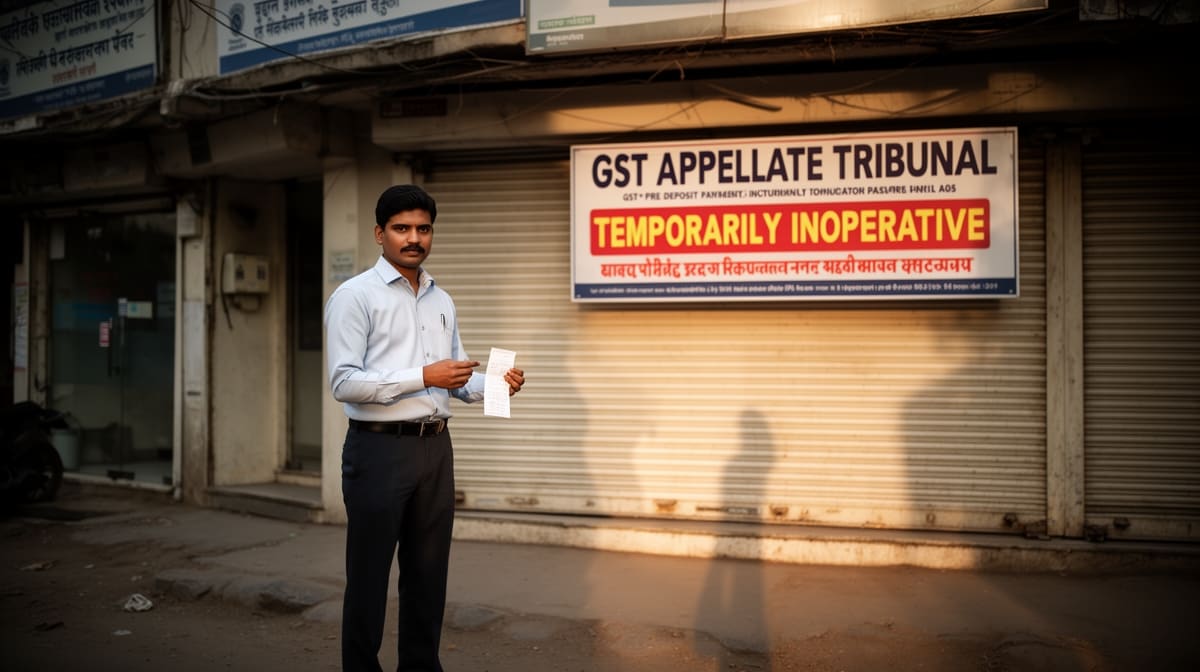
The Madhya Pradesh High Court has clarified that when the GST Appellate Tribunal remains non-functional, the statutory mechanism for staying recovery proceedings is activated solely through compliance with the pre-deposit requirement under Section 112 of the CGST Act. This ruling provides critical procedural relief to taxpayers caught in administrative gridlock.
Background & Facts
The Dispute
The petitioner, MS Maheshwari Agencies, challenged orders passed by the Assessing Officer and the Appellate Authority under the Goods and Services Tax Act, 2017, which imposed tax liabilities and initiated recovery proceedings. The petitioner contested the assessment but sought to stay enforcement while pursuing appellate remedies.
Procedural History
- 2024: Final assessment order issued by Assessing Officer
- 2024: Appellate Authority upheld the assessment
- 2025: Petitioner filed Writ Petition under Article 226 before the Madhya Pradesh High Court
- 2025: Petitioner had filed an appeal under Section 112 of the CGST Act but could not proceed due to non-functioning of the GST Appellate Tribunal
Relief Sought
The petitioner sought a stay on recovery proceedings pending the functional restoration of the GST Appellate Tribunal, arguing that the absence of an appellate forum rendered the statutory remedy illusory.
The Legal Issue
The central question was whether the payment of the prescribed pre-deposit under Section 112(8) of the CGST Act automatically triggers a stay on recovery proceedings under Section 112(9), even when the appellate tribunal is not operational.
Arguments Presented
For the Petitioner
Counsel argued that the non-functioning of the GST Appellate Tribunal created a procedural vacuum, rendering the statutory right to appeal ineffective. Reliance was placed on State of Haryana v. Bhagwan Das to assert that when a statutory remedy is rendered inaccessible due to administrative failure, the High Court must intervene to prevent irreparable harm. The petitioner emphasized that compliance with the pre-deposit condition under Section 112(8) should, by operation of law, invoke the automatic stay under Section 112(9).
For the Respondent
The State contended that the High Court lacks jurisdiction to interfere in tax matters where a statutory appellate remedy exists, even if temporarily suspended. It argued that the circular issued by the Central Board of Indirect Taxes and Customs was merely advisory and did not create enforceable rights. The State further maintained that the petitioner had not exhausted remedies and that judicial intervention would undermine the legislative scheme.
The Court's Analysis
The Court examined the interplay between Section 112(8) and Section 112(9) of the CGST Act, along with Circular No. 224/18/2024-GST dated 11th July, 2024. It noted that while the circular is not a statute, it clarifies the administrative interpretation of statutory provisions already in force.
"If any person files an appeal in accordance with the requirement of sub-section (8) of Section 112... the recovery proceedings of the balance amount shall be deemed to be stayed till the disposal of the appeal as per sub-section (9)."
The Court held that the legislature intended the pre-deposit to act as a condition precedent to invoking the stay. Once that condition is satisfied, the stay under Section 112(9) becomes automatic, irrespective of whether the appellate tribunal is functional. The Court rejected the State’s argument that the circular was merely advisory, observing that it merely operationalized an existing statutory provision.
The Court further emphasized that the doctrine of ut res magis valeat quam pereat - that the law should be interpreted to give effect rather than defeat its purpose - supports the view that a taxpayer who complies with the pre-deposit requirement must not be left without protection against coercive recovery.
The Verdict
The petitioner prevailed. The Court held that payment of the pre-deposit under Section 112(8) CGST Act triggers an automatic stay on recovery proceedings under Section 112(9), even when the GST Appellate Tribunal is non-functional. The writ petition was disposed of with liberty to the petitioner to invoke the remedy under the circular.
What This Means For Similar Cases
Pre-Deposit Automatically Stays Recovery
- Practitioners must immediately file pre-deposit applications upon receipt of adverse orders, even if the tribunal is inactive
- Recovery notices issued after pre-deposit must be challenged on grounds of statutory violation, not procedural delay
- Tax authorities cannot ignore the stay merely because the appellate forum is not operational
Circulars as Binding Interpretations
- Administrative circulars clarifying statutory provisions gain legal weight when they reflect legislative intent
- Taxpayers may rely on such circulars to assert rights even in the absence of tribunal functioning
- Courts will treat these as authoritative interpretations unless shown to be ultra vires
Judicial Restraint in Tax Matters Is Not Absolute
- High Courts retain jurisdiction under Article 226 to prevent abuse of power when statutory remedies are rendered ineffective
- The existence of an appellate remedy does not bar judicial intervention if the remedy is rendered illusory by administrative failure
- This judgment reinforces that procedural fairness cannot be sacrificed for bureaucratic convenience