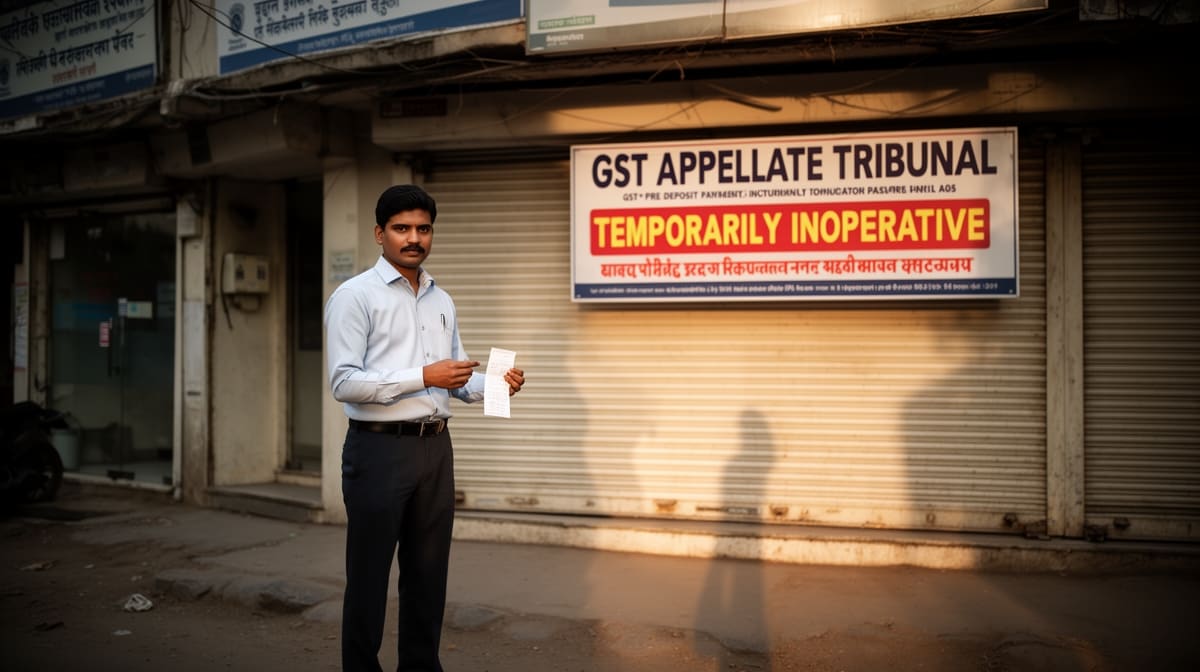
The Chhattisgarh High Court has clarified that taxpayers facing recovery proceedings under the CGST Act may secure a stay on demand recovery by complying with prescribed procedural safeguards under a central circular, even in the absence of a constituted Appellate Tribunal. This ruling provides critical relief to businesses caught in administrative limbo due to delayed tribunal formation.
Background & Facts
The Dispute
The petitioner, Maa Kali Industries Proprietorship Firm, is a registered taxpayer under the Chhattisgarh Goods and Services Tax Act, 2017. It received an order dated 04.11.2022 from Respondent No. 3 (Deputy Commissioner, Raipur Circle I) confirming a tax demand. The petitioner filed a first appeal under Section 107 of the CGST Act, which was dismissed by Respondent No. 2 (Additional Commissioner, Appeal) on 28.03.2024. Subsequently, an attachment notice was issued on 16.01.2026 to enforce recovery of the confirmed demand.
Key Facts
- The petitioner challenged the recovery proceedings initiated under Section 83 of the CGST Act, alleging violation of statutory safeguards.
- The total confirmed demand, as per the appellate order dated 28.03.2024, remains unpaid.
- The petitioner has not filed an appeal before the Appellate Tribunal because the Tribunal has not yet been constituted.
- The petitioner seeks quashing of the attachment notice and stay on recovery pending tribunal formation.
Procedural History
- 04.11.2022: Order confirming tax demand issued by Deputy Commissioner, Raipur Circle I.
- 28.03.2024: First appeal dismissed by Additional Commissioner (Appeal).
- 16.01.2026: Attachment notice issued under Section 83 of CGST Act.
- 05.01.2026: Writ Petition No. 55 of 2026 filed before the Chhattisgarh High Court.
- 17.04.2026: Hearing on admission; matter admitted and heard finally with consent of parties.
The Parties' Positions
For the Petitioner:
- Relied on CBIC Circular No. 224/18/2024 dated 11.07.2024, which provides a mechanism for taxpayers to obtain stay on recovery even when the Appellate Tribunal is not functional.
- Cited Paragraphs 4, 5, and 6 of the circular, which permit payment of pre-deposit amount via the GST portal and filing of an undertaking to file appeal before the Tribunal upon its constitution.
- Argued that the attachment notice violates the spirit of the circular and the statutory intent under Section 112(9) of the CGST Act.
- Invoked Notification No. S.O. 4220(E) dated 17.09.2025, which extends the limitation period for filing appeals to 30.06.2026 for orders communicated before 01.04.2026.
For the Respondents:
- Did not oppose the petitioner’s prayer.
- Accepted that the circular provides a lawful and practical mechanism to balance revenue collection with taxpayer rights.
- Confirmed that the State Government has adopted the central notification dated 17.09.2025.
Relief Sought
The petitioner sought:
- Quashing of the attachment notice dated 16.01.2026.
- Stay on recovery of the confirmed demand pending filing of appeal before the Appellate Tribunal.
- Direction to the authorities to recognize the undertaking and pre-deposit mechanism under Circular No. 224/18/2024.
The Legal Issue
Can a taxpayer obtain a statutory stay on recovery of confirmed GST demand under Section 112(9) of the CGST Act by complying with the procedural conditions laid down in CBIC Circular No. 224/18/2024, even when the Appellate Tribunal has not yet been constituted?
Arguments Presented
For the Petitioner
The petitioner relied on Circular No. 224/18/2024 issued by the Central Board of Indirect Taxes and Customs on 11.07.2024, which explicitly permits taxpayers to file an undertaking with the jurisdictional officer and pay an amount equal to the pre-deposit required under Section 112(8) of the CGST Act. The circular clarifies that such payment, when made through the GST portal and mapped to the relevant demand, shall be treated as compliance with the pre-deposit requirement for the purpose of obtaining a stay under Section 112(9). The petitioner further cited Notification No. S.O. 4220(E) dated 17.09.2025, which extends the limitation period for filing appeals to 30.06.2026 for orders communicated before 01.04.2026, reinforcing the government’s intent to provide a reasonable window for appellate recourse.
For the Respondent
The State did not contest the petitioner’s submissions. The learned Dy. Government Advocate acknowledged the binding nature of the circular and confirmed that the State Government had adopted the central notification. The State accepted that the petitioner’s compliance with the circular’s conditions would entitle it to the statutory stay.
The Court's Analysis
The Court examined the legislative intent behind Section 112 of the CGST Act, which provides for a pre-deposit mechanism to prevent abuse of appellate rights while ensuring revenue protection. The Court noted that the non-constitution of the Appellate Tribunal created a procedural vacuum, leaving taxpayers in limbo - unable to file appeals but subject to aggressive recovery actions.
"In order to facilitate the taxpayers to make the payment of the amount of pre-deposit as per sub-section (8) of Section 112 of the CGST Act and to avail the benefit of stay from recovery of the remaining amount of confirmed demand as per sub-section (9) of section 112 of the CGST Act, it is clarified that... the amount so paid would be mapped against the selected order and demand amount would be reduced in the balance liability..."
The Court held that the circular issued on 11.07.2024 is not merely administrative guidance but a lawful exercise of power under Section 164 of the CGST Act, which empowers the Board to issue directions for uniformity in implementation. The circular aligns with the statutory scheme and prevents hardship to taxpayers who are otherwise compliant and willing to pursue appellate remedies.
The Court further observed that the extension of limitation under Notification No. S.O. 4220(E) dated 17.09.2025 demonstrates a clear policy of the Central Government to provide a reasonable timeframe for filing appeals. The State’s adoption of this notification further strengthens the legitimacy of the mechanism.
The Court concluded that the attachment notice, issued without regard to the taxpayer’s willingness to comply with the circular, was premature and contrary to the statutory framework.
The Verdict
The petitioner is granted liberty to file an undertaking/declaration with the jurisdictional proper officer within 15 days of receipt of this order, stating that it will file an appeal before the Appellate Tribunal upon its constitution, within the time limits prescribed under Section 112 of the CGST Act and Notification No. S.O. 4220(E) dated 17.09.2025. The petitioner shall also pay the pre-deposit amount equal to the amount required under Section 112(8) via the GST portal within the same period. Upon such compliance, recovery of the confirmed demand under the orders dated 04.11.2022 and 28.03.2024 shall remain stayed as per Section 112(9). If the undertaking and pre-deposit are not completed within 15 days, this order shall cease to have effect.
What This Means For Similar Cases
Stay on Recovery Is Conditional but Accessible
- Practitioners must now advise clients to proactively file undertakings and make pre-deposits via the GST portal even if the Appellate Tribunal is not yet functional.
- Recovery proceedings initiated without regard to such compliance are legally vulnerable and may be quashed.
- The burden shifts to the revenue authorities to verify compliance with the circular before initiating attachment or recovery.
Circulars Can Create De Facto Legal Safeguards
- Administrative circulars issued under statutory authority (e.g., Section 164) can create enforceable rights for taxpayers when they align with legislative intent.
- Courts will uphold such circulars as legitimate tools to bridge administrative gaps, especially when statutory bodies (like the Tribunal) are delayed.
- Taxpayers must retain proof of undertaking submission and payment confirmation on the GST portal as critical evidence.
Limitation Extensions Are Binding on States
- State authorities are bound by central notifications extending limitation periods for appeals under the CGST Act.
- Any attempt by state officers to enforce recovery beyond the extended deadline (e.g., 30.06.2026) without due process is legally unsustainable.
- Practitioners should routinely check for such notifications before advising on limitation deadlines.