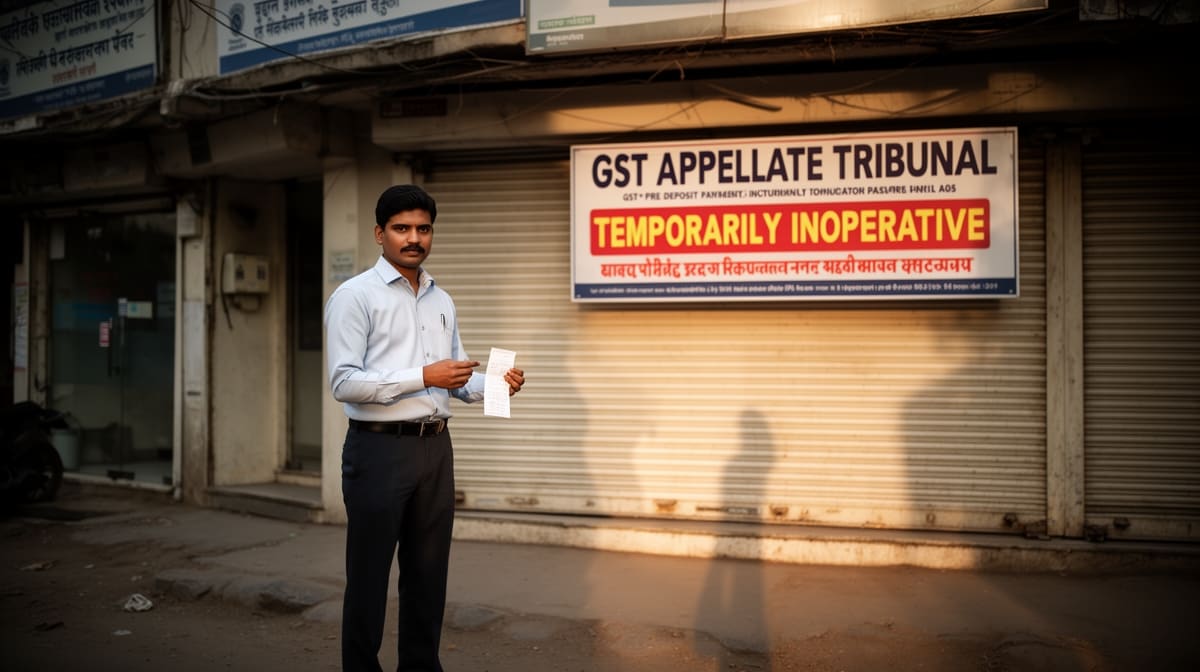
The Rajasthan High Court has clarified that the non-functionality of the GST Appellate Tribunal does not deprive taxpayers of their right to appeal. In a significant ruling, the Court extended the limitation period for filing appeals under Section 112(8) of the Rajasthan Goods and Services Tax Act, 2017, allowing petitioners to file appeals within three months of the Tribunal's constitution. This decision provides crucial relief to taxpayers facing procedural hurdles due to administrative delays.
Background & Facts
The Dispute
The petitioner, Nircon Polymers Private Limited, challenged the order of the First Appellate Authority under the Rajasthan Goods and Services Tax Act, 2017 (RGST Act). The core issue arose from the inability to file an appeal due to the non-functional status of the GST Appellate Tribunal in Rajasthan. The petitioner argued that this administrative lapse should not prejudice their statutory right to appeal.
Procedural History
- The petitioner approached the Rajasthan High Court via a writ petition after exhausting remedies before the First Appellate Authority.
- The respondents, including the Appellate Authority, State Tax, Jaipur and the Union of India, acknowledged the non-functionality of the Tribunal but sought disposal of the petition with protective directions.
- The Court noted that similar matters had been disposed of in Jagdamba Motors v. Union of India & Ors. and D.B. Civil Writ Petition No. 1113/2024, where directions were issued to safeguard taxpayers' rights during the Tribunal's absence.
Relief Sought
The petitioner sought:
- An extension of the limitation period for filing an appeal under Section 112 of the RGST Act.
- Protection from recovery proceedings pending the constitution of the Tribunal.
- Liberty to file an appeal within a stipulated period after the Tribunal's constitution.
The Legal Issue
The central question was whether the non-functionality of the GST Appellate Tribunal could deprive taxpayers of their statutory right to appeal under Section 112 of the RGST Act, and if so, what protective measures could be granted to preserve this right.
Arguments Presented
For the Petitioner
- Contended that the inability to file an appeal due to the Tribunal's non-functionality violated the principles of natural justice and statutory rights.
- Relied on the precedent set in D.B. Civil Writ Petition No. 1113/2024, where the Court had granted similar relief.
- Argued that the petitioner should not be penalized for administrative delays beyond their control.
For the Respondents
- Acknowledged the non-functionality of the Tribunal but submitted that protective directions had been issued in similar cases.
- Referenced a circular dated 23.03.2020 issued by the Government of Rajasthan Finance Department (Tax Division), which provided guidance on handling appeals during the Tribunal's absence.
- Agreed to the disposal of the petition with directions to deposit the amount as per Section 112(8) of the RGST Act and file an appeal within three months of the Tribunal's constitution.
The Court's Analysis
The Court observed that the issue was squarely covered by its earlier decision in D.B. Civil Writ Petition No. 1113/2024, where it had disposed of similar petitions with protective directions. The Court emphasized the following principles:
-
Statutory Right to Appeal: The right to appeal under Section 112 of the RGST Act is a statutory right that cannot be denied due to administrative lapses.
-
Protection Under Section 112(8): The Court relied on Section 112(8) of the RGST Act, which provides for protective measures in cases where the appeal cannot be filed due to circumstances beyond the taxpayer's control. The provision states:
"Where the appellant has paid the amount as per the provisions of this subsection, further proceedings shall not be drawn for recovery of the balance amount, provided that the appellant avails the statutory remedy of appeal within the prescribed period."
-
Balancing Interests: The Court balanced the interests of the taxpayer with the need for procedural compliance. It held that while the Tribunal's non-functionality was an administrative issue, it should not prejudice the taxpayer's rights. The Court directed that the petitioner deposit the requisite amount under Section 112(8) and file the appeal within three months of the Tribunal's constitution.
-
Precedent Application: The Court followed the ratio decidendi of D.B. Civil Writ Petition No. 1113/2024, where it had granted similar relief to taxpayers facing identical circumstances. This ensured consistency in judicial approach and provided clarity on the protective measures available under the RGST Act.
The Verdict
The petition was disposed of in terms of the order dated 15.02.2024 passed in D.B. Civil Writ Petition No. 1113/2024. The Court directed the petitioner to deposit the amount as per Section 112(8) of the RGST Act within three months from the date of the order. The petitioner was granted liberty to file an appeal within three months of the constitution of the GST Appellate Tribunal.
What This Means For Similar Cases
Extension of Limitation Period
- Taxpayers can now seek extension of the limitation period for filing appeals under Section 112 of the RGST Act if the Tribunal is non-functional.
- Practitioners should cite this judgment to argue for protective directions in cases where administrative delays hinder statutory rights.
Protective Measures Under Section 112(8)
- Section 112(8) of the RGST Act provides a safeguard for taxpayers by allowing them to deposit the requisite amount and file an appeal within a stipulated period after the Tribunal's constitution.
- Courts are likely to grant similar relief in cases where the Tribunal's non-functionality is proven, ensuring that taxpayers are not prejudiced by administrative lapses.
Precedent for Future Litigation
-
This judgment sets a precedent for handling cases where statutory rights are affected by administrative delays. Practitioners can rely on this decision to seek relief in similar matters across other tax statutes.
-
The Court's approach underscores the importance of natural justice and statutory compliance, even in the face of procedural hurdles.
-
Actionable Takeaways for Practitioners:
- Always check the functional status of the relevant Tribunal before advising clients on appeal timelines.
- Cite D.B. Civil Writ Petition No. 1113/2024 and this judgment to seek protective directions in cases of Tribunal non-functionality.
- Ensure compliance with Section 112(8) of the RGST Act by depositing the requisite amount within the prescribed timeline to avoid recovery proceedings.