The Madhya Pradesh High Court has clarified that the statutory mechanism under Section 112(9) of the Central Goods and Services Tax Act, 2017 provides an exclusive and efficacious remedy for taxpayers challenging assessment orders, rendering writ petitions under Article 226 redundant when the statutory appeal process remains accessible.
Background & Facts
The Dispute
The petitioner, G.K. Traders, challenged an ex parte order dated 25.06.2025 issued by the GST authorities, which imposed tax liability, interest, and penalty. The petitioner contended that the order was issued without proper hearing and that the demand was legally unsustainable.
Procedural History
- June 2025: Ex parte assessment order issued by the GST Officer (Respondent No. 3)
- July 2025: Petitioner filed a writ petition under Article 226 before the High Court seeking quashing of the order
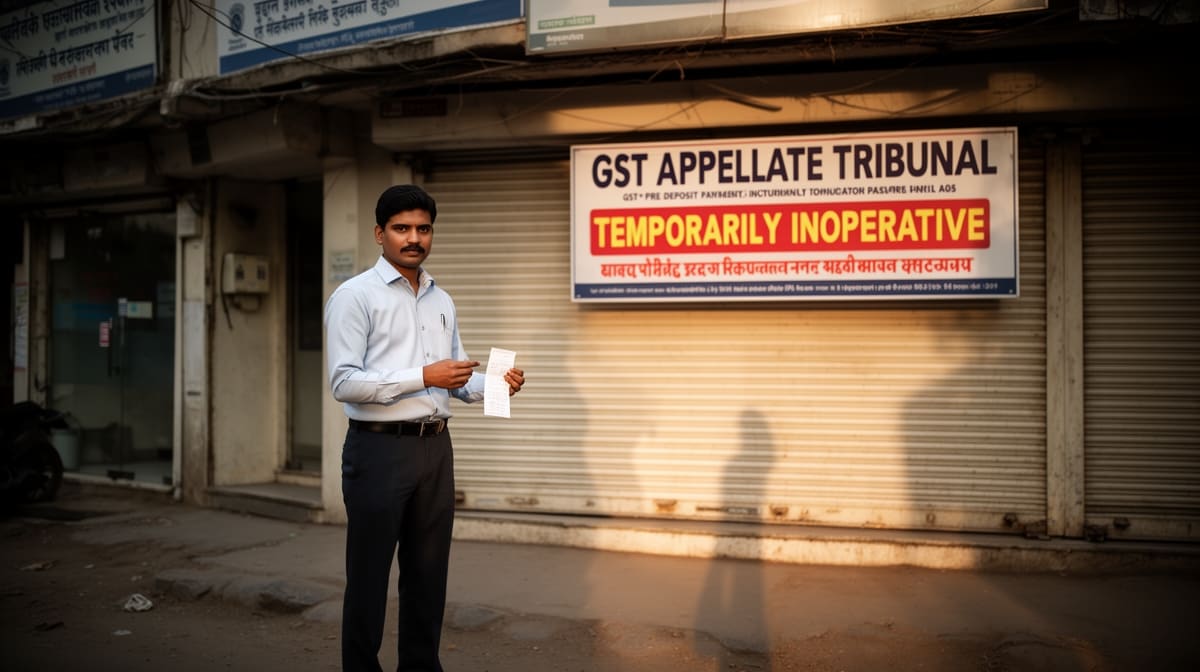
- March 2026: Respondents informed the Court that the GST Appellate Tribunal would commence functioning from 01.04.2026
- March 2026: Respondents also cited a government notification extending the period for filing appeals until June 2026
Relief Sought
The petitioner sought quashing of the ex parte order and cancellation of the tax, interest, and penalty demand. Alternatively, the petitioner requested interim relief against enforcement of the demand.
The Legal Issue
The central question was whether a taxpayer may invoke the extraordinary jurisdiction of the High Court under Article 226 to challenge a GST assessment order, when an alternative and efficacious statutory remedy under Section 112(9) of the CGST Act is available and has not been exhausted.
Arguments Presented
For the Petitioner
The petitioner’s counsel argued that the ex parte order violated principles of natural justice and that the petitioner had no meaningful opportunity to be heard. He contended that the writ petition was maintainable because the statutory remedy was rendered ineffective due to the delayed commencement of the GST Appellate Tribunal.
For the Respondent/State
The State, represented by the Additional Advocate General, submitted that Section 112(9) of the CGST Act provides an explicit and statutory mechanism for stay of demand: deposit of 10% of the disputed amount triggers an automatic stay. The State emphasized that the Tribunal’s commencement was imminent and that a notification extended the limitation period for filing appeals until June 2026, ensuring no prejudice to the petitioner’s rights.
The Court's Analysis
The Court examined the settled doctrine that writ jurisdiction under Article 226 is not a substitute for statutory remedies. It relied on the principle that where a specific statutory remedy exists and is efficacious, courts must decline to entertain writ petitions unless the remedy is illusory or wholly inadequate.
"The existence of a statutory appellate mechanism with an automatic stay provision upon deposit of 10% of the disputed amount renders the writ petition redundant. The petitioner is not deprived of any substantive right; he is merely required to follow the legislative scheme."
The Court noted that the notification extending the appeal period until June 2026 removed any claim of delay or prejudice. The Court further observed that the automatic stay under Section 112(9) is a robust safeguard designed precisely to prevent coercive recovery during the pendency of appeals. The petitioner’s failure to avail this remedy could not justify bypassing the statutory framework.
The Court emphasized that judicial restraint is essential in tax matters where Parliament has created a comprehensive appellate structure. Allowing writ petitions in such cases would undermine legislative intent and flood courts with avoidable litigation.
The Verdict
The petitioner’s writ petition was dismissed as redundant. The Court held that Section 112(9) CGST Act provides an adequate and efficacious remedy, and the petitioner may file an appeal before the GST Appellate Tribunal upon depositing 10% of the disputed amount, which will operate as an automatic stay. The petition was disposed of with liberty to file such appeal.
What This Means For Similar Cases
Automatic Stay Is Not Conditional
- Practitioners must now advise clients to deposit 10% of disputed GST demand immediately upon receipt of assessment order to trigger automatic stay under Section 112(9)
- No separate application for stay is required - deposit alone suffices
- Failure to deposit does not invalidate the appeal but forfeits the stay benefit
Writ Petitions Are Not a Shortcut
- Writ petitions under Article 226 challenging GST assessments are now clearly non-maintainable if the statutory appeal route is open
- Courts will routinely dismiss such petitions unless the statutory remedy is shown to be illusory or unavailable
- Practitioners must exhaust the appellate process before approaching High Courts
Delay Is Not an Excuse When Statutory Extensions Exist
- Government notifications extending limitation periods for GST appeals are binding and must be relied upon to rebut claims of prejudice
- Taxpayers cannot claim denial of justice when the law provides a clear, extended window to file appeals
- Legal teams must proactively track official notifications affecting limitation periods