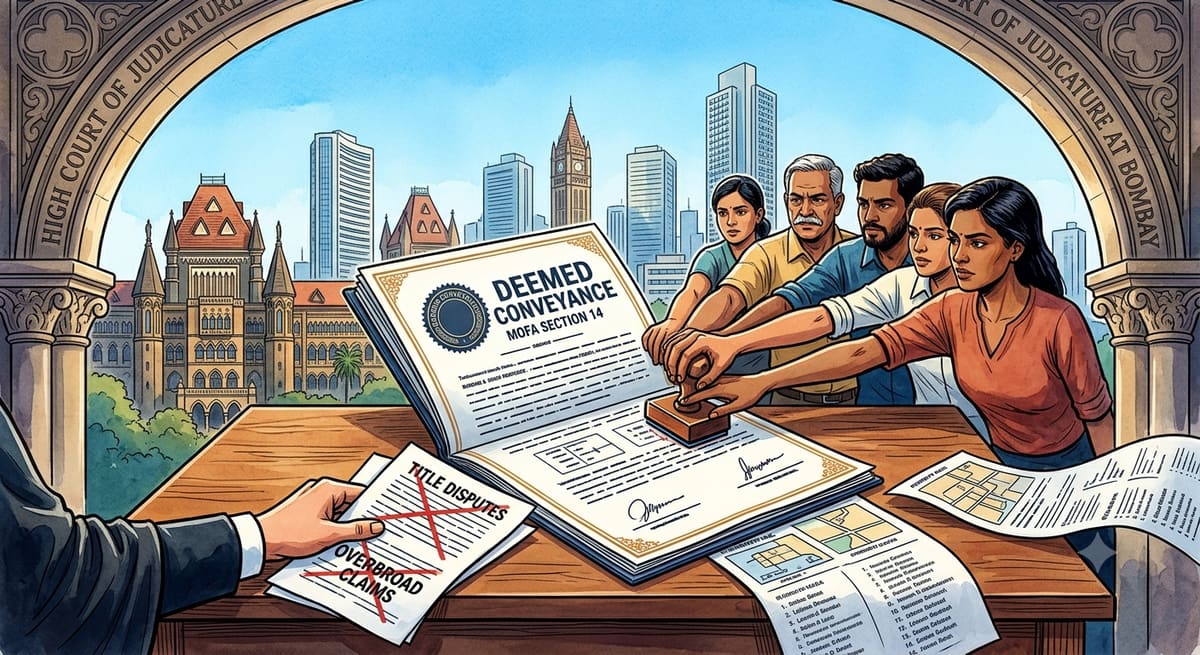
The Bombay High Court has affirmed that the statutory right of a housing society to seek deemed conveyance under Section 11 of the Maharashtra Ownership Flats Act is not extinguished merely because the developer has prepared a draft conveyance deed. The judgment clarifies that genuine disputes over property boundaries, usage, or conditions render the developer’s partial readiness insufficient to bar statutory intervention.
Background & Facts
The Dispute
The present writ petition challenges an order passed by the Competent Authority under Section 11 of the Maharashtra Ownership Flats Act (MOFA), 1963, granting unilateral deemed conveyance in favour of the housing society. The order directed the transfer of land measuring 5759.62 square metres and a building with a built-up area of 9777.31 square metres from the developer, Lunkad Builders LLP, to the society. The conveyance had not been executed voluntarily despite agreements under Section 4 of MOFA having been signed between the developer and flat purchasers.
Key Facts
- Agreements under Section 4 of MOFA were executed between Lunkad Builders LLP and flat purchasers.
- The developer prepared a draft conveyance deed excluding a green belt area of 768.08 square metres, claiming it was planned and sanctioned by the society’s representatives.
- The society rejected the draft conveyance, expressing dissatisfaction with the exclusion and other terms.
- The developer filed objections before the Competent Authority, disputing not only the green belt area but also the basement and ground floor showroom.
- The green belt area was not part of the saleable area under the original agreements and was designated for common use.
- The property card had not been divided or legally surveyed to demarcate the green belt area.
- The society filed an application under Section 11 of MOFA after the statutory four-month period for conveyance expired.
Procedural History
- Date of flat purchaser agreements: Not specified, but occurred prior to society registration.
- Date of society registration: Not specified, but statutory four-month period for conveyance commenced thereafter.
- Date of draft conveyance preparation: Not specified, but prior to Section 11 application.
- Date of society’s rejection of draft conveyance: Not specified, but occurred before Section 11 application.
- Date of Section 11 application: Not specified, but filed after expiry of four-month statutory period.
- Date of Competent Authority’s order: Not specified, but issued prior to petition.
- Date of writ petition filing: 2025 (exact date not provided).
- Date of judgment: 16 March 2026.
The Parties' Positions
Petitioner (Lunkad Builders LLP): Argued that it was always ready and willing to execute the conveyance deed, having prepared a draft. The exclusion of the green belt area was justified and accepted by the society’s own representatives. The society’s recourse to Section 11 was therefore premature and legally unsustainable.
Respondent (State of Maharashtra and Competent Authority): Contended that the developer raised multiple objections to the conveyance, including disputes over the green belt, basement, and showroom. These disputes demonstrated lack of unconditional readiness, justifying statutory intervention.
Respondent No. 3 (Housing Society): Supported the Competent Authority’s order, asserting that the developer’s draft was incomplete and contested, and that Section 11 was the only available remedy.
Relief Sought
The petitioner sought quashing of the Competent Authority’s order dated prior to 2025, and a declaration that deemed conveyance under Section 11 was not maintainable where the developer had demonstrated readiness to execute a conveyance deed.
The Legal Issue
The central question was whether a housing society’s right to seek deemed conveyance under Section 11 of the Maharashtra Ownership Flats Act is barred if the developer has prepared a draft conveyance deed, even if the society rejects it due to unresolved disputes over property boundaries or usage.
Arguments Presented
For the Petitioner
The petitioner contended that the developer’s preparation of a draft conveyance deed, even with exclusions, demonstrated readiness and willingness to comply with statutory obligations. Relying on principles of equity and good faith, the petitioner argued that the society’s failure to accept the draft and proceed with registration rendered its Section 11 application non-maintainable. The petitioner further argued that the Competent Authority should not have intervened where a voluntary solution was available.
For the Respondent
The State and the society countered that the developer’s draft was not an unconditional offer but a contested proposal with multiple exclusions. The developer raised objections to the basement, showroom, and green belt area, indicating a lack of genuine willingness to complete conveyance. The society’s rejection of the draft was justified, and Section 11 was designed precisely for such scenarios where voluntary conveyance fails due to disputes.
The Court's Analysis
The Court examined the statutory framework under Section 11 of the Maharashtra Ownership Flats Act, which empowers the Competent Authority to grant deemed conveyance when the promoter fails to execute the conveyance within four months of society registration. The Court held that the mere preparation of a draft deed does not equate to compliance with the statutory obligation.
"The mere fact that the developer claims readiness does not automatically take away that right if the parties are unable to reach a final and effective conveyance."
The Court noted that the developer’s reply before the Competent Authority contained multiple objections - not merely to the green belt area, but also to the basement and showroom - indicating a pattern of dispute rather than cooperation. The developer’s conduct demonstrated conditional willingness, not unconditional compliance.
The Court further emphasized that the Competent Authority had not ignored the green belt objection. Instead, it had expressly excluded the 768.08 square metre area from the conveyance order, thereby addressing the petitioner’s primary concern. The authority’s action was thus both lawful and proportionate.
The Court concluded that Section 11 exists to protect societies from promoter intransigence. Where disputes persist, even if a draft exists, the statutory remedy remains available. The developer’s partial readiness could not override the society’s statutory right to seek a legally enforceable conveyance.
The Verdict
The petition was dismissed. The Bombay High Court upheld the Competent Authority’s order granting deemed conveyance under Section 11 of the MOFA Act. The green belt area of 768.08 square metres was lawfully excluded from the conveyance. No monetary relief or costs were awarded, as the petition was dismissed outright. The order of the Competent Authority stands affirmed.
What This Means For Similar Cases
Deemed Conveyance Is Not Barred by Draft Deeds
- Practitioners must advise societies that preparing a draft conveyance by the developer does not extinguish the right to invoke Section 11 MOFA.
- A draft deed with exclusions or conditions is not equivalent to statutory compliance.
- Societies may proceed under Section 11 even if the developer claims willingness, provided disputes remain unresolved.
Competent Authority Must Address Objections Explicitly
- Authorities must record reasoned responses to objections raised by developers, particularly regarding boundary disputes or non-saleable areas.
- Exclusion of disputed areas from the conveyance order, as done here, satisfies due process and prevents arbitrary intervention.
- Courts will uphold such reasoned exclusions as lawful and proportionate.
Developer’s Multiple Objections Indicate Non-Compliance
- Raising objections to multiple components of the property (basement, showroom, green belt) signals lack of unconditional readiness.
- Practitioners should treat such objections as evidence of statutory non-compliance under MOFA, not as negotiation.
- A developer cannot delay conveyance by raising new disputes after the statutory period expires.