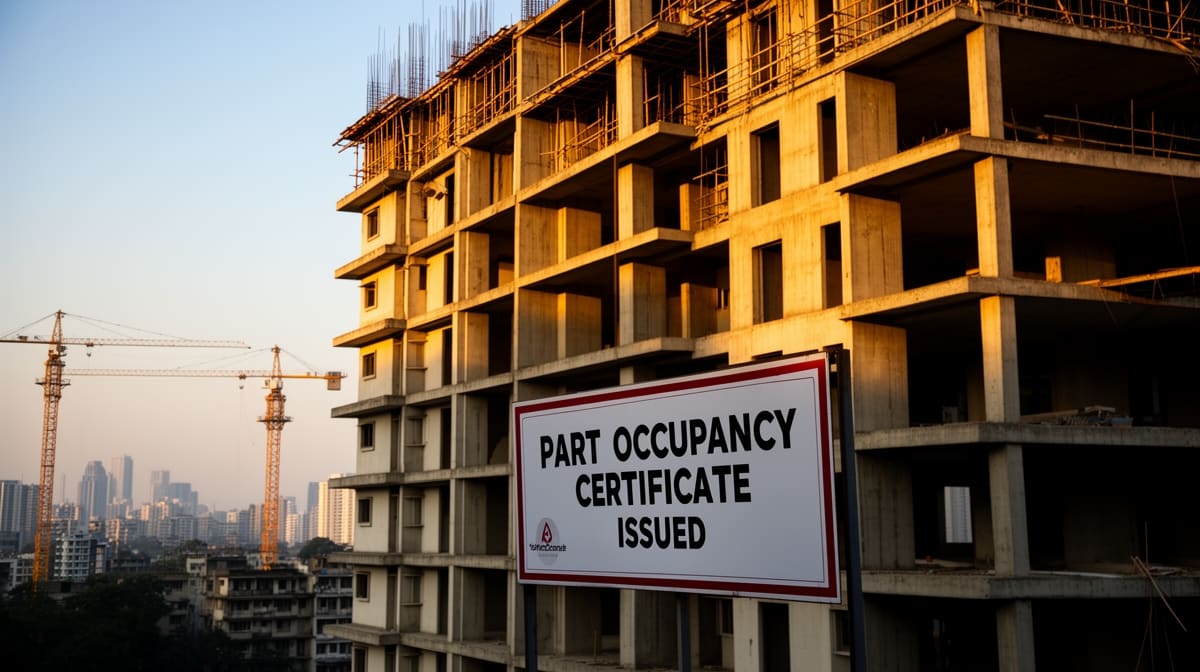
The Bombay High Court has clarified that the statutory mechanism for deemed conveyance under the Maharashtra Ownership Flats Act, 1963, operates independently of unresolved contractual disputes regarding incomplete construction. This ruling reinforces the summary nature of MOFA’s remedial framework, ensuring that flat purchasers are not indefinitely deprived of title due to developer defaults.
Background & Facts
The Dispute
The petitioners, landowners of C.T.S. No. F/674 in Bandra, Mumbai, entered into multiple Development Agreements with respondents acting as developers. These agreements provided for a 17-storey building, with the 16th and 17th floors reserved for the petitioners’ entitlement. A sanctioned plan was approved in January 2016, and a Part Occupancy Certificate (POC) was issued in December 2018 for the ground plus 15th floors. The petitioners allege that the developers intentionally withheld construction of the upper floors to avoid fulfilling their contractual obligations.
Procedural History
- 2013 - 2019: Multiple Development Agreements executed between petitioners and developers
- 11 December 2018: Part Occupancy Certificate issued for ground plus 15 floors
- 24 February 2022: Resident Society (Respondent No.2) registered under MOFA
- 7 December 2023: Society filed Application No.2 of 2024 seeking deemed conveyance under Section 11 of MOFA
- 30 July 2024: District Deputy Registrar granted unilateral deemed conveyance certificate
- 2025: Petitioners filed Writ Petition No.107 of 2025 challenging the order
Relief Sought
The petitioners sought quashing of the deemed conveyance order, arguing that statutory conditions under Section 11 of MOFA were not satisfied due to incomplete construction, non-compliance with the Government Resolution of 2018, and manipulation of society resolutions. They contended that conveyance should be deferred until the entire sanctioned project, including the 16th and 17th floors, was completed.
The Legal Issue
The central question was whether Section 11 of the Maharashtra Ownership Flats Act, 1963 permits the Competent Authority to grant a certificate of deemed conveyance when the sanctioned building project remains incomplete, and whether contractual disputes over future construction and FSI entitlement can legally bar the statutory remedy.
Arguments Presented
For the Petitioner
The petitioners argued that Section 11 of MOFA requires completion of the entire sanctioned project before conveyance can be granted. They relied on Clause (8) of the Government Resolution dated 22 June 2018, which mandates an Occupation Certificate prior to deemed conveyance. They further contended that the society’s resolution authorizing the application was fabricated, and that the developers filed the application to evade completion of the 16th and 17th floors. They emphasized that the petitioners retained rights to future FSI under the Development Agreements, and that granting conveyance prematurely would extinguish those rights.
For the Respondent
Respondent No.2, the registered society, argued that Rule 9 of the MOFA Rules prescribes a fixed four-month window from the date of society registration to seek conveyance, and that this timeline cannot be made contingent on uncertain future events. They relied on the Part Occupancy Certificate as sufficient compliance with statutory requirements. They further submitted that disputes regarding development agreements, balance FSI, and future construction fall exclusively within the domain of civil courts, and that MOFA’s summary procedure must not be subverted by contractual litigation.
The Court's Analysis
The Court examined the statutory architecture of MOFA and its Rules, emphasizing that Section 11 provides a summary, non-adversarial remedy to empower flat purchasers through their societies. The Court held that the Competent Authority’s role is not to adjudicate complex contractual disputes between developers and landowners, but to verify compliance with the procedural and documentary requirements under the Act.
"The Competent Authority is not a substitute civil court for resolving complex contractual and title disputes."
The Court distinguished between statutory compliance and contractual performance. While the petitioners raised valid concerns about the developers’ alleged failure to complete construction, these issues pertained to breach of Development Agreements under Section 4 of MOFA, which are enforceable only in civil proceedings. The existence of a pending civil suit (No.2258 of 2024) confirmed that the petitioners had already chosen the appropriate forum for such claims.
The Court further held that the Part Occupancy Certificate, though partial, constituted sufficient evidence of structural compliance for the constructed portion. The Government Resolution of 2018, while administratively instructive, did not override the statutory mandate of Section 11. The Competent Authority acted within jurisdiction by relying on documents submitted under Rule 9, including the society’s registration certificate and the POC.
The Court rejected the petitioners’ argument that conveyance must await completion of the entire project, noting that such a requirement would convert MOFA’s summary remedy into a prolonged adjudicatory process, defeating its legislative purpose. The Court affirmed that the right to future construction and FSI usage remains intact and can be pursued through civil litigation.
The Verdict
The petitioners’ challenge was dismissed. The Court held that Section 11 of MOFA permits deemed conveyance even when the sanctioned project remains incomplete, provided the society complies with statutory conditions under the Rules. The Competent Authority acted lawfully, and the petitioners’ remedies lie in civil proceedings, not writ jurisdiction.
What This Means For Similar Cases
Deemed Conveyance Is Not Conditional on Full Completion
- Practitioners must advise societies to file for deemed conveyance within four months of registration, regardless of pending construction
- Developers cannot delay conveyance by withholding completion of non-essential portions
- Partial Occupancy Certificates are sufficient for statutory purposes under Section 11
Civil Remedies Remain the Proper Forum for Contractual Disputes
- Disputes over development agreements, FSI entitlements, or future construction must be pursued in civil courts
- Writ petitions cannot be used to re-litigate contractual breaches under MOFA
- Petitioners must not conflate statutory rights under MOFA with contractual claims under the Transfer of Property Act or Contract Act
Competent Authority’s Role Is Procedural, Not Substantive
- The Competent Authority need not investigate motives, allegations of fraud, or fabrication of resolutions
- Such issues require evidentiary hearings, witness cross-examination, and findings only possible in civil trials
- Courts will not interfere with deemed conveyance orders absent manifest illegality or jurisdictional error