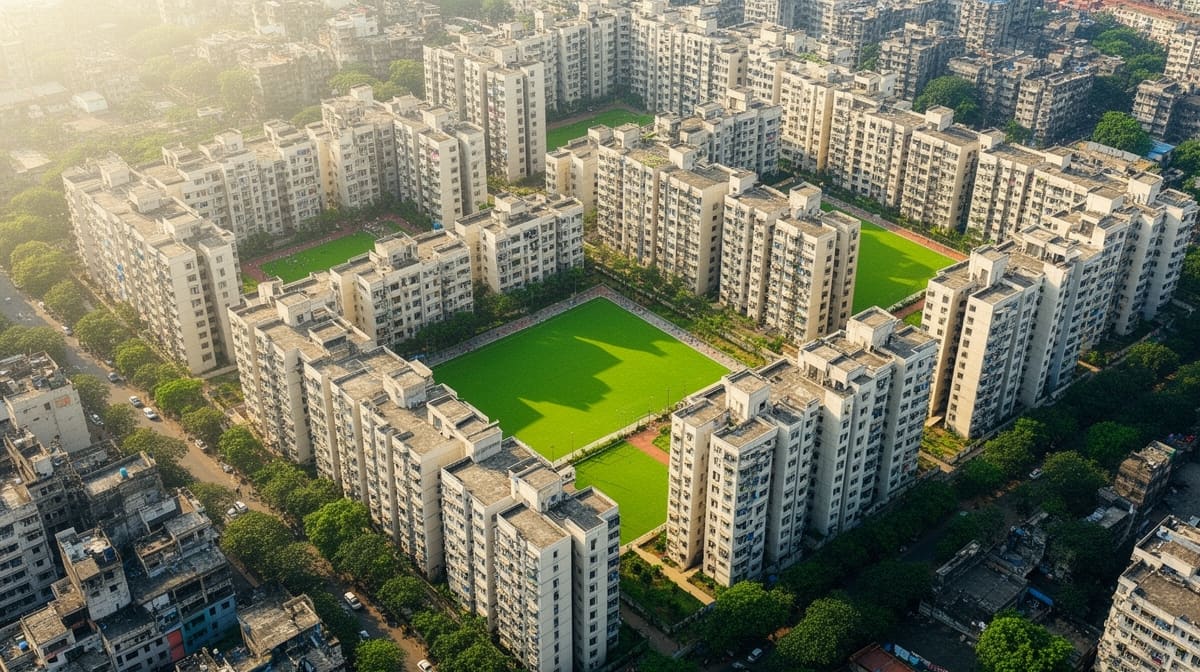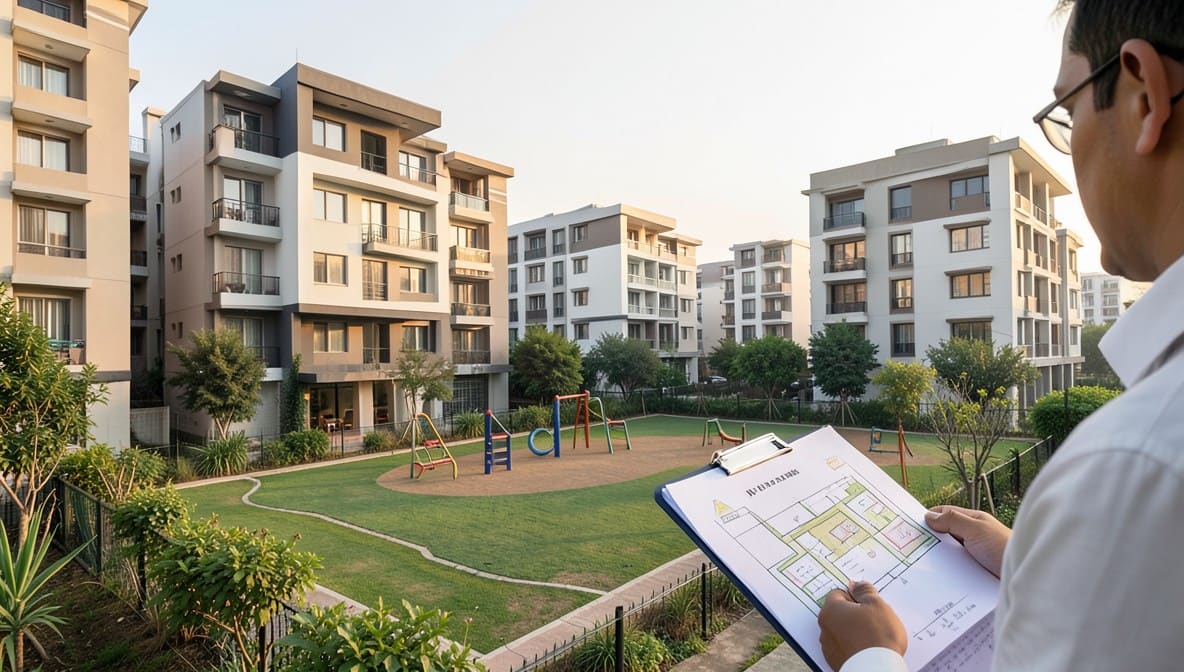
The Bombay High Court has laid down a definitive framework for determining land entitlement in deemed conveyance applications under the Maharashtra Ownership Flats Act, 1963, particularly in layouts developed using Transfer of Development Rights. The judgment resolves long-standing ambiguity by distinguishing between plinth area, appurtenant open spaces, and common recreational areas, ensuring that cooperative housing societies receive not merely the building footprint but also the legally mandated ancillary land necessary for its functional enjoyment.
Background & Facts
The Dispute
The petitioner, Rashesh Cooperative Housing Society Limited, is a residential cooperative society registered under the Maharashtra Cooperative Societies Act, 1963, formed on 1 December 2015. The society’s building was constructed by Shreeji Developers, a partnership firm represented by respondents Nos. 3 to 7. The land, located in Village Bhayandar, Thane, comprised 23 parcels originally owned by late Manharlal B. Mehta and Varsha M. Mehta. The development plan for the larger tract was sanctioned by the Mira Bhayander Municipal Corporation on 23 March 2006. Development rights and Floor Space Index (FSI) were granted to Shreeji Developers on 5 August 2006. Revised commencement certificates were issued on 23 March 2006 and 26 June 2007. The building received an occupation certificate on 2 December 2013.
Despite formation of the society, Shreeji Developers failed to execute conveyance of the land in favour of the society. On 22 June 2018, the Government of Maharashtra issued a Government Resolution (GR) providing guidelines for deemed conveyance in multi-building layouts, particularly those involving TDR. The petitioner sought conveyance under this GR.
Key Facts
- Total land area: 23464.93 square metres, comprising multiple survey numbers (661, 776, 677)
- Total built-up area of all structures in layout: 34459.18 square metres
- Built-up area of petitioner’s building (Rashesh CHSL): 6888.60 square metres
- Sanctioned plan for building: MB/MNP/NR/7498/2018-19 dated 29 March 2019
- Petitioner’s architect submitted two certificates: one dated 4 January 2022 and another dated 26 June 2025
- Respondents’ architect submitted certificate dated 15 April 2025, based on sanctioned plan
- Respondent No.8 (The Estate Investment Co. Pvt. Ltd.) granted no objection to conveyance on 29 May 2023
- Survey report prepared by Mr. M.B. Rane on 4 January 2022
- Legal notice issued by petitioner on 11 May 2023
- Architect’s Certificate dated 26 June 2025 claimed total conveyable area of 3987.16 sq.m. (plinth) + 703.62 sq.m. (RG share)
Procedural History
- 1 December 2015: Rashesh Cooperative Housing Society Limited registered
- 22 June 2018: Government Resolution on deemed conveyance issued
- 4 January 2022: Survey report prepared by Mr. M.B. Rane
- 11 May 2023: Legal notice issued to respondents
- 9 June 2023: Architect’s Certificate on proportionate area submitted
- 19 June 2023: Application No.379 of 2023 filed before District Deputy Registrar, Thane (Respondent No.2)
- 6 July 2023: Notice in Form X issued by Respondent No.2
- 11 July 2023: Public notice published
- 31 July 2023: Reply affidavit filed by Respondent No.4
- 4 September 2023: Joint reply affidavit filed by Respondents 3, 4, and 7
- 21 August 2023 & 11 September 2023: Petitioner filed rejoinder affidavits
- 25 September 2023: Written submissions filed by petitioner
- 11 October 2023: Respondent No.2 granted conveyance only for plinth area
- 11 February 2025: Bombay High Court set aside 11 October 2023 order and remanded matter for fresh adjudication
- 15 April 2025: Fresh Architect’s Certificate submitted by petitioner
- 28 April 2025: Petitioner filed amendment application
- 22 May 2025: Respondents filed reply to amendment
- 12 June 2025: Petitioner filed rejoinder
- 24 June 2025: Respondent No.2 orally declined to hear amendment and directed fresh certificate
- 26 June 2025: Petitioner obtained new Architect’s Certificate
- 1 July 2025: Written submissions and fresh certificate submitted to Respondent No.2
- 8 July 2025: Respondent No.2 rejected application, granting conveyance only for plinth area (1151.56 sq.m.) and appurtenant area (1050.00 sq.m.) as per respondents’ certificate
- 28 March 2026: Writ Petition No.10961 of 2025 filed before Bombay High Court
Relief Sought
The petitioner sought:
- Deemed conveyance of plinth area of 3987.16 square metres
- Appurtenant area of 1050.00 square metres (as per respondents’ certificate) or alternatively, 2570.00 sq.m. based on proportionate share
- Undivided proportionate share in Recreational Ground of 703.62 square metres
- Conveyance of total exclusive area of 4690.78 square metres (plinth + appurtenant + RG)
- Clarification that RG share is a beneficial undivided right, not exclusive possession
The Legal Issue
The central questions were: (1) What constitutes ‘appurtenant area’ under the Maharashtra Ownership Flats Act, 1963 and the Government Resolution dated 22 June 2018 in a TDR-based layout? (2) Should the petitioner’s land entitlement be computed by plinth area alone or by proportionate share of total built-up area? (3) Is the society entitled to a proportionate undivided share in the layout’s Recreational Ground, and if so, how is it to be recorded?
Arguments Presented
For the Petitioner
The petitioner argued that the term ‘appurtenant area’ must be interpreted broadly to include all land necessary for the beneficial enjoyment of the building, including setbacks, access roads, parking, and utility strips, as mandated by the Development Control Regulations and the 2018 GR. It contended that the 3987.16 sq.m. figure derived from proportionate share of net plot area (based on built-up ratio) should be treated as plinth area, as the society’s participation in the layout was 19.99%. It further claimed entitlement to 703.62 sq.m. as undivided share in the Recreational Ground, citing Guideline (iv)(2) of the 2018 GR, which permits conveyance of both plinth and appurtenant area. It emphasized that the earlier remand order required the Competent Authority to consider the 2018 GR holistically, not merely accept the respondents’ certificate.
For the Respondent
Respondents contended that ‘appurtenant area’ is a legally settled concept meaning only those open spaces immediately surrounding the building that are functionally necessary for its use, as prescribed by building regulations. They relied on judicial precedents including Maharaj Singh v. State of Uttar Pradesh and Larsen & Toubro Limited v. Trustees of Dharmamurthy Rao Bahadur Calavala Cunnan Chetty’s Charities to argue that appurtenant area must be physically contiguous, subordinate to the building, and tied to mandatory setbacks under the Unified Development Control and Promotion Regulations (UDCPR). They submitted that the 1050.00 sq.m. figure, derived from the sanctioned plan dated 29 March 2019, was the only reliable measure. They further argued that Recreational Ground is a common amenity, not appurtenant, and that the petitioner’s claim to exclusive possession of 703.62 sq.m. was legally untenable.
The Court's Analysis
The Court undertook a comprehensive analysis of the Maharashtra Ownership Flats Act, 1963 (MOFA), the Government Resolution dated 22 June 2018, the Unified Development Control and Promotion Regulations (UDCPR), and relevant judicial precedents. It emphasized that MOFA is a welfare statute designed to protect flat purchasers from promoters who retain ownership of land and common areas after sale.
"Ownership of a building in law includes beneficial rights necessary for its use, such as ingress, egress, open setbacks required by regulation, utility connections, access for repairs, safety movement, ventilation zones and such portions of land. A building stands upon land and draws its use from surrounding spaces as required by planning law. Hence, conveyance under Section 11 must include such land as is appurtenant."
The Court rejected the petitioner’s argument that the 3987.16 sq.m. figure represented plinth area. It clarified that plinth area refers to the ground-level footprint of the building, not a proportionate share of the total plot. The petitioner’s figure was derived from a ratio of total built-up area (6888.60/34459.18 × 19945.19), which reflected land entitlement, not physical construction footprint.
"If these two concepts are mixed, confusion follows. Hence, the figure of 3987.16 square metres cannot be accepted as plinth area. By contrast, the Respondent’s certificate uses clear language. It specifically states that ‘Plinth Area of the said Building No.1 known as Rashesh is 1151.56 sq.mts.’ This wording leaves little room for doubt."
The Court accepted the respondents’ architect’s certification of plinth area (1151.56 sq.m.) and appurtenant area (1050.00 sq.m.) as reliable because it was based on the sanctioned municipal plan. It held that appurtenant area includes marginal open spaces - front, side, and rear setbacks - required by planning law for light, air, fire safety, and access, even if they exceed minimum statutory norms.
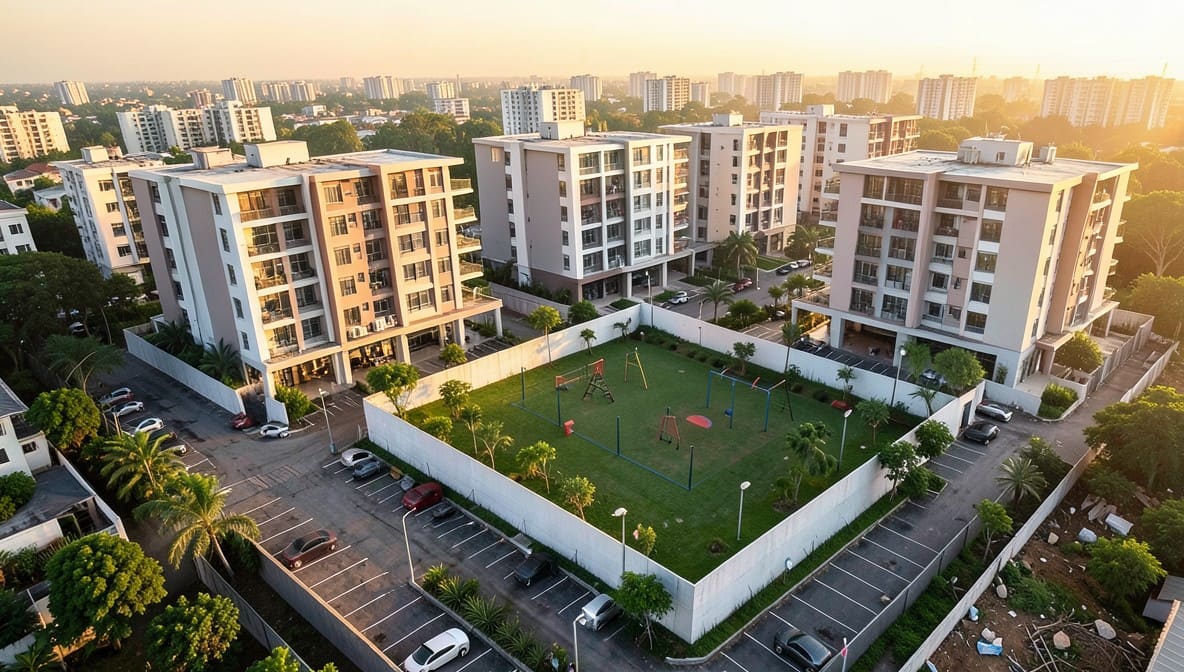
Regarding the Recreational Ground (RG), the Court held that while the petitioner is not entitled to exclusive possession of any portion of the RG, it is entitled to an undivided proportionate share. The 703.62 sq.m. figure, derived from the same 19.99% ratio, was accepted as the society’s equitable share in the common amenity, consistent with Clause 3.4.7(iv) of the UDCPR and Clause 27(1)(g)(ii)(a) of the DCPR, 2034.
The Court distinguished appurtenant area from common area: appurtenant land is building-specific and functionally necessary, while common areas serve the entire layout and are collectively owned. It emphasized that the 2018 GR’s requirement to separately identify plinth and appurtenant area was not met in the petitioner’s earlier certificate, necessitating the remand.
The Verdict
The writ petition was partly allowed. The order dated 8 July 2025 of Respondent No.2 was quashed. The petitioner society is entitled to deemed conveyance of:
- Exact Plinth Area: 1151.56 square metres
- Exact Appurtenant Area: 1050.00 square metres
- Total Exclusive Conveyable Area: 2201.56 square metres
- Undivided proportionate right in common Recreational Ground: 703.62 square metres
Respondent No.2 shall issue a fresh deemed conveyance certificate incorporating these figures within eight weeks. Respondents Nos. 3 to 7 shall furnish all title documents and sanctioned plans within two weeks. In case of non-cooperation, Respondent No.2 shall proceed ex parte. No order as to costs.
What This Means For Similar Cases
Appurtenant Area Is Not Merely Statutory Setbacks
- Practitioners must now argue that appurtenant area includes all open spaces functionally necessary for building use, even if they exceed minimum margin requirements under DCPR
- Sanctioned plans showing parking, access roads, or utility strips as designated for a specific building can be claimed as appurtenant, even if not labeled as such
- Proportionate share formulas cannot substitute physical measurement of appurtenant land
Proportionate Share Applies Only to Common Areas, Not Plinth
- The formula of total built-up area to net plot area is valid only for allocating common amenities like RG, clubhouses, or roads
- Plinth area must always be measured as the actual ground footprint of the building, per sanctioned plans
- Petitioners must submit separate, architect-certified breakdowns of plinth and appurtenant areas to comply with the 2018 GR
Recreational Ground Entitlement Is a Beneficial Right, Not Exclusive Possession
- Societies are entitled to undivided proportionate share in RG, not demarcated plots
- This share must be recorded in the conveyance deed as a beneficial interest, subject to rights of other societies
- Any attempt to claim exclusive control over RG portions will be rejected
- Practitioners should draft conveyance deeds to explicitly state: "undivided proportionate beneficial right in Recreational Ground of [X] sq.m."