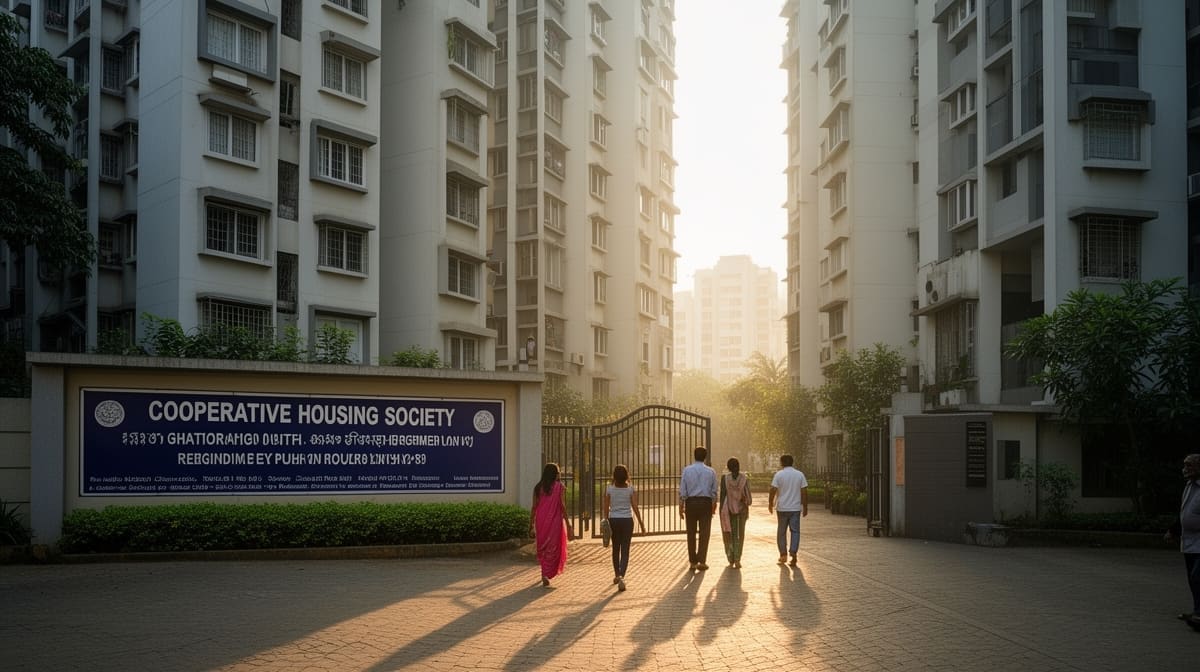
The Bombay High Court recently addressed a critical dispute involving land entitlement between two cooperative housing societies under the Maharashtra Ownership Flats (Regulation of the Promotion of Construction, Sale, Management and Transfer) Act, 1963 (MOFA). The judgment underscores that land conveyance must be proportionate to the built-up area utilized by each society, refusing to allow one society to exploit an administrative error to claim excess land at the expense of another.
Background & Facts
The Dispute
The Petitioner, Kuber Kartik New Link Road Premises Co-op Society Limited, challenged an order dated 15 May 2025 passed by the District Deputy Registrar, Co-operative Society, Mumbai, which granted unilateral deemed conveyance of 6974.83 sq. mtrs of land in its favor, along with an FSI advantage of 24.57 sq. mtrs. The Petitioner contended that out of the total layout land of 11,656.92 sq. mtrs, after excluding 1508 sq. mtrs already conveyed to Respondent No. 3-Society via an earlier order dated 29 November 2021, the entire balance land (10,148.92 sq. mtrs) should have been conveyed to it.
Key Facts
- The layout development pertained to land bearing CTS Nos. 628, 629, 630, 631, 632, and 633, totaling 11,706 sq. mtrs.
- The developer, Respondent No. 2, initially proposed construction for Krishna Society (Respondent No. 3) and the Petitioner’s buildings (Kuber Complex and Kartik Complex).
- Section 4 Agreements under MOFA reflected distinct land parcels for each society:
- Krishna Society (Respondent No. 3): 1525.43 sq. mtrs (CTS No. 633).
- Kuber Complex: 1887 sq. mtrs (CTS 628), 1893.4 sq. mtrs (CTS 629), and 1992.4 sq. mtrs (CTS 630).
- Kartik Complex: 2131.15 sq. mtrs (CTS 631) and 2344.43 sq. mtrs (CTS 632).
- Respondent No. 3 filed Application No. 18 of 2021 for unilateral deemed conveyance, which was granted on 29 November 2021 for 1508 sq. mtrs (CTS No. 633).
- The Petitioner filed Application No. 212 of 2024 seeking conveyance of the balance land, which was granted on 15 May 2025 for 6392.42 sq. mtrs plus 582.41 sq. mtrs in the Recreation Ground (RG) area, aggregating 6974.83 sq. mtrs.
Procedural History
- 29 November 2021: Competent Authority grants unilateral deemed conveyance to Respondent No. 3 for 1508 sq. mtrs.
- 15 May 2025: Competent Authority issues a Corrigendum in Application No. 18 of 2021, increasing Respondent No. 3’s entitlement to 4098.81 sq. mtrs plus 583.28 sq. mtrs (RG area), totaling 4682.09 sq. mtrs.
- 15 May 2025: Competent Authority grants Application No. 212 of 2024 in favor of the Petitioner for 6392.42 sq. mtrs plus 582.41 sq. mtrs (RG area), totaling 6974.83 sq. mtrs.
- 7 March 2026: Bombay High Court sets aside the Corrigendum dated 15 May 2025 in Writ Petition No. 13181 of 2025.
- 30 March 2026: Respondent No. 2 (Developer) executes a Deed of Conveyance in favor of Respondent No. 3, conveying 2590.81 sq. mtrs plus 583.28 sq. mtrs (RG area), aggregating 3174.09 sq. mtrs.
- 22 June 2026: Present Writ Petition No. 7620 of 2026 filed by the Petitioner challenging the order dated 15 May 2025.
Relief Sought
The Petitioner sought quashing of the order dated 15 May 2025, arguing that the entire balance land (10,148.92 sq. mtrs) should be conveyed to it after excluding the 1508 sq. mtrs already granted to Respondent No. 3.
The Legal Issue
The central question was whether an administrative error in granting unilateral deemed conveyance for a lesser area to one society could entitle another society to claim the entire balance land, disregarding the proportionate entitlement based on built-up area under MOFA and the Government Resolution dated 22 June 2018.
Arguments Presented
For the Petitioner
- Contended that the Corrigendum dated 15 May 2025 was set aside by the High Court, crystallizing Respondent No. 3’s entitlement to only 1508 sq. mtrs.
- Argued that the Deed of Conveyance dated 30 March 2026 executed by Respondent Nos. 2 and 3 was an act of judicial overreach, circumventing the Court’s earlier order.
- Insisted that the entire balance land (10,148.92 sq. mtrs) should be conveyed to the Petitioner.
For the Respondents
- Respondent No. 1 (State): Represented by the learned AGP, supported the Competent Authority’s order.
- Respondent No. 2 (Developer): Argued that the Deed of Conveyance dated 30 March 2026 was a legitimate transaction.
- Respondent No. 3 (Society): Contended that its combined entitlement (1508 sq. mtrs + 3174.09 sq. mtrs) was valid and proportionate to its built-up area (9772.35 sq. mtrs).
The Court's Analysis
The Court examined the Government Resolution dated 22 June 2018, which mandates that land entitlement in a layout must be divided proportionate to the built-up area utilized by each society. The Court calculated the net plot area available for subdivision as follows:
- Total layout land: 11,706 sq. mtrs.
- Less road setback: 49.18 sq. mtrs → 11,656.92 sq. mtrs.
- Less Recreation Ground (RG) area: 1165.69 sq. mtrs → 10,491.23 sq. mtrs (net plot area).
The built-up areas of the societies were:
- Petitioner-Society (Kuber + Kartik Complex): 9757.88 sq. mtrs.
- Respondent No. 3-Society: 9772.35 sq. mtrs.
Based on the proportionate division, the Petitioner’s entitlement was calculated as 6392.42 sq. mtrs plus 582.41 sq. mtrs (RG area), totaling 6974.83 sq. mtrs, which aligned with the impugned order dated 15 May 2025. The Court observed:
"The impugned order ensures that both the societies receive only proportionate portions of land. This Court is convinced with the ultimate outcome of the order dated 15 May 2025 passed by the Competent Authority in Petitioner's Application No. 212 of 2024."
The Court criticized Respondent Nos. 2 and 3 for executing the Deed of Conveyance dated 30 March 2026, calling it an attempt to circumvent the Court’s earlier order dated 7 March 2026. However, it refused to set aside the impugned order, as doing so would render Respondent No. 3’s building (with a built-up area of 9772.35 sq. mtrs) unsustainable on just 1508 sq. mtrs of land, potentially leading to its demolition.
The Court relied on the Supreme Court’s judgment in Garment Craft v. Prakash Chand Goel ((2022) 4 SCC 181), emphasizing that Article 227 is a supervisory and corrective jurisdiction, not an appellate one. It held:
"The High Court exercising supervisory jurisdiction does not act as a court of first appeal to reappreciate, reweigh the evidence or facts upon which the determination under challenge is based. Supervisory jurisdiction is not to correct every error of fact or even a legal flaw when the final finding is justified or can be supported."
The Verdict
The Court dismissed the writ petition, upholding the order dated 15 May 2025 passed by the Competent Authority. It held that:
- The Petitioner’s entitlement was correctly determined as 6974.83 sq. mtrs (including RG area), proportionate to its built-up area.
- The Deed of Conveyance dated 30 March 2026, though irregular, did not warrant interference under Article 227, as the impugned order already ensured proportionate land division.
- The Petitioner’s attempt to grab excess land by exploiting Respondent No. 3’s administrative error was rejected.
- The Court kept all rights open for the Petitioner to challenge the land conveyance via a civil suit, uninfluenced by its observations.
What This Means For Similar Cases
Proportionate Entitlement Under MOFA
- Built-up area determines land share: The judgment reinforces that under MOFA and the Government Resolution dated 22 June 2018, land entitlement in a layout must be proportionate to the built-up area utilized by each society. Developers and societies must ensure accurate reflection of land parcels in Section 4 Agreements to avoid disputes.
- No advantage from administrative errors: A society cannot claim excess land by exploiting another society’s mistake in securing deemed conveyance for a lesser area. The Court will prioritize proportionate justice over technical errors.
Limits of Article 227 Jurisdiction
- Supervisory, not appellate: The Court clarified that Article 227 is not a tool to reappreciate evidence or correct every legal flaw. It will intervene only in cases of grave dereliction of duty, flagrant abuse of law, or perverse findings.
- Undesirable consequences: Courts will refuse to exercise Article 227 if the outcome would lead to impractical or unjust results, such as the demolition of a building due to insufficient land.
Remedies Beyond Writ Petitions
- Civil suits for title disputes: The judgment highlights that certificates of deemed conveyance are not final adjudications of rights. Aggrieved parties can institute civil suits to challenge land conveyance, providing an alternative remedy where Article 227 is unavailable.