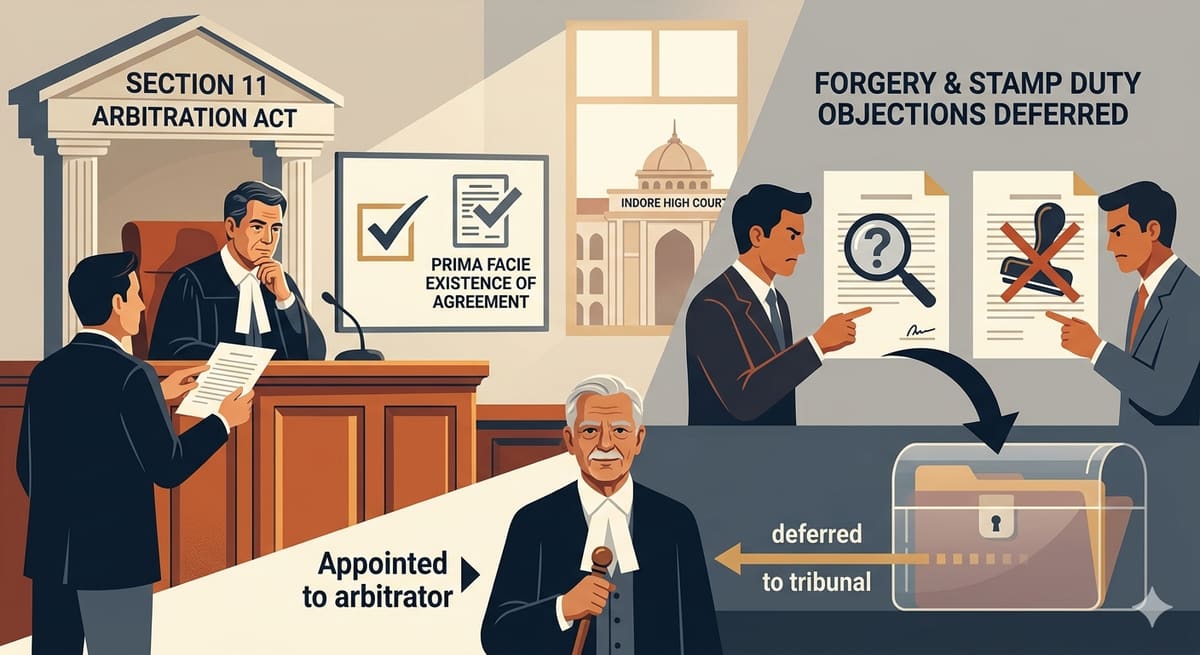
The Madhya Pradesh High Court has reaffirmed the limited judicial role at the stage of arbitrator appointment under Section 11 of the Arbitration and Conciliation Act, 1996. In a decisive ruling, the Court held that objections concerning the authenticity of signatures, authority of a partner to bind a firm, or stamp duty compliance cannot derail the appointment process - these are matters for the arbitral tribunal to determine.
Background & Facts
The Dispute
The applicant, Suomi Irrigation Private Ltd., a company incorporated under the Companies Act, 2013, entered into a loan agreement with the respondent, Raghav Agency, a partnership firm, on 08.12.2017. The agreement provided for a loan facility of Rs. 6,50,00,000 at 12% compound interest per annum, with an arbitration clause stipulating that disputes be resolved by a sole arbitrator nominated by the applicant company.
Key Facts
The applicant disbursed Rs. 3,75,76,000 to the respondent between 18.12.2017 and 22.02.2019.
The respondent repaid Rs. 76,99,800 in multiple delayed installments.
As of 21.02.2025, the outstanding amount was Rs. 8,13,69,696.
On 21.02.2025, the applicant issued a legal notice demanding repayment and warning of arbitration invocation.
On 12.03.2025, the applicant formally invoked the arbitration clause and proposed a sole arbitrator.
The respondent neither accepted nor rejected the proposal.
The applicant filed the present application under Section 11(6) of the Arbitration and Conciliation Act, 1996, for appointment of an arbitrator.
The respondent denied execution of the agreement, alleging forged signatures of partner Vijay Mahore.
The respondent also claimed that a single partner cannot bind the firm without consent of all partners.
The respondent further contended the agreement was executed on an insufficiently stamped document.
The applicant rebutted by producing promissory notes (Annexure A-1), dishonoured cheques, and the respondent’s own tax audit report dated 22.12.2020, which recorded the loan liability and repayments.
The respondent submitted a handwriting expert report comparing photocopies of the agreement with signatures from a 2015 partnership deed modification.
Procedural History
08.12.2017: Loan agreement executed between applicant and respondent.
18.12.2017 to 22.02.2019: Disbursement of Rs. 3,75,76,000 by applicant.
21.02.2025: Legal notice demanding repayment and invoking arbitration.
12.03.2025: Formal invocation of arbitration clause.
27.01.2026: Hearing before the Madhya Pradesh High Court.
04.05.2026: Judgment pronounced.
The Parties' Positions
For the Applicant
The loan agreement was duly executed and partially performed.
Repayment of Rs. 76,99,800 and acknowledgment in tax audit report confirm the agreement’s validity.
Under Sections 18, 19, 20, 21, 22, and 23 of the Partnership Act, 1932, the act of a partner in the ordinary course of business binds the firm.
The arbitration clause is clear, unambiguous, and enforceable.
Objections on forgery, stamp duty, or partner authority are not for the Court under Section 11.
For the Respondent
The loan agreement was forged; signatures of Vijay Mahore were not authentic.
A single partner cannot bind the partnership firm without consent of all partners.
The agreement was executed on an insufficiently stamped document, rendering it unenforceable under N.N. Global Mercantile v. Indo Unique Flame.
The arbitration clause is void as it vests unilateral power of appointment in one party.
The very existence of the agreement is disputed, so arbitration cannot be invoked under Magic Eye Developer v. Green Edge Infrastructure.
Relief Sought
The applicant sought appointment of a sole arbitrator under Section 11(6) of the Arbitration and Conciliation Act, 1996, to resolve the outstanding dispute concerning repayment of Rs. 8,13,69,696 and interest.
The Legal Issue
The central question was whether, at the stage of appointment of an arbitrator under Section 11 of the Arbitration and Conciliation Act, 1996, the High Court is empowered to adjudicate allegations of forged signatures, lack of partner authority, or invalid stamping - issues that go to the validity of the underlying agreement - or whether its role is confined to determining only the prima facie existence of an arbitration agreement.
Arguments Presented
For the Appellant/Petitioner
The applicant relied on the settled principle that under Section 11(6A), as inserted by the 2015 Amendment (still in force as unnotified), the Court’s jurisdiction is limited to examining only the prima facie existence of an arbitration agreement. It cited In Re: Interplay Between Arbitration Agreements and the Indian Stamp Act (2024) 6 SCC 1, which overruled N.N. Global Mercantile, holding that stamp duty objections are for the arbitrator. It further relied on SBI General Insurance v. Krish Spinning (2024) to affirm that courts must not delve into disputes on authenticity, authority, or enforceability at this stage. The applicant emphasized that partial performance - receipt of funds, repayment, and acknowledgment in tax records - establishes a prima facie agreement.
For the Respondent/State
The respondent argued that the agreement was void ab initio due to forgery, lack of partner authority under partnership law, and insufficient stamping. It relied on N.N. Global Mercantile, Vidya Drolia v. Durga Trading Corporation, and Magic Eye Developer to contend that where the existence of the underlying contract is denied, arbitration cannot be ordered. It further argued that unilateral appointment of arbitrator violates the principle of party autonomy.
The Court's Analysis
The Court began by examining the language of Section 11(6A), which mandates that the Court “shall confine to the examination of the existence of an arbitration agreement.” Although the 2019 Amendment omitted this sub-section, it remains in force as unnotified. The Court noted that the Statement of Objects and Reasons of the 2015 Amendment explicitly intended to prevent judicial interference beyond the prima facie existence of the arbitration clause.
"The significance of the use of the expression 'not other issues' in the statement of objects and reasons of the 2015 amendment was noticed by a seven-Judge bench... these other issues not only pertain to the validity of the arbitration agreement, but also include any other issues which are a consequence of unnecessary judicial interference in the arbitration proceedings."
The Court held that the respondent’s allegations of forgery, lack of partner authority, and stamp duty deficiency are all “other issues” that must be left to the arbitral tribunal. The Court emphasized that the respondent did not deny receipt of Rs. 3,75,76,000 or repayment of Rs. 76,99,800, nor did it dispute the existence of promissory notes or the tax audit report reflecting the liability. This conduct, the Court found, contradicts the claim that no agreement was ever executed.
Regarding partner authority, the Court held that Section 19 of the Partnership Act, 1932 confers implied authority on a partner to bind the firm in the ordinary course of business. No restriction on such authority was pleaded by the respondent. The Court further noted that the expert report relied on photocopies and admitted signatures from a different document, rendering it unreliable at this stage.
The Court explicitly overruled reliance on N.N. Global Mercantile, noting it was overruled by In Re: Interplay (2024) 6 SCC 1. Similarly, Vidya Drolia and Magic Eye Developer were distinguished as cases involving non-arbitrable disputes (e.g., tenancy, matrimonial), not disputes over the validity of the underlying contract.
The Court concluded that the arbitration clause in Clause 13 is clear, unambiguous, and prima facie valid. The Court’s role under Section 11 is not to adjudicate the merits or authenticity of the contract, but to determine whether an arbitration agreement exists on its face.
The Verdict
The applicant succeeded. The Court appointed Hon’ble Shri Justice Duppala Venkata Ramana (Retd.), Judge of the Madhya Pradesh High Court, as the sole arbitrator. The Court directed the Principal Registrar to obtain a declaration in Form VI of the Sixth Schedule under Section 11(8) and Section 12(1) of the Arbitration and Conciliation Act, 1996, before the next hearing on 06.05.2026. All objections regarding forgery, partner authority, stamp duty, or unilateral appointment are reserved for determination by the arbitral tribunal.
What This Means For Similar Cases
Prima Facie Existence Is Sufficient for Arbitrator Appointment
Practitioners must now argue that any challenge to the authenticity, validity, or enforceability of the underlying contract must be raised before the arbitrator, not the Court under Section 11.
Evidence of partial performance - receipt of funds, repayment, or documentary acknowledgment - strongly supports prima facie existence.
Partner’s Authority to Bind Firm Is Presumed Unless Restricted
In partnership disputes involving arbitration clauses, the burden shifts to the respondent to plead and prove express restrictions on a partner’s authority under Section 22 of the Partnership Act.
Absent such pleading, the act of a partner in the ordinary course of business binds the firm.
Stamp Duty Objections Are No Longer a Bar at Section 11 Stage
Following In Re: Interplay (2024) 6 SCC 1, courts must not dismiss Section 11 applications on grounds of insufficient stamping.
The arbitrator is the proper forum to decide stamp duty compliance and its consequences.
Practitioners should avoid filing Section 11 applications with detailed affidavits on forgery or stamp duty - these are irrelevant at this stage and may delay proceedings.
Always ensure the arbitration clause is clearly drafted and referenced in the application.
Where the opposing party denies the contract’s existence, focus on proving conduct consistent with performance (payments, acknowledgments, tax filings).