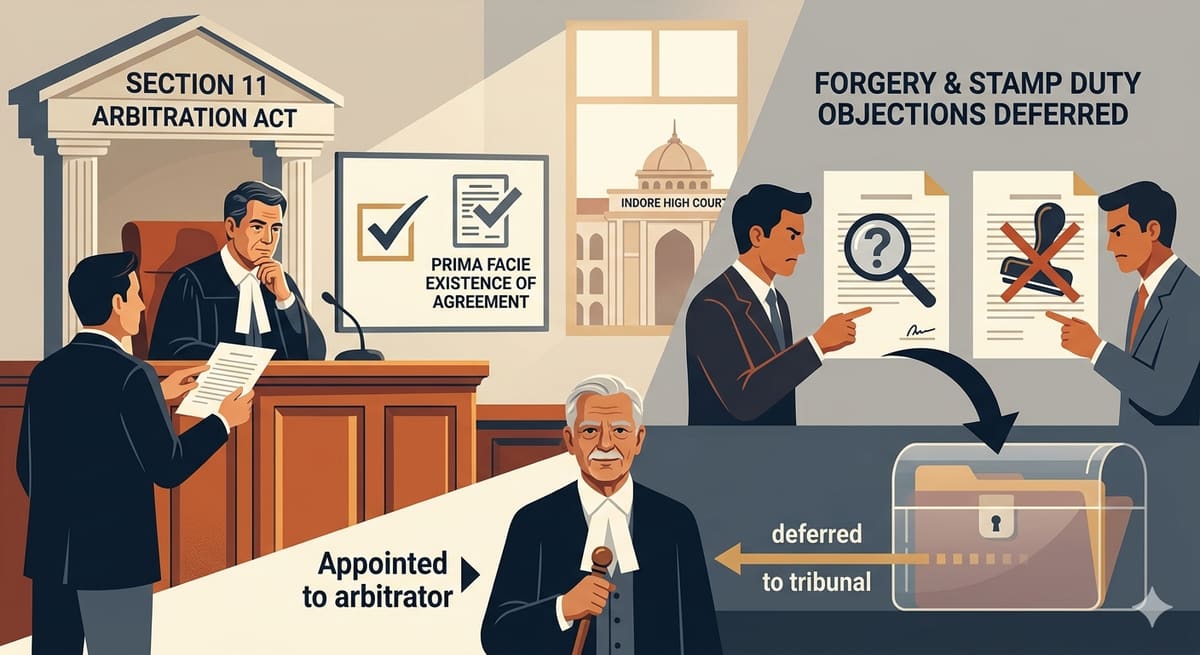
The Madhya Pradesh High Court has clarified that an arbitration clause cannot be enforced where no partnership has ever come into existence, even if a written agreement purports to create one. The judgment underscores that the existence of a valid arbitration agreement depends on the underlying contractual relationship being operative, not merely contemplated.
Background & Facts
The Dispute
The petitioner, Ratan Lalchandani, and the respondent, Gopaldas, entered into a partnership deed dated 03.07.2013 for the joint development of a marriage garden, hotel, and restaurant on land owned by the respondent in Indore. The land, measuring 1.62 hectares, was valued at Rs. 3.10 crores and contributed by the respondent as capital. The petitioner was to invest Rs. 1.55 crores towards construction and operations, with profits to be shared equally. The deed contained an arbitration clause in Paragraph 18, providing for resolution of disputes by arbitration.
Key Facts
- The partnership deed was executed on 03.07.2013
- The petitioner made no financial investment in the project
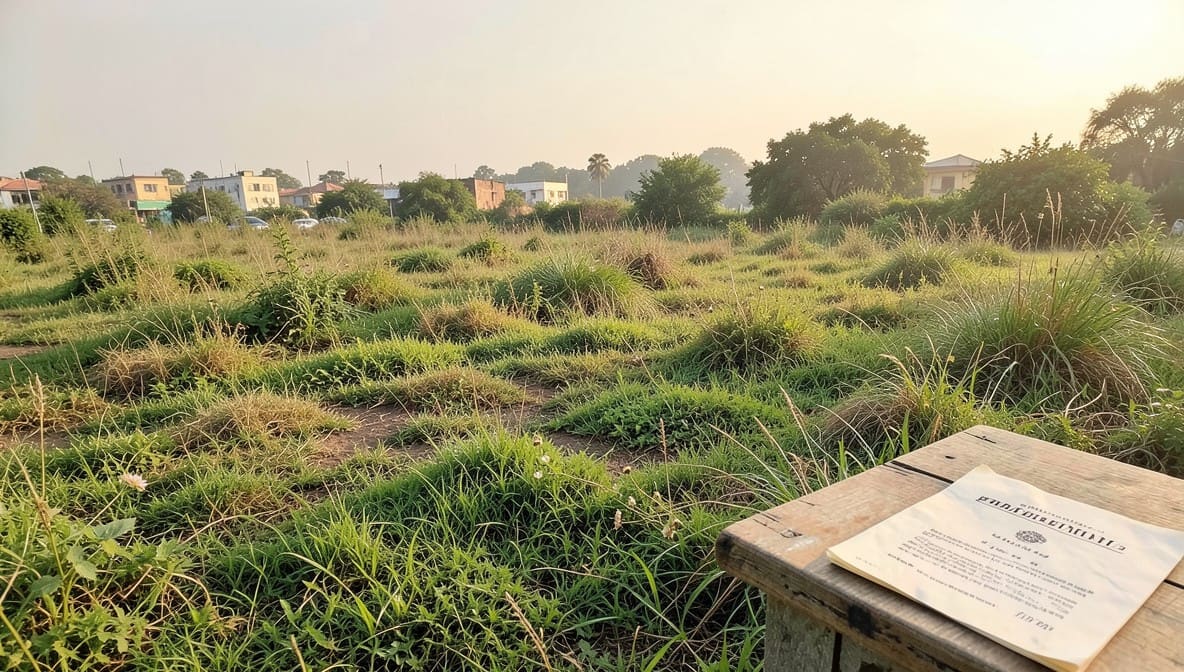
- No construction, development, or commercial activity commenced on the land
- The land remained in its original state, subject to pending acquisition proceedings under the Indore Development Authority’s Town Development Scheme
- The respondent issued a notice of dissolution dated 21.01.2020
- The petitioner responded on 18.07.2020, disputing dissolution
- The petitioner issued a notice for arbitration on 01.12.2022, seeking settlement of accounts and distribution of the land
- The respondent rejected the arbitration notice on 13.12.2022, contending no partnership existed and proposing conciliation instead
- The petitioner filed the present petition under Section 11(6) of the Arbitration and Conciliation Act, 1996 on 30.01.2023
Procedural History
- 03.07.2013: Partnership deed executed
- 21.01.2020: Respondent issued notice of dissolution
- 18.07.2020: Petitioner responded to dissolution notice
- 01.12.2022: Petitioner issued notice for appointment of arbitrator
- 13.12.2022: Respondent replied rejecting arbitration and proposing conciliation
- 30.01.2023: Petition under Section 11(6) filed before the Madhya Pradesh High Court
- 02.02.2026: Arguments reserved
- 07.04.2026: Judgment pronounced
The Parties' Positions
Petitioner’s Position: The arbitration clause in the partnership deed is valid and enforceable. The non-registration of the firm under the Indian Partnership Act, 1932 does not bar arbitration, as held in Umesh Goel v. H.P. Coop. Group Housing Society Ltd. The dispute over distribution of assets upon dissolution falls squarely within the scope of the arbitration clause. Limitation is not a bar, especially considering the COVID-19 extension period.
Respondent’s Position: No partnership ever existed because the business was never commenced. The petitioner failed to invest any funds, and no commercial activity occurred. The deed was merely an agreement to form a partnership in the future, not a contract of partnership. Therefore, the arbitration clause is inoperative. The petitioner’s claim for a share in the land is an attempt to usurp the property without investment.
Relief Sought
The petitioner sought appointment of an arbitrator to adjudicate claims for: (1) settlement of partnership accounts, (2) distribution of the immovable property under Clause 17 of the deed, and (3) declaration that the respondent’s sale of the land to a third party was illegal.
The Legal Issue
The central question was whether an arbitration agreement contained in a partnership deed is enforceable when the underlying partnership never commenced operations and no commercial entity came into existence.
Arguments Presented
For the Petitioner
The petitioner relied on Umesh Goel v. H.P. Coop. Group Housing Society Ltd. to argue that Section 69 of the Indian Partnership Act, 1932 does not bar arbitration proceedings in unregistered firms. He contended that the existence of a written arbitration clause satisfies the threshold under Section 11(6)A of the Arbitration Act. He further argued that questions of limitation, performance, or breach are matters for the arbitrator to decide, not the referral court. The court’s role under Section 11(6)A is limited to verifying the existence of an arbitration agreement, not adjudicating the merits of the dispute.
For the Respondent
The respondent argued that a partnership requires the actual carrying on of business, not merely an agreement to do so. Citing R.R. Sarna v. J. Reuben and Sitaram Kalani v. Manmal Gattani, he asserted that without any investment, construction, or commercial activity, no partnership existed. Therefore, the arbitration clause, being ancillary to the partnership, could not be invoked. The dispute over land distribution was not a dispute arising from the partnership agreement but a claim to property unrelated to any business operation.
The Court's Analysis
The Court undertook a detailed examination of the nature of the partnership deed and the legal requirements for the existence of a partnership under Section 4 of the Indian Partnership Act, 1932. It emphasized that partnership is not created by mere agreement but by the actual carrying on of business.
"What is essential to constitute partnership is the actual existence of a business carried on by partners. Therefore, so long as the business, whereof the profits the partners agree to share does not exist, there can be no partnership."
The Court distinguished between an agreement to form a partnership and a contract of partnership. It held that the absence of any commercial activity - no capital deployment, no hiring of staff, no establishment of credit, no generation of revenue - meant the entity never attained the status of a partnership. The land remained undeveloped, and the petitioner’s failure to invest, even in the face of pending acquisition proceedings, was not excused by the terms of the deed.
The Court further analyzed the scope of judicial review under Section 11(6)A, referencing DLF Home Developers Ltd. v. Rajapura Homes (P) Ltd. and Vidya Drolia v. Durga Trading Corporation. It held that while courts must not conduct a mini-trial, they are obligated to examine whether the dispute genuinely correlates with the arbitration agreement. Here, the petitioner sought a share in immovable property, not an accounting of partnership profits or liabilities. The dispute was not about the conduct of the business but about ownership of the land itself.
"The dispute that is sought to be resolved in the present case, is share of the petitioner in the property, whereas the agreement was for running business in the property. The dispute in question, therefore, has no co-relation to the agreement."
The Court concluded that without a valid partnership, there could be no enforceable arbitration agreement. The arbitration clause was not a standalone contract but a mechanism for resolving disputes arising from the partnership. Where the partnership never existed, the clause had no operative force.
The Verdict
The petition was dismissed. The Court held that no arbitration agreement was enforceable because no partnership ever came into existence. The petitioner’s claim for distribution of the land was unrelated to the business contemplated under the deed. No arbitrator was appointed. The Court directed that the parties may pursue any civil remedies available under law, but not through arbitration.
What This Means For Similar Cases
Arbitration Clauses Are Not Enforceable Without an Operating Contract
- Practitioners must verify whether the underlying contract (e.g., partnership, joint venture) is operative before invoking arbitration
- A mere written agreement to form a future entity does not create an enforceable arbitration clause
- Courts will examine whether the subject matter of the dispute correlates with the contractual relationship
Non-Commencement of Business Invalidates Ancillary Dispute Resolution Mechanisms
- Failure to invest, construct, or commence operations negates the existence of a partnership
- Even if a deed contains arbitration provisions, they are inoperative if the core business relationship never materialized
- Parties cannot use arbitration to enforce property rights unrelated to the business purpose of the agreement
Judicial Scrutiny Under Section 11(6)A Is Not Mechanical
- Courts are not bound to refer disputes to arbitration merely because an arbitration clause exists
- A prima facie review must assess whether the dispute is arbitrable in substance, not just in form
- The "when in doubt, refer" principle does not apply where the arbitration agreement is demonstrably non-existent or disconnected from the dispute