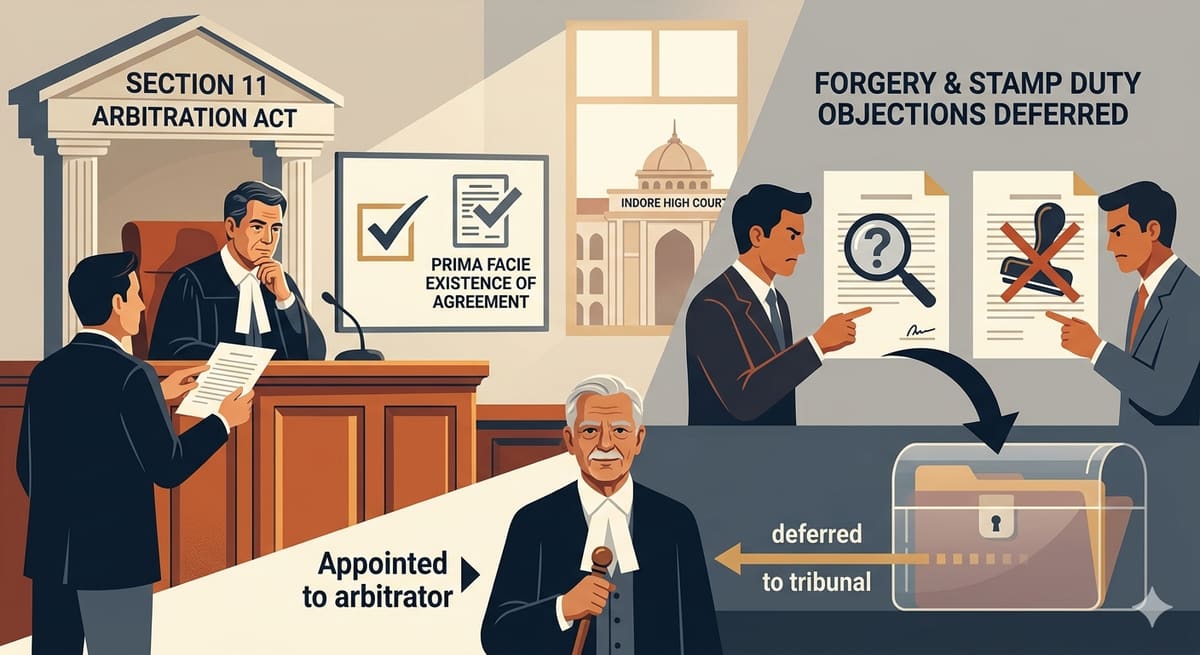
The Patna High Court has affirmed that where parties have agreed to arbitration under a valid clause, the court’s role under Section 11(6) of the Arbitration and Conciliation Act, 1996 is to facilitate appointment of an arbitrator - not to adjudicate underlying disputes or allegations of fraud. This order reinforces the pro-arbitration stance of Indian law and clarifies that allegations of misconduct must be addressed by the arbitrator, not by denying access to arbitration.
Background & Facts
The Dispute
The petitioner, Sarvesh Security Services Pvt. Ltd., entered into an agreement dated 31.07.2018 with the Bihar Tourism Development Corporation Ltd. for the provision of security services. The agreement contained an arbitration clause in Clause 3, which designated the Secretary, Tourism Department, Government of Bihar, as the sole arbitrator to resolve any disputes arising thereunder. The petitioner alleged that the respondents failed to make timely payments for services rendered, despite submission of bills. After repeated non-payment and an unsuccessful demand letter dated 23.09.2019, the petitioner invoked the arbitration clause. The respondents did not respond to the invocation, prompting the petitioner to file the present request petition under Section 11(6) of the Arbitration and Conciliation Act, 1996.
Key Facts
- Agreement dated 31.07.2018 for security services with 2026:PATHC:36240 Patna High Court REQ. CASE No.3 of 2025 dt.17-04-2026 2/8
- Petitioner submitted bills for services rendered from 2018 to 2023
- Payment demand letter sent on 23.09.2019; no payment made
- Arbitration clause invoked on 31.07.2018 (date of agreement, not invocation date; actual invocation date not specified but implied post-23.09.2019)
- Respondents alleged non-compliance with contractual obligations:
- Failure to submit EPF & ESIC compliance records under Clause C1.24
- Failure to provide name-wise list of security guards benefiting from EPF/ESI, despite demand via letter dated 22.09.2023
- Submission of forged absentee reports, including a signature allegedly forged by the Manager, Bodh Gaya Node-2
- Show-cause notices issued on 04.07.2022 and 09.07.2022; no compliant response received
- Bills for December 2021 to February 2023 (14 months 10 days) remained unpaid due to non-submission of verified reports
- Payment of Rs. 6,53,232/- made for August - October 2020 after deduction for unapproved deployments at Brahmakund, Rajgir, Hotel Vanavar Vihar, Nagarjun Vihar, and Hotel Patliputra Ashok
- No bill with revised minimum wage rates was received by respondents, per their affidavit
Procedural History
- 31.07.2018: Agreement executed between parties
- 23.09.2019: Petitioner’s first payment demand letter
- 04.07.2022: Respondent issued show-cause notice for forged absentee reports
- 09.07.2022: Second show-cause notice issued
- 22.09.2023: Respondent demanded EPF/ESI beneficiary list
- Undated, prior to 03.01.2025: Petitioner invoked arbitration clause
- 03.01.2025: Request Petition No. 3 of 2025 filed under Section 11(6) of the Arbitration and Conciliation Act, 1996
- 17.04.2026: Hearing before Patna High Court
The Parties' Positions
For the Petitioner
- The arbitration clause is valid and enforceable
- The respondents failed to respond to the invocation of arbitration
- The court’s duty under Section 11(6) is to appoint an arbitrator when one is not appointed by the parties
- Allegations of fraud and non-compliance are merits-based and must be decided by the arbitrator
For the Respondents
- Clause 3 of the agreement designates the Secretary, Tourism Department, as the sole arbitrator
- The petitioner never approached the designated arbitrator
- The petitioner committed fraud by submitting forged absentee reports
- Fraud vitiates the arbitration agreement
- The petitioner has not fulfilled contractual obligations (EPF/ESI compliance, verified reports)
- The claim is inflated and beyond contractual terms
Relief Sought
The petitioner sought appointment of an independent arbitrator under Section 11(6) of the Arbitration and Conciliation Act, 1996 to adjudicate the payment dispute.
The Legal Issue
Can a court under Section 11(6) of the Arbitration and Conciliation Act, 1996 appoint an arbitrator when the contract specifies a designated arbitrator, but the petitioner has not approached that authority, and the respondent alleges fraud and non-compliance?
Arguments Presented
For the Petitioner
The petitioner relied on the principle that courts must not delve into the merits of disputes at the stage of arbitrator appointment under Section 11(6). The agreement clearly provides for arbitration, and the failure of the designated arbitrator (Secretary, Tourism Department) to act does not invalidate the arbitration clause. The petitioner argued that the court’s role is procedural and not adjudicatory, citing Bharat Aluminium Co. v. Kaiser Aluminium Technical Services Inc. and Datar Switchgears Ltd. v. Tata Finance Ltd. to support the separability of the arbitration clause from the main contract.
For the Respondent
The respondents contended that the petitioner’s failure to approach the designated arbitrator - Secretary, Tourism Department - renders the petition premature and misconceived. They further argued that the submission of forged documents constitutes fraud, which, under N. Radhakrishnan v. Maestro Engineers, vitiates the entire arbitration agreement. They asserted that the court should not facilitate arbitration where the petitioner has engaged in fraudulent conduct and breached material contractual obligations.
The Court's Analysis
The Court examined the nature of proceedings under Section 11(6) and reaffirmed that the court’s inquiry at this stage is limited to verifying the existence of an arbitration agreement, its validity, and whether the party seeking appointment has been unable to secure the appointment of an arbitrator as per the agreement.
"The court’s role under Section 11(6) is not to adjudicate the merits of the dispute, nor to determine allegations of fraud or breach of contract. These are matters for the arbitrator to decide."
The Court noted that while the agreement designates the Secretary, Tourism Department, as the arbitrator, there was no evidence that the petitioner had been denied access to that authority or that the Secretary had refused to act. The respondents’ failure to respond to the invocation, however, amounted to inaction that effectively prevented the agreed mechanism from operating.
The Court further held that allegations of fraud, even if serious, do not automatically nullify the arbitration clause unless the fraud directly infects the formation of the arbitration agreement itself. The forged absentee reports and non-submission of EPF/ESI records pertain to performance under the main contract, not the validity of the arbitration clause.
"Fraud vitiates transactions, but not necessarily the dispute resolution mechanism embedded within them. The arbitrator is best placed to examine the veracity of documents and the conduct of the parties."
The Court rejected the respondents’ argument that the petitioner’s non-compliance barred arbitration, emphasizing that such issues are substantive and must be adjudicated by the arbitrator. The court also noted that the parties had not mutually agreed to exclude the court’s jurisdiction under Section 11(6), and the designated arbitrator had not been approached, creating a vacuum that the court was duty-bound to fill.
The Verdict
The petitioner succeeded. The Patna High Court appointed Hon’ble Mr. Justice Jyoti Saran, former Judge of this Court, as the arbitrator to adjudicate all disputes arising from the agreement dated 31.07.2018. The Court directed that all merits-based pleas - including allegations of fraud, non-compliance with EPF/ESI obligations, forged documents, and inflated claims - be left open for determination by the arbitrator. The arbitrator shall be entitled to fees as per the Schedule of the Act. The parties are directed to cooperate fully, avoid unnecessary adjournments, and ensure expeditious hearing. The issue of limitation, if any, is reserved for the arbitrator’s consideration. The order was communicated to the arbitrator by the Joint Registrar (List) and counsel for both parties.
What This Means For Similar Cases
Arbitration Clauses Are Procedurally Enforceable Even Amid Allegations of Fraud
- Practitioners must file applications under Section 11(6) when the designated arbitrator is not appointed or refuses to act, even if the counterparty alleges fraud in performance
- Courts will not refuse appointment of arbitrator on grounds of alleged fraud in contract performance unless the fraud directly undermines the arbitration clause’s formation
- Fraud allegations must be raised before the arbitrator, not as a jurisdictional bar to arbitration
Designated Arbitrators Must Be Given a Fair Chance to Act
- If a contract names a specific person or authority as arbitrator, the party seeking arbitration must first attempt to involve that person
- Failure to approach the designated arbitrator does not automatically invalidate the petition under Section 11(6), especially if the designated authority remains inactive
- Courts may appoint an alternate arbitrator where the agreed mechanism is rendered ineffective by inaction
Procedural Compliance Trumps Substantive Disputes at Appointment Stage
-
Parties cannot use substantive breaches as a shield to avoid arbitration
-
The burden is on the party resisting arbitration to prove that the arbitration clause itself is void, voidable, or inoperative
-
Courts must act as facilitators, not gatekeepers, of arbitration under Section 11(6)
-
Always verify whether the designated arbitrator has been approached before filing under Section 11(6)
-
If the designated arbitrator is a government official, document attempts to contact them via registered post or official communication
-
Do not concede fraud allegations at the appointment stage - preserve them for the arbitral tribunal