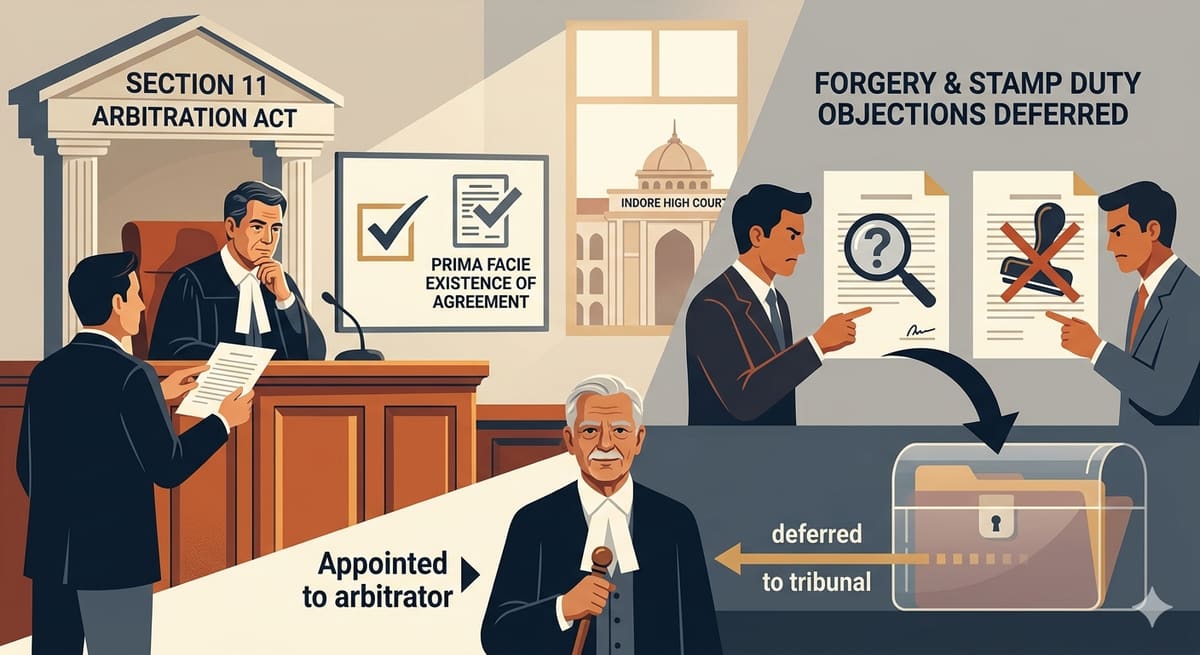
The Kerala High Court, in a recent arbitration request, clarified the limited scope of judicial inquiry under Section 11 of the Arbitration and Conciliation Act, 1996. The Court emphasized that courts must refer disputes to arbitration if a prima facie arbitration agreement exists, leaving questions of genuineness, arbitrability, and limitation to the arbitral tribunal. This judgment reinforces the principle of minimal judicial interference at the referral stage, aligning with the Supreme Court's guidance in Maharashtra State Electricity Distribution Company Limited v. R.Z. Malpani.
Background & Facts
The Dispute
The petitioner, Mr. Jibu John, and the respondent, Mr. Biju Raju, are relatives. The petitioner alleged that the respondent approached him during June-July 2016 for financial assistance, promising repayment upon the sale of his or his father's family properties. Between 30.06.2016 and 21.07.2016, the petitioner advanced a total sum of Rs. 88,00,000 to the respondent. On 01.10.2017, the respondent executed a promissory note for the said amount with 9% interest per annum. Later, on 01.03.2020, the respondent issued a cheque for Rs. 1,09,13,215 in lieu of the promissory note but requested the petitioner not to present it for encashment, assuring repayment shortly.
Key Facts
- 30.06.2016 to 21.07.2016: Petitioner advanced Rs. 88,00,000 to the respondent.
- 01.10.2017: Promissory note executed for Rs. 88,00,000 with 9% interest.
- 01.03.2020: Cheque issued for Rs. 1,09,13,215 but not encashed at the respondent's request.
- 07.10.2022: With the intervention of family members, an agreement (Annexure-I) was executed between the parties. The total liability as on that date was stated as Rs. 1,29,36,340. The respondent agreed to convey 2.55 Ares of land in Sy.No.845/9 of Nadama Village to the petitioner within two years in partial discharge of the liability. The balance amount of Rs. 72,66,340, subject to deductions for registration and stamp duty, was to be paid with 7.5% interest per annum within the same period.
- The respondent handed over the original title deeds of the property to the petitioner post-agreement.
- The property was not conveyed within the agreed two-year period.
Procedural History
- 22.09.2025: Petitioner issued Annexure-II notice invoking the arbitration clause in Annexure-I agreement.
- 27.09.2025: Respondent issued Annexure-V reply, denying the execution of any valid agreement and alleging forgery.
- AR No. 249 of 2025: Arbitration request filed before the Kerala High Court seeking nomination of an arbitrator.
- 23.06.2026: Matter came up for admission.
- 30.06.2026: Judgment delivered.
The Parties' Positions
- Petitioner: Asserted that Annexure-I was a valid agreement executed with the intervention of relatives and well-wishers. Contended that the respondent later denied its validity to escape obligations.
- Respondent: Denied the execution of Annexure-I, alleging it was a forged document. Initiated criminal proceedings against the petitioner for forgery. Argued that no valid arbitration agreement existed, rendering the arbitration request non-maintainable.
Relief Sought
The petitioner sought nomination of a sole arbitrator by the Kerala High Court Arbitration Centre to resolve disputes arising under Annexure-I agreement, including questions of jurisdiction, limitation, and arbitrability.
The Legal Issue
The central question was whether the Court, under Section 11 of the Arbitration and Conciliation Act, 1996, could refuse to refer the parties to arbitration on the ground that the existence of the arbitration agreement (Annexure-I) was disputed, or whether it should limit its inquiry to the prima facie existence of such an agreement.
Arguments Presented
For the Petitioner
- Relied on Maharashtra State Electricity Distribution Company Limited v. R.Z. Malpani and New India Assurance Company Limited v. Genus Power Infrastructure Limited to argue that the Court's role under Section 11 is limited to examining the prima facie existence of an arbitration agreement.
- Contended that the respondent's denial of Annexure-I was an afterthought to evade liability, as evidenced by the handing over of title deeds and the structured repayment plan agreed upon.
- Argued that questions of genuineness, arbitrability, and limitation should be left to the arbitral tribunal, as held by the Supreme Court.
For the Respondent
- Relied on Narendra Singh v. Ashendra Mishra, Ravindra Savia v. Avitel Post Studioz Ltd., and State of Uttar Pradesh v. R.K. Pandey to argue that the Court could refuse reference if the arbitration agreement was forged or non-existent.
- Contended that Annexure-I was a forged document, as alleged in the criminal proceedings initiated by the respondent.
- Submitted that no valid arbitration agreement existed, and thus, the arbitration request was not maintainable.
The Court's Analysis
The Court emphasized the restrained jurisdiction under Section 11 of the Arbitration Act, citing the Supreme Court's judgment in Maharashtra State Electricity Distribution Company Limited v. R.Z. Malpani:
"21. As such, the pronouncement of this Court in SBI General Insurance Co. Ltd. (Supra) lays down a clear and comprehensive explanation about the scope of examination at the stage of Section 11 proceedings: it is limited to finding a prima facie existence of arbitration agreement and nothing beyond it. Questions of 'accord and satisfaction', limitation, dishonesty and frivolity, arbitrability of the subject-matter are to be left to the adjudication by the arbitral tribunal under Section 16 of the 1996 Act which is a reflection of the doctrine of 'Kompetenz-Kompetenz' or 'competence de la competence'. It is therefore incumbent upon us to only examine the prima facie existence of an arbitration agreement."
"42. It goes without saying that the scope of inquiry at the stage of Section 11 is extremely limited and only pertains to an examination about prima facie existence of an arbitration agreement. Judicial non-interference in the arbitration process is the sacrosanct principle which guides alternative dispute resolution and Courts must be highly circumspect in interfering at the referral stage, especially since there is no appeal available in the 1996 Act against an order under Section 11. The Arbitral Tribunal, in exercise of its jurisdiction under Section 16 must be left to decide on its jurisdiction. The Courts should follow the principle of 'When in doubt, do refer' and lean towards referring matters to arbitration when the arbitration agreement is prima facie existent."
The Court observed that while the respondent vehemently denied the genuineness of Annexure-I, the undisputed facts - such as the financial transactions between the parties and the handing over of title deeds - supported a plausible inference of the agreement's existence. The Court noted that the respondent failed to explain the circumstances under which the title deeds were handed over to the petitioner. Thus, the Court concluded that the matter should be referred to arbitration, leaving all disputes, including the genuineness of the agreement, to be adjudicated by the arbitral tribunal.
The Verdict
The arbitration request was allowed. The Court issued the following directions:
- The Kerala High Court Arbitration Centre was directed to nominate a sole arbitrator from Panel-I, preferably from Ernakulam, to resolve the disputes arising under Annexure-I agreement.
- The learned arbitrator was empowered to entertain all issues between the parties, including questions of jurisdiction, limitation, and arbitrability.
- The Registry was directed to communicate the substance of the order to the Kerala High Court Arbitration Centre within 10 days, and the Centre was to inform the arbitrator within a further period of one week and obtain Form 3 as required under Rule 20(4) of the Kerala High Court (Arbitration Centre) Rules, 2025.
- Upon receipt of Form 3, the Registry was to issue a certified copy of the order with the form appended to the Kerala High Court Arbitration Centre.
- The fees of the arbitrator and the manner of payment were to be governed by Rules 28 and 27 of the Kerala High Court (Arbitration Centre) Rules, 2025, respectively.
- The arbitrator was at liberty to seek expert assistance if required during the proceedings.
What This Means For Similar Cases
Limited Judicial Inquiry Under Section 11
- Courts must adopt a minimalist approach under Section 11 of the Arbitration Act. The inquiry is confined to determining the prima facie existence of an arbitration agreement, and not its validity or genuineness.
- Questions of arbitrability, limitation, dishonesty, or accord and satisfaction must be left to the arbitral tribunal under Section 16 of the Act, which embodies the doctrine of Kompetenz-Kompetenz.
Principle of 'When in Doubt, Do Refer'
- Courts should lean towards referring disputes to arbitration if a prima facie arbitration agreement exists. Refusal to refer should be reserved for the rarest of rare cases, where the non-existence of the agreement is evident even without delving into disputed facts.
- Practitioners must argue for reference to arbitration even in cases where the existence of the agreement is contested, unless the non-existence is glaringly apparent.
Role of Arbitral Tribunal in Disputed Agreements
- The arbitral tribunal is the appropriate forum to adjudicate disputes regarding the genuineness, validity, and enforceability of the arbitration agreement.
- Parties should be prepared to present their claims and counterclaims before the tribunal, including arguments on jurisdiction, limitation, and arbitrability.