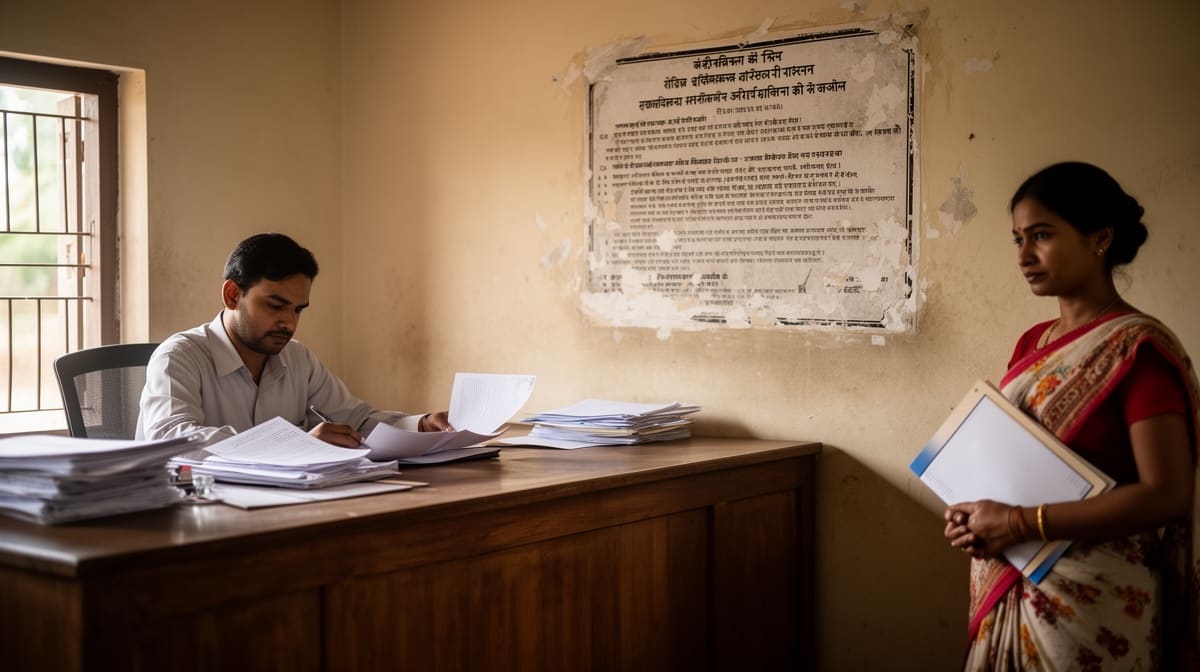
The Bombay High Court has clarified that the limitation period for filing a suit seeking a declaration of death under Section 108 of the Indian Evidence Act does not commence from the date a person goes missing, but from the issuance of a police certificate confirming permanent disappearance. This ruling provides critical clarity for families seeking legal recognition of death for succession, property, and administrative purposes.
Background & Facts
The Dispute
The appellant, Prakash S/o Gordhandas @ Govardhan Wadhuram Ahuja, filed a suit under Section 34/38 of the Specific Relief Act seeking a declaration that his father, Gordhandas @ Govardhan Wadhuram Ahuja, be presumed dead under Section 108 of the Indian Evidence Act, 1872, and a mandatory direction to the Municipal Corporation of Greater Mumbai (BMC) to issue a death certificate.
Key Facts
- The appellant’s father went missing on 29.10.2012
- A police complaint was lodged at Antop Hill Police Station on 07.11.2012
- A public notice regarding the disappearance was published in a newspaper on 18.11.2012
- On 20.07.2022, after nearly ten years, the Antop Hill Police Station issued a certificate stating that the investigation into the missing person case was still ongoing, but due to the substantial passage of time, the individual was certified as "permanently missing"
- The suit was filed on 15.02.2025
- The trial court dismissed the suit on 27.02.2026, holding that limitation began to run from 29.10.2012, and the suit was barred as it was filed beyond three years from the expiry of seven years (i.e., beyond 29.10.2019)
Procedural History
- 29.10.2012: Father of plaintiff goes missing
- 07.11.2012: Police complaint filed at Antop Hill Police Station
- 18.11.2012: Newspaper notice published
- 20.07.2022: Police issue certificate certifying person as "permanently missing" despite ongoing investigation
- 15.02.2025: Suit filed before City Civil Court, Mumbai (Suit No. 747 of 2025)
- 27.02.2026: City Civil Court dismisses suit on ground of limitation
- 05.03.2026: First Appeal No. 382 of 2026 filed before Bombay High Court
- 20.04.2026: Oral judgment delivered by Justice Sharmila U. Deshmukh
The Parties' Positions
The appellant contended that the cause of action arose only upon receipt of the police certificate on 20.07.2022, as it was only then that a formal, official confirmation of permanent disappearance was available. He argued that Section 108 of the Evidence Act requires a judicial forum to invoke the presumption, and no such occasion arose until the police certificate was issued.
The respondents, BMC and the State of Maharashtra, argued that the limitation period commenced from the date of disappearance, and that the suit was time-barred as it was filed more than three years after the expiry of the seven-year period under Section 108. They also raised the issue of non-joinder of the State of Maharashtra as a necessary party.
Relief Sought
The appellant sought:
- A declaration that his father is presumed dead under Section 108 of the Indian Evidence Act
- A mandatory direction to BMC to issue a death certificate
- Costs of litigation
The Legal Issue
The central question was whether the limitation period for filing a suit under Section 34/38 of the Specific Relief Act seeking a declaration of death under Section 108 of the Indian Evidence Act begins from the date of disappearance, or from the date a formal certification of permanent disappearance is issued by the police, thereby creating a justiciable cause of action.
Arguments Presented
For the Appellant
Learned counsel relied on LIC of India v. Anuradha (AIR 2004 SC 2070) to argue that the statutory presumption under Section 108 arises only when the question of death is raised in a judicial or quasi-judicial proceeding. He submitted that until the police issued the certificate on 20.07.2022, there was no conclusive, official basis to invoke the presumption. The suit was filed within three years of that date, and hence was within limitation. He further argued that the police certificate, though issued during an ongoing investigation, constituted sufficient evidence to trigger the legal right to seek a declaration.
For the Respondent
Counsel for BMC contended that the seven-year period under Section 108 expired on 29.10.2019, and the suit, filed in February 2025, was clearly barred by limitation. He argued that the police certificate was merely an administrative observation and did not create a new cause of action. He also reiterated that the State of Maharashtra, as the overarching authority over police, should have been impleaded as a separate party.
The Court's Analysis
The Court undertook a detailed analysis of Section 108 of the Indian Evidence Act, which provides that when the question is whether a person is alive or dead, and it is proved that he has not been heard of for seven years by those who would naturally have heard of him, the burden shifts to the person asserting he is alive.
"The statutory presumption would arise only on lapse of seven years and only when the question is raised in a Court or Tribunal."
The Court emphasized that the presumption under Section 108 is not self-operating. It requires a judicial forum to invoke it. The Hon’ble Supreme Court in LIC of India v. Anuradha had held that so long as no dispute is raised before any forum, the occasion for raising the presumption does not arise.
The Court noted that the police certificate dated 20.07.2022, while acknowledging that the investigation was still technically ongoing, explicitly stated that due to the substantial passage of time, the individual was certified as "permanently missing." This was not a mere administrative note but a formal, official attestation that the conditions for invoking Section 108 had been met in practice.
The Court held that the appellant could not have reasonably filed the suit before this certification, as there was no conclusive evidence to support the declaration sought. The cause of action, therefore, arose only on 20.07.2022, and the suit filed on 15.02.2025 was well within the three-year limitation period under Article 120 of the Limitation Act.
Regarding non-joinder of the State of Maharashtra, the Court held that the police authority, being a subordinate body of the BMC under the Mumbai Municipal Corporation Act, was sufficient for adjudication. The State was not a necessary party for the relief sought.
The Verdict
The appellant succeeded. The First Appeal was allowed. The impugned judgment dated 27.02.2026 was quashed and set aside. The suit was decreed in terms of prayers (a) and (b), declaring the father presumed dead under Section 108 of the Indian Evidence Act and directing the Municipal Corporation of Greater Mumbai to issue a death certificate forthwith. The interim application was disposed of as infructuous.
What This Means For Similar Cases
Cause of Action Arises Upon Official Certification
- Practitioners must now treat the issuance of a formal police or administrative certificate confirming permanent disappearance as the trigger for limitation under Section 108
- Filing suits before such certification risks dismissal on limitation grounds, even if seven years have passed
- A mere lapse of seven years without official confirmation is insufficient to establish a justiciable claim
Police Certificates Are Legally Significant
- Certificates issued by police under Section 174 CrPC or similar administrative procedures, even if investigation remains open, may constitute sufficient evidence to invoke Section 108
- Courts will now examine the substance of such certificates - not their procedural status - to determine whether they create a legal basis for declaration
- Legal notices and newspaper publications alone are inadequate; official certification is now required
Municipal Corporations Are Proper Respondents
- Municipal Corporations, as issuers of death certificates under local laws, are proper and sufficient respondents in suits seeking such certificates
- The State of Maharashtra need not be impleaded as a separate party unless the claim challenges police conduct or seeks damages
- This reduces litigation complexity and cost for families seeking death certificates