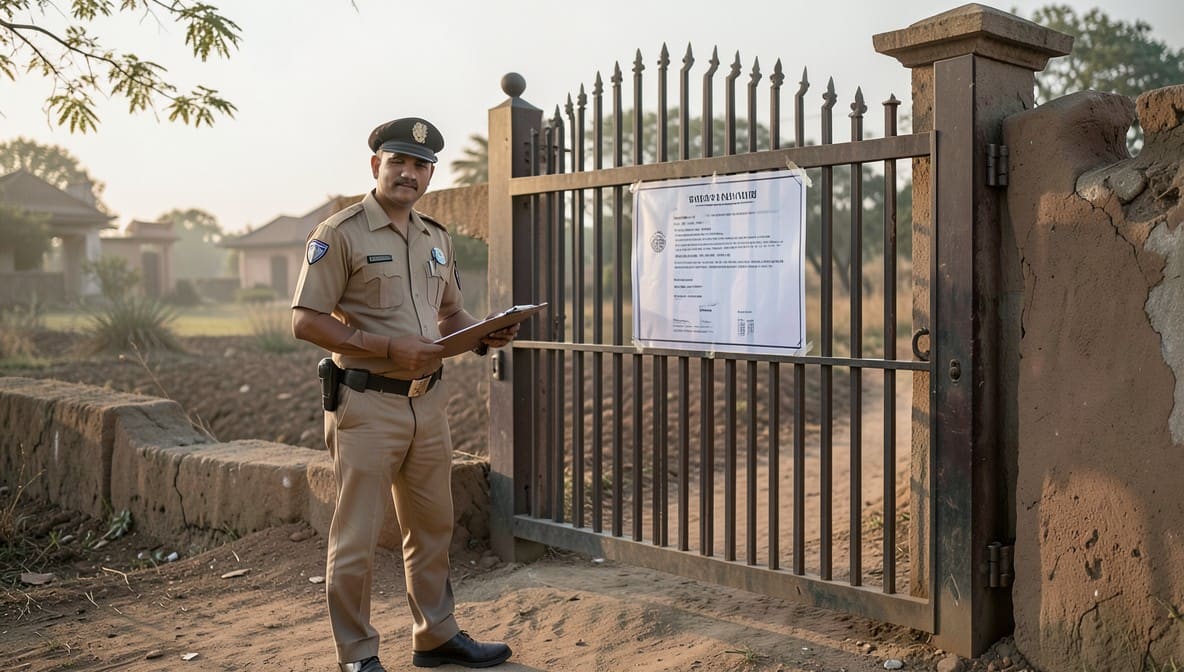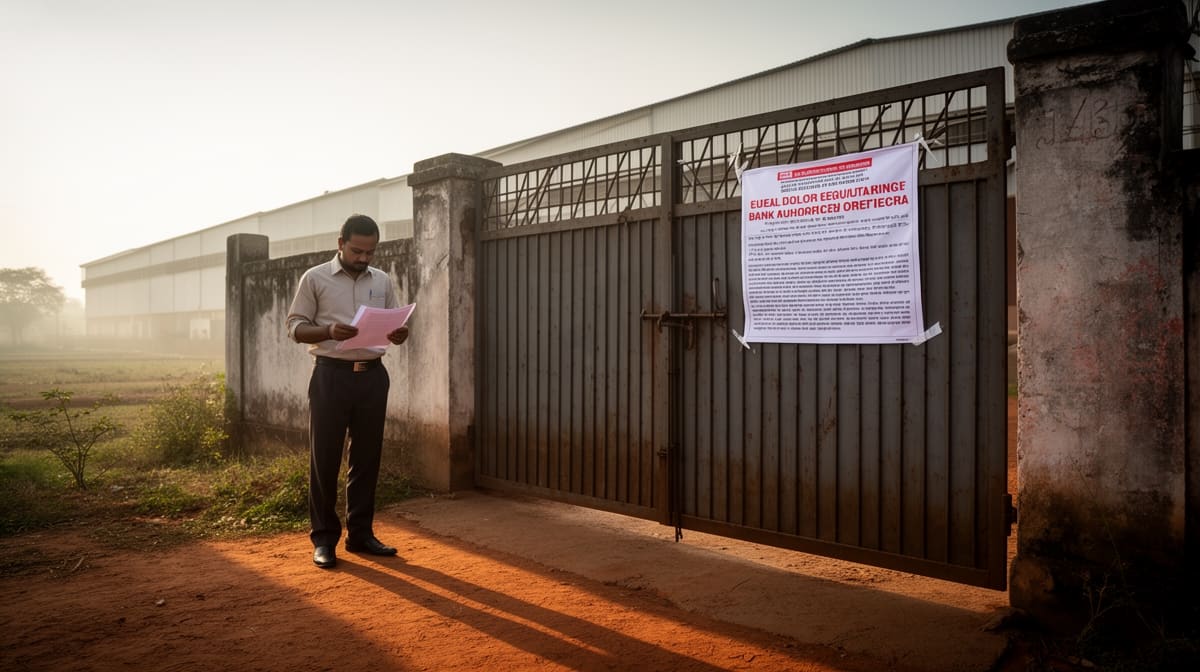
The Rajasthan High Court has held that police assistance for implementing possession orders under Section 14 of the SARFAESI Act constitutes a statutory obligation of the State and cannot be subjected to user charges under Section 46 of the Rajasthan Police Act, 2007. The Division Bench quashed a Single Judge order that had upheld police demands for deployment costs at rates prescribed under Rule 10 of the Rajasthan Police Rules, 2008, ruling that the statutory character of Section 14 proceedings distinguishes them from private commercial services covered by the Police Act.
Background & Facts
The Dispute
Au Small Finance Bank Ltd. (the appellant-Bank), a secured creditor under the Securitisation and Reconstruction of Financial Assets and Enforcement of Security Interest Act, 2002 (SARFAESI Act), initiated recovery proceedings against multiple borrowers across Rajasthan who had defaulted on loan repayments. After classifying the accounts as Non-Performing Assets (NPAs) and following the statutory notice procedure under Section 13(2), the Bank sought physical possession of secured assets. When borrowers resisted handover, the Bank approached the competent Designated Authorities (District Magistrates/Chief Metropolitan Magistrates) under Section 14 of the SARFAESI Act for statutory assistance in taking possession.
Key Facts
- The appellant-Bank operated through its authorized officer Sh. Gaurav Bhati from its Jodhpur office
- Multiple borrowers across districts (Pratapgarh, Chittorgarh, Jodhpur, Hanumangarh, Sirohi, Bikaner, Dungarpur, Bhilwara, Balotra, Phalodi, Sriganganagar, Pali, Udaipur, Jaisalmer, Churu) had availed financial facilities and defaulted
- Loan accounts were classified as NPAs after default in repayment
- Demand notices under Section 13(2) SARFAESI Act were issued and statutory procedures followed
- Designated Authorities passed orders under Section 14 directing police deployment for possession
- During implementation, respondent-police authorities raised demands for police charges/fees
- Demands referenced a circular dated 03.02.2026 and Rule 10 of the Rajasthan Police Rules, 2008
- Rule 10 prescribes rank-wise rates for police services and contemplates levy under Section 46 of the Rajasthan Police Act, 2007
Procedural History
- Various dates 2026: Bank filed writ petitions before the Single Judge challenging police charge demands and the 03.02.2026 circular
- 12.08.2026: Single Judge disposed of writ petitions, upholding police entitlement to levy charges but restricting rates to Rule 10 of Rajasthan Police Rules, 2008
- 26.10.2026: Conclusion of arguments in Special Appeals before Division Bench
- 26.10.2026: Judgment reserved
- 29.10.2026: Full judgment pronounced by Division Bench (Justice Vinit Kumar Mathur and Justice Chandra Shekhar Sharma)
Relief Sought
The appellant-Bank sought quashing of the Single Judge order dated 12.08.2026, declaration that police assistance under Section 14 SARFAESI Act cannot be charged, and direction to State to provide police force without levying any charges.
The Legal Issue
The central question was whether Section 46 of the Rajasthan Police Act, 2007 authorizes the State to levy charges for police deployment in aid of implementing orders passed by Designated Authorities under Section 14 of the SARFAESI Act, or whether such assistance constitutes a statutory obligation that must be discharged without cost to the secured creditor.
Arguments Presented
For the Appellant
Learned counsel Mr. Vijay Purohit submitted that deployment of police personnel pursuant to a Section 14 order is not a private commercial service but assistance in implementing a statutory order. He argued that Section 14(2) SARFAESI Act expressly empowers the Magistrate to "take or cause to be taken such steps and use, or cause to be used, such force as may be necessary" for compliance, which necessarily contemplates police aid as part of the statutory mechanism. Counsel contended that Section 46 of the Rajasthan Police Act, 2007 applies only to occupations, gatherings, exhibitions, sales, and entertainments for monetary gain requiring additional police for public security or order - not to statutory enforcement under a special enactment. He emphasized that a charging provision must be construed strictly and cannot be extended by analogy or administrative practice. The Single Judge erred in treating statutory assistance as a private service merely because the Bank commercially benefited from possession.
For the Respondent
Mr. B.L. Bhati, Additional Advocate General, supported the Single Judge's order, contending that the mortgaged asset is private property and possession recovery serves the Bank's commercial interests. He argued that police deployment for such recovery is not routine law-and-order duty but an additional service to the secured creditor, attracting charges on a quid pro quo basis. The State maintained that Rule 10 rates were correctly applied and the impugned order warranted no interference.
The Court's Analysis
The Division Bench examined the statutory scheme of Section 14 SARFAESI Act and Section 46 Rajasthan Police Act, 2007. The Court observed that Section 14(1) empowers the Chief Metropolitan Magistrate or District Magistrate to take possession of secured assets and forward them to the secured creditor, while sub-section (2) authorizes use of necessary force for compliance. A conjoint reading reveals the statute "not only confers power upon the competent authority to facilitate the taking over of possession of the secured assets, but also casts a corresponding duty upon such authority to ensure the effective implementation of its directions in accordance with law."
"The orders passed by the Chief Metropolitan Magistrate or the District Magistrate under Section 14 of the SARFAESI Act are statutory in nature as they bear the trappings of judicial orders, inasmuch as they are passed by a statutory authority in the exercise of powers conferred by law. The implementation of such orders, therefore, constitutes the discharge of a statutory obligation in furtherance of the legislative mandate."
The Court held that police assistance for implementing Section 14 orders "partakes of the character of a sovereign function of the State" and its cost "cannot be imposed upon the secured creditor merely because the proceedings arise out of a commercial transaction." Section 46 of the Rajasthan Police Act contemplates charges for additional police force deployed for "occupations, gatherings, exhibitions, sales or entertainments conducted for monetary gain, or for the purposes of public security, public peace or public order" - it "does not specifically contemplate the levy of charges for police assistance requisitioned for the implementation of statutory orders passed under Section 14 of the SARFAESI Act."
The Court further noted that Rule 10 of the Rajasthan Police Rules, 2008 is subordinate to Section 46 and "cannot enlarge the scope of the said provision or create an independent category of liability not contemplated by the parent enactment." The Single Judge's reliance on Rule 10 was misplaced without first establishing Section 46's applicability.
The Bench endorsed the reasoning of the Allahabad High Court in PNB Housing Finance Ltd. v. State of Uttar Pradesh (Writ - C No. 9723 of 2024, decided 14.11.2024), which held that the District Magistrate/CJM is obliged to ensure execution of Section 14 orders and "it is not the secured creditor who after obtaining an order under Section 14... who is supposed to run from pillar to post or to the police personnel to get the order executed."
Referring to the SARFAESI Act's Statement of Objects and Reasons, the Court emphasized that an "efficient, robust and expeditious mechanism for the recovery of outstanding dues would not only instil confidence among banking institutions... but would also strengthen the financial ecosystem, facilitate the smooth flow of credit, and ultimately serve as a catalyst for the sustained growth, economic prosperity and overall development of our nation."
The Verdict
The Division Bench allowed the batch of special appeals. The Single Judge's order dated 12.08.2026 was quashed and set aside. The writ petitions were allowed. The respondent-State was directed to provide the requisite additional police force for effective implementation of orders passed under Section 14 of the SARFAESI Act, without levying any charges. All pending stay applications and other applications were disposed of.
What This Means For Similar Cases
Police Assistance Under Section 14 Is A Sovereign Function, Not A Commercial Service
The judgment establishes a clear doctrinal distinction: when police personnel are deployed to execute orders of a Designated Authority under Section 14 SARFAESI Act, they perform a statutory duty in furtherance of a legislative mandate. The commercial benefit accruing to the secured creditor does not transform this sovereign function into a chargeable service. Practitioners should argue that any demand for charges in such cases lacks statutory authority.
Section 46 Rajasthan Police Act Has A Defined Scope - It Does Not Cover SARFAESI Enforcement
- Section 46 applies only to specified private activities (occupations, gatherings, exhibitions, sales, entertainments) for monetary gain requiring additional police for public security/order
- It does not extend to police aid for implementing statutory orders under special enactments like SARFAESI Act
- Charging provisions must be strictly construed; they cannot be expanded by executive circulars or administrative convenience
Rule 10 Rajasthan Police Rules Is Subordinate To Section 46
- Rule 10 prescribes rates but derives its authority from Section 46
- If Section 46 does not apply to a deployment, Rule 10 rates cannot be invoked
- The Single Judge erred by applying Rule 10 rates without first determining Section 46's applicability
Precedent Value For Other High Courts
The endorsement of the Allahabad High Court's reasoning in PNB Housing Finance Ltd. creates persuasive authority for secured creditors challenging police charge demands in other jurisdictions. Lawyers should cite both judgments when resisting similar demands under state police acts.
Practical Takeaways For Banking Lawyers
- Immediately challenge any police demand for charges in Section 14 proceedings by filing writ petitions
- Argue that the Designated Authority's order under Section 14 carries an implicit direction for cost-free police assistance
- Cite the statutory duty cast on the State to ensure effective implementation of SARFAESI objectives
- Reference the Statement of Objects and Reasons of SARFAESI Act to underscore legislative intent for expeditious, cost-effective recovery