The Madhya Pradesh High Court has issued critical interim directions to prevent coercive recovery under the SARFAESI Act when the Debts Recovery Tribunal is rendered non-functional due to vacancy of the Presiding Officer. The judgment provides a vital safeguard for borrowers caught in procedural limbo, ensuring that the absence of a functional forum does not justify unilateral asset seizure by banks.
Background & Facts
The Dispute
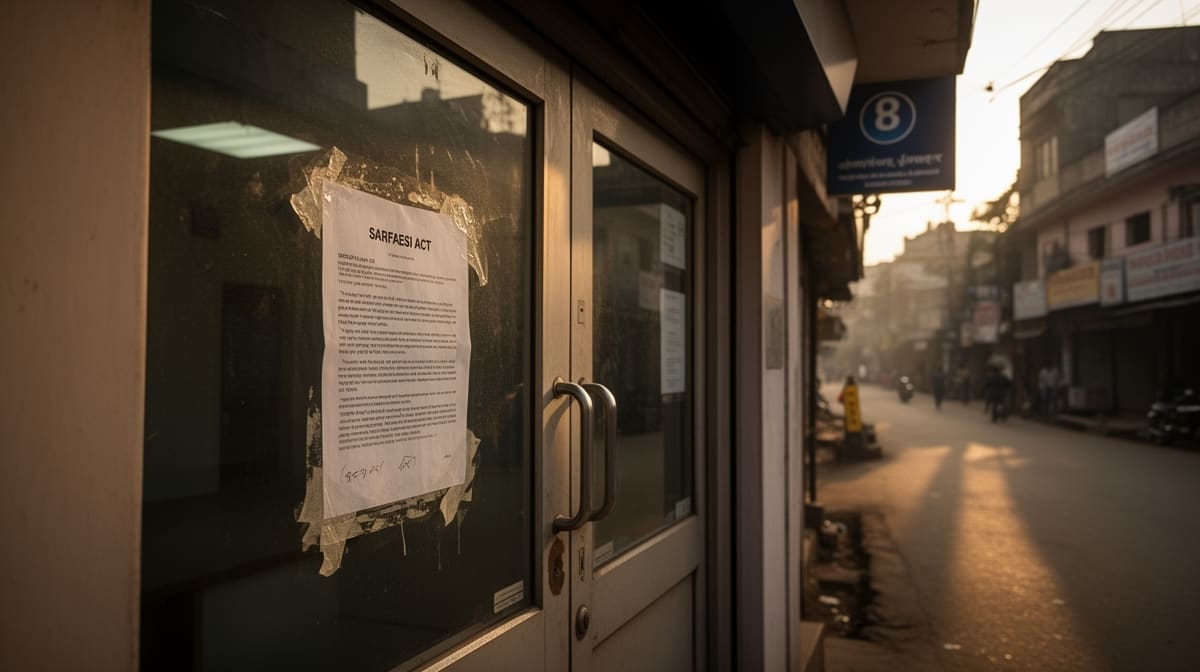
The petitioners, M/s Surendra Kumar Jain through its proprietor Mr. Subhash Chand Jain, are borrowers who defaulted on a loan facility extended by Axis Bank Limited (Respondent No. 1). The bank initiated proceedings under the Securitisation and Reconstruction of Financial Assets and Enforcement of Security Interest Act, 2002 (SARFAESI Act), leading to the issuance of a possession notice dated 31.03.2026 by the Tehsildar, Vidisha, for taking physical possession of the secured asset on 22.04.2026. This notice was issued pursuant to an order dated 29.01.2026 passed by the Chief Judicial Magistrate, Vidisha, under Section 14 of the SARFAESI Act.
Key Facts
- The loan amount outstanding as of the petition filing was Rs. 1.26 Crore (Rs. 1,26,00,000)
- The petitioners filed a Special Appeal (S.A. 423/2026) before the Debts Recovery Tribunal (DRT), Jabalpur, challenging the bank’s actions
- The Presiding Officer of DRT, Jabalpur, demitted office, leaving the tribunal non-functional
- The matter was referred to DRT, Lucknow, but no Presiding Officer was available there either
- The petitioners have not been granted any interim relief by any forum due to the functional vacuum
- The petitioners offered to deposit Rs. 35 Lakhs towards the outstanding liability as a goodwill gesture
Procedural History
- Date of loan default: Not specified in judgment, but implied to have occurred prior to initiation of SARFAESI proceedings
- Date of possession notice: 31.03.2026 issued by Tehsildar, Vidisha
- Date of Section 14 order: 29.01.2026 passed by CJM, Vidisha
- Date of filing of S.A. 423/2026: Not specified, but pending before DRT Jabalpur
- Date of DRT Jabalpur functional breakdown: After demission of Presiding Officer (exact date not stated)
- Date of referral to DRT Lucknow: After breakdown of DRT Jabalpur (exact date not stated)
- Date of petition filing: 2026 (exact date not specified, but filed before 21.04.2026)
- Date of Division Bench order cited: 08.04.2026 in W.P. No. 12618/2026 (Laxminarayan Kachhi v. Hinduja Housing Finance Ltd.)
- Date of judgment: 21.04.2026
The Parties' Positions
For the Petitioners:
- Argued that the absence of a functional DRT renders them remediless
- Highlighted that the Division Bench of this Court had previously stayed coercive action in similar circumstances in Laxminarayan Kachhi v. Hinduja Housing Finance Ltd.
- Offered to deposit Rs. 35 Lakhs as a condition for staying possession
- Contended that auction or physical possession would irreparably prejudice their right to contest the claim before the DRT
For the Respondent Bank (Axis Bank Limited):
- Did not appear or file any response
For the State (Respondent No. 2):
- Represented by Government Advocate, who did not oppose the petitioners’ prayer for stay
Relief Sought
The petitioners sought:
- Stay of the possession notice dated 31.03.2026 and the Section 14 order dated 29.01.2026
- Mandamus to the bank to maintain status quo over the property
- Direction to the bank not to auction or interfere with peaceful possession
- Stay of coercive action until the DRT decides the pending S.A. 423/2026
The Legal Issue
The central question was whether coercive action under Section 14 of the SARFAESI Act may proceed against a borrower when the Debts Recovery Tribunal is non-functional due to vacancy of the Presiding Officer, and the borrower has already filed a pending appeal before the same tribunal.
Arguments Presented
For the Petitioner
The petitioners relied on the precedent set by the Division Bench of this Court in Laxminarayan Kachhi v. Hinduja Housing Finance Ltd. (order dated 08.04.2026), which had stayed possession proceedings in a similar scenario where DRT Jabalpur was non-functional. They argued that the SARFAESI Act does not contemplate enforcement of security interest when the statutory appellate forum is rendered inoperative. The principle of audi alteram partem and the right to effective remedy under Article 21 of the Constitution were invoked to argue that the borrower cannot be penalized for administrative failure of the state.
For the Respondent
The Respondent Bank did not appear or file any counter-submissions. The State, through the Government Advocate, did not oppose the petitioners’ prayer, acknowledging the functional vacuum in the DRT system.
The Court's Analysis
The Court acknowledged the procedural impasse created by the non-functionality of DRT Jabalpur and the unavailability of a Presiding Officer at DRT Lucknow. It noted that the petitioners had not been afforded any opportunity to ventilate their grievances before a competent forum, despite having filed S.A. 423/2026. The Court emphasized that the SARFAESI Act is a remedial statute designed to balance the interests of lenders and borrowers, and that enforcement mechanisms under Section 14 cannot override the statutory right of appeal.
"The right to be heard before deprivation of property is a fundamental principle of natural justice, and cannot be circumvented by administrative inaction."
The Court distinguished the present case from situations where DRTs are merely overburdened, noting that here, the tribunal was entirely non-functional. It relied on the earlier Division Bench order in Laxminarayan Kachhi to affirm that the borrower’s right to a fair hearing cannot be sacrificed due to institutional failure. The Court also observed that the petitioners’ willingness to deposit Rs. 35 Lakhs demonstrated bonafide intent to discharge liability, thereby reducing the risk of asset dissipation.
The Court explicitly clarified that it was not expressing any opinion on the merits of the pending appeal before the DRT, nor was it adjudicating the validity of the bank’s claim.
The Verdict
The petitioners succeeded. The Court directed:
- The petitioners to deposit Rs. 35,00,000 (Thirty Five Lakhs) with Axis Bank Limited within 30 days of the order, to be adjusted against the final liability
- The DRT, Jabalpur, to take up S.A. 423/2026 for hearing as soon as it becomes functional, and decide the interim relief expeditiously
- No coercive action, including physical possession or auction, to be taken against the petitioners until the DRT decides the interim application in S.A. 423/2026, subject to compliance with the deposit condition
- The petitioners to communicate this order to the Registrar, DRT, Jabalpur, within seven working days
- Parties to approach this Court if there is excessive delay in appointment of a Presiding Officer
What This Means For Similar Cases
Borrowers Cannot Be Punished for DRT Inoperability
- Practitioners must now argue that Section 14 enforcement is suspended when the DRT is non-functional due to vacancy, not merely delayed
- The burden shifts to the bank to demonstrate that an alternative forum is available and functional before initiating possession
- Courts will treat administrative failure as a ground for interim protection under Article 226
Deposit as a Condition for Stay Is Now Standard
- Offering a substantial portion of the outstanding liability (e.g., 25-30%) as a deposit is now a recognized condition for obtaining stay against possession
- This balances the bank’s interest in security with the borrower’s right to due process
- Practitioners should advise clients to proactively offer deposits in pending SARFAESI matters where DRT is non-functional
Procedural Vacuum Triggers Judicial Intervention
- Courts will not allow banks to exploit gaps in the DRT system to enforce security interests
- The Laxminarayan Kachhi precedent now forms binding guidance for all High Courts in similar circumstances
- Any delay in filling DRT vacancies must be brought to the notice of the High Court under this judgment