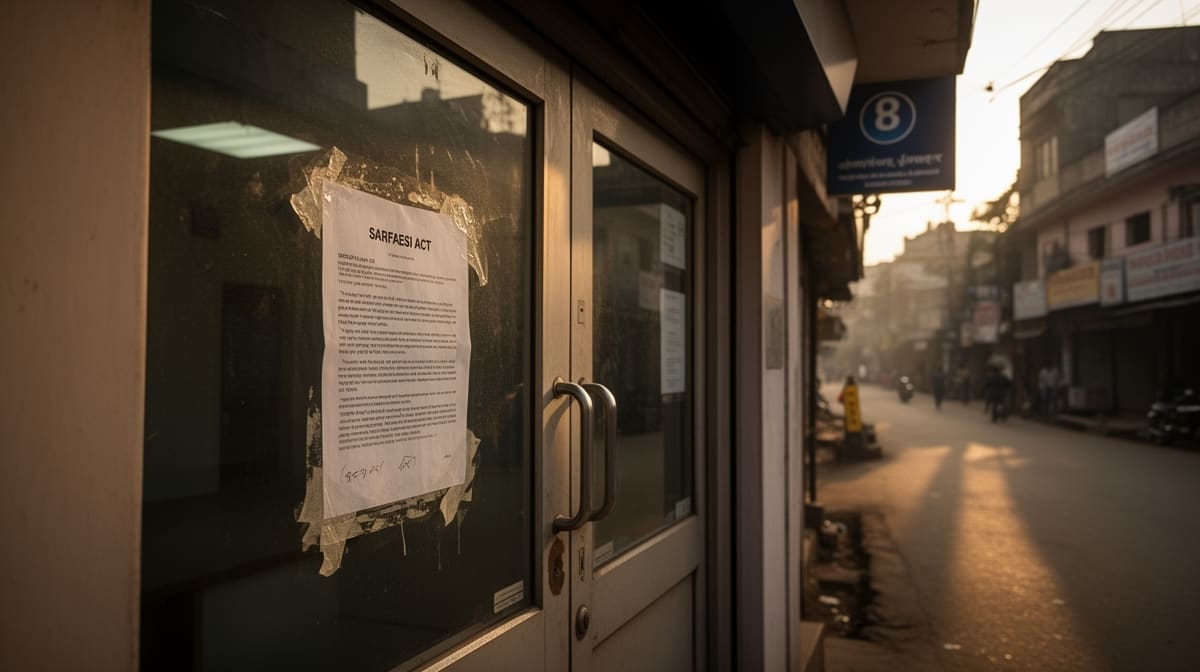
The Madhya Pradesh High Court has intervened in a matter under the Securitisation and Reconstruction of Financial Assets and Enforcement of Security Interest Act, 2002 (SARFAESI Act), granting interim relief to borrowers facing possession action by a bank. The Court directed the petitioners to deposit 10% of the outstanding dues within 30 days and stayed all coercive measures until the Debts Recovery Tribunal (DRT), Jabalpur, becomes functional and decides on the interim relief application in the pending securitisation appeal. This order follows the Supreme Court's recent precedent in E. Muthurathinasabathy & Others v. M/s. Sri International & Others, emphasizing the need for procedural safeguards during institutional delays.
Background & Facts
The Dispute
The petitioners, borrowers aggrieved by a possession notice dated 27.05.2026 issued by the State Bank of India under Section 14 of the SARFAESI Act, approached the High Court under Article 226 of the Constitution of India. The notice was issued pursuant to an order under the SARFAESI Act, empowering the bank to take possession of the secured assets. The petitioners contended that they had already filed a Securitisation Appeal before the Debts Recovery Tribunal (DRT), Jabalpur, but the tribunal was non-functional, leaving them without an effective remedy.
Key Facts
- 27.05.2026: Possession notice issued by the respondent bank under Section 14 of the SARFAESI Act
- Pre-27.05.2026: Petitioners had filed a Securitisation Appeal before the DRT, Jabalpur
- Status of DRT: Non-functional at the time of filing the writ petition
- Relief Sought: Stay on coercive action and interim protection pending disposal of the securitisation appeal
Procedural History
- Securitisation Appeal: Filed before the DRT, Jabalpur (date not specified in judgment)
- Writ Petition No. 20097 of 2026: Filed before the Madhya Pradesh High Court, Indore Bench, seeking relief under Article 226
- 10.06.2026: Present order passed by the High Court
The Parties' Positions
For the Petitioners
- Argued that the DRT, Jabalpur, was non-functional, leaving them without an effective remedy
- Contended that the bank's possession action was premature and coercive, given the pendency of the securitisation appeal
- Relied on the Supreme Court's decision in E. Muthurathinasabathy & Others v. M/s. Sri International & Others (SLP (C) No. 8850-8851 of 2023, dated 01.04.2026) to seek interim protection
For the Respondents
- Produced an order passed by the Coordinate Bench at Jabalpur in M/s. D.G. Oil Foods Pvt. Ltd. & Others v. Indian Bank (W.P. No. 12124/2026) to argue for a similar disposition
- Did not oppose the grant of interim relief subject to compliance with conditions
The Legal Issue
The primary question before the Court was whether interim relief could be granted to borrowers under the SARFAESI Act when the Debts Recovery Tribunal (DRT) was non-functional, thereby depriving them of an effective remedy against coercive action by secured creditors. Additionally, the Court had to determine the conditions under which such relief could be granted without prejudicing the rights of either party.
Arguments Presented
For the Petitioners
- Emphasized the non-functionality of the DRT, which rendered the securitisation appeal infructuous
- Cited the Supreme Court's decision in E. Muthurathinasabathy & Others v. M/s. Sri International & Others to argue that coercive action should be stayed pending the disposal of the appeal
- Contended that the bank's possession notice was premature and violated principles of natural justice
For the Respondents
- Relied on the order in M/s. D.G. Oil Foods Pvt. Ltd. & Others v. Indian Bank to argue that the Court should pass a similar conditional order
- Did not oppose the grant of interim relief but sought adequate safeguards to protect the bank's interests
The Court's Analysis
The Court observed that the petitioners had already filed a Securitisation Appeal before the DRT, Jabalpur, but the tribunal was non-functional. This situation left the petitioners without an effective remedy, necessitating the Court's intervention under Article 226. The Court relied on the Supreme Court's precedent in E. Muthurathinasabathy & Others v. M/s. Sri International & Others, which had laid down guidelines for granting interim relief in similar circumstances.
The Court balanced the interests of both parties by directing the petitioners to deposit 10% of the outstanding dues within 30 days, with 50% of this amount to be deposited within the first fortnight. This condition was imposed to ensure that the bank's financial interests were not unduly prejudiced. The Court further directed the DRT to expeditiously dispose of the securitisation appeal as soon as it became functional and stayed all coercive action against the petitioners until the interim relief application was decided.
"In view of the law laid down by the Apex Court arising out of SLP (C) No.8850-8851 of 2023 (E. Muthurathinasabathy & Others Vs. M/s. Sri International & Others with connected matters) dated 01/04/2026, we dispose of the present writ petition with the following directions...
The Court also clarified that it had not expressed any opinion on the merits of the case and left the parties free to approach it in case of excessive delay in the proceedings. Additionally, the Court directed the bank and the auction purchaser to strictly follow the procedure under Rule 9(1) of the Security Interest (Enforcement) Rules, 2002 to ensure transparency and fairness.
The Verdict
The writ petition was disposed of with the following directions:
- The petitioners were directed to deposit 10% of the outstanding dues with the respondent bank within 30 days from the date of the order (10.06.2026), with 50% of this amount to be deposited within the first fortnight.
- The DRT, Jabalpur, was directed to take up the securitisation appeal as soon as it became functional and decide the interim relief application expeditiously.
- No coercive action was to be taken against the petitioners until the interim relief application was decided by the DRT, subject to compliance with direction No. 1.
- The petitioners were directed to communicate the order to the Registrar, DRT, Jabalpur, within seven working days from the date of the order.
- In case of excessive delay in the proceedings, including delays in the appointment of the Presiding Officer or the assignment of additional charge to another DRT, the parties were free to approach the High Court.
- The auction purchaser and the bank were directed to follow the procedure under Rule 9(1) of the Security Interest (Enforcement) Rules, 2002.
- The Court expressly refrained from expressing any opinion on the merits of the case.
What This Means For Similar Cases
Interim Relief as a Safeguard Against Institutional Delays
This judgment underscores the High Court's role as a protector of borrowers' rights when institutional mechanisms like the DRT fail to function. Practitioners should note:
- Article 226 jurisdiction can be invoked when the statutory remedy (e.g., securitisation appeal) is rendered ineffective due to non-functionality of tribunals
- Courts are likely to grant interim relief to prevent irreparable harm, but such relief will be conditional to balance the interests of both parties
- The Supreme Court's precedent in E. Muthurathinasabathy & Others serves as a guiding principle for similar cases
Conditions for Granting Interim Relief
- Deposit of a percentage of dues: Courts may require borrowers to deposit a portion of the outstanding amount (e.g., 10%) as a precondition for staying coercive action
- Strict timelines: Compliance with deposit conditions will be subject to specific timelines (e.g., 30 days, with 50% within the first fortnight)
- Communication of orders: Borrowers may be required to communicate the court's orders to the tribunal within a stipulated timeframe (e.g., seven working days)
Procedural Compliance Under SARFAESI Act
- Rule 9(1) of the Security Interest (Enforcement) Rules, 2002: Secured creditors and auction purchasers must strictly adhere to the procedural requirements under this rule to avoid legal challenges
- Transparency in enforcement: Any deviation from the prescribed procedure may render the possession or auction process vulnerable to judicial scrutiny
Practitioners should advise clients to ensure full compliance with procedural rules to mitigate the risk of legal setbacks.