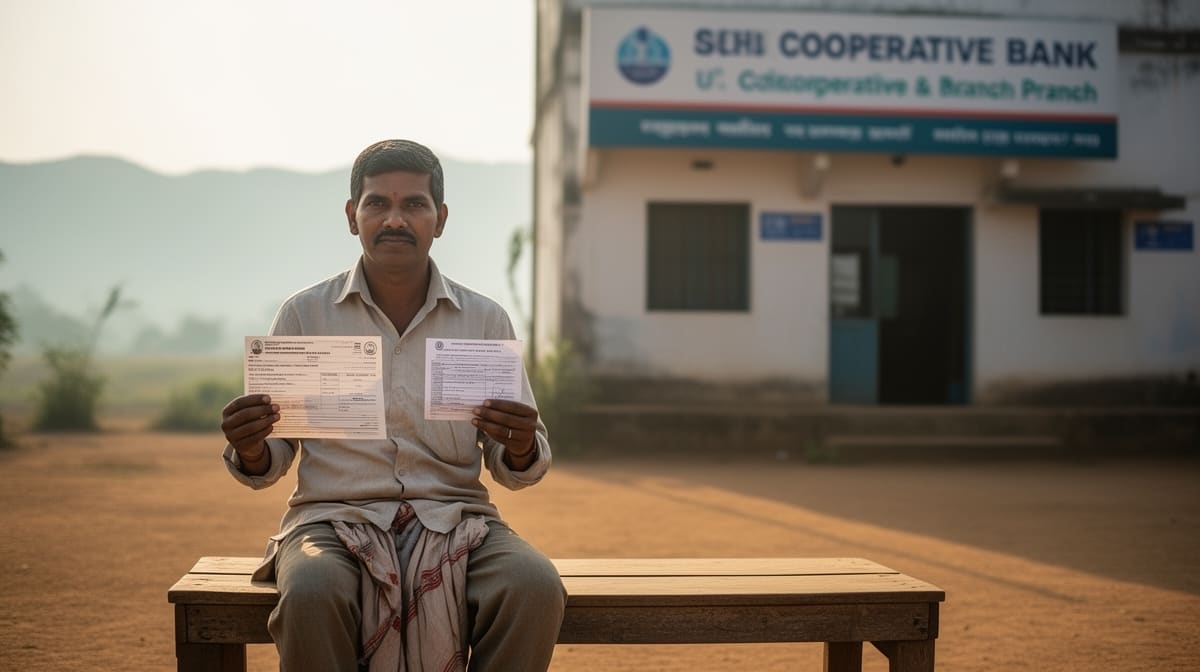
In a significant intervention protecting small farmers from coercive recovery measures, the Allahabad High Court has directed that land auction be stayed if a borrower agrees to repay an outstanding agricultural loan in structured installments. The judgment underscores the principle that financial hardship arising from crop failure does not justify immediate dispossession of livelihood assets.
Background & Facts
The Dispute
The petitioner, Baliram (Balram Verma), a small farmer from District Balrampur, Uttar Pradesh, availed a loan from a public sector bank under a government-sponsored agricultural credit scheme. Due to poor crop yield in the preceding agricultural season, he was unable to repay the outstanding amount of Rs. 1,53,430/-. The bank issued a recovery certificate and initiated proceedings under the Uttar Pradesh Recovery of Public Money Act, leading to the publication of an auction notice for his agricultural land bearing Gata No. 65/36. The auction was scheduled for 19.06.2026.
Key Facts
- The petitioner’s loan account number is 90400100072946
- The outstanding amount as per the recovery certificate is Rs. 1,53,430/-
- The auction notice was published on 15.04.2026
- The auction date is fixed for 19.06.2026
- The petitioner has no other source of income apart from farming
- He has submitted a written request for restructuring the loan into manageable installments
- He offered to deposit a substantial portion of the dues immediately to demonstrate bona fides
Procedural History
- 15.04.2026: Auction notice issued by District Magistrate, Balrampur, under recovery proceedings
- 19.06.2026: Scheduled date of land auction
- 05.06.2026: Writ Petition (WP(C) No. 6482 of 2026) filed before the Allahabad High Court, Lucknow Bench
- 18.06.2026: Hearing conducted before Hon’ble Justice Arun Kumar Singh Deshwal
Relief Sought
The petitioner sought:
- Quashing of the auction notice dated 15.04.2026
- A direction to the bank to provide a correct statement of the loan account
- A prohibition on coercive recovery actions, including auction
- Permission to repay the loan in easy installments
The Parties' Positions
Petitioner: Argued that he is a destitute farmer whose only asset is the land under threat of auction. He has no capacity to pay the entire amount at once and seeks a humane, structured repayment plan. He offered to deposit Rs. 50,000/- immediately as a gesture of good faith.
Respondents (State and Bank): The bank’s counsel did not oppose the petitioner’s request for an installment plan, provided the entire dues are repaid in a structured manner. The State did not contest the humanitarian aspect of the relief sought.
The Legal Issue
The central question was whether a court may intervene to prevent the auction of a farmer’s land for recovery of an agricultural loan when the borrower demonstrates genuine inability to pay in lump sum and offers a feasible repayment plan.
Arguments Presented
For the Petitioner
The petitioner’s counsel relied on the constitutional right to livelihood under Article 21 and the principle of proportionality in state action. He cited State of U.P. v. Rakesh Kumar to argue that recovery proceedings must not result in disproportionate hardship. He emphasized that the land is the petitioner’s sole means of sustenance and that auction would render him homeless and destitute. He offered to deposit Rs. 50,000/- immediately and proposed a three-installment repayment plan.
For the Respondent
The counsel for the bank did not oppose the petitioner’s proposal. He confirmed that the bank is willing to accept repayment in installments if the petitioner deposits an initial sum and commits to a clear schedule. He stated that the bank’s objective is recovery, not dispossession, and that the auction was a procedural step, not an end in itself.
The Court's Analysis
The Court observed that while banks have a statutory right to recover dues, the manner of recovery must be reasonable and proportionate. The Court noted that the petitioner is not a wilful defaulter but a victim of agricultural distress. The auction of land, which constitutes the petitioner’s primary asset and source of livelihood, would amount to a disproportionate response.
"The recovery of a loan cannot be permitted to result in the destruction of the borrower’s means of subsistence, particularly when the borrower is a small farmer who has offered a credible repayment plan."
The Court further held that the bank’s willingness to accept installments, coupled with the petitioner’s offer to deposit Rs. 50,000/- immediately, demonstrates a mutual intent to resolve the matter without resorting to coercive measures. The Court emphasized that judicial intervention is warranted to prevent irreparable harm to a vulnerable section of society.
The Court rejected the notion that procedural compliance with recovery laws absolves the authorities of their duty to act equitably. It held that the spirit of agricultural credit schemes is to support farmers, not to penalize them for circumstances beyond their control.
The Verdict
The petitioner succeeded. The Court directed that if the petitioner deposits Rs. 50,000/- within ten days of the order, the auction scheduled for 19.06.2026 shall not be confirmed. The petitioner must submit a representation to the Branch Manager for a correct loan statement within two days of deposit, which the Manager must respond to within ten days. The remaining outstanding amount shall be repaid in three monthly installments: Rs. 34,477/- on 20.07.2026, Rs. 34,477/- on 20.08.2026, and Rs. 34,476/- on 21.09.2026. If all installments are paid on time, recovery proceedings shall remain stayed. Failure to comply will permit the bank to resume recovery proceedings under law.
What This Means For Similar Cases
Installment Plans Are a Legal Right, Not a Concession
- Practitioners representing farmers facing land auctions must now argue that proportionality and livelihood protection are integral to recovery proceedings
- Courts may intervene even before auction if a credible repayment plan is offered
- Banks cannot insist on lump-sum payment when the borrower’s inability is due to agrarian distress
Documentation Must Precede Enforcement
- Before initiating auction, banks must provide a clear, verified account statement upon request
- Failure to furnish accurate statements invalidates the procedural basis for recovery
- Petitioners can now demand account reconciliation as a precondition to any coercive action
Judicial Discretion Overrides Rigid Recovery Procedures
- The judgment establishes that courts have inherent power to modify recovery methods under Article 226 to prevent manifest injustice
- Recovery certificates are not final or unchallengeable if they lead to disproportionate outcomes
- This precedent applies to all agricultural loan recovery cases under state recovery acts