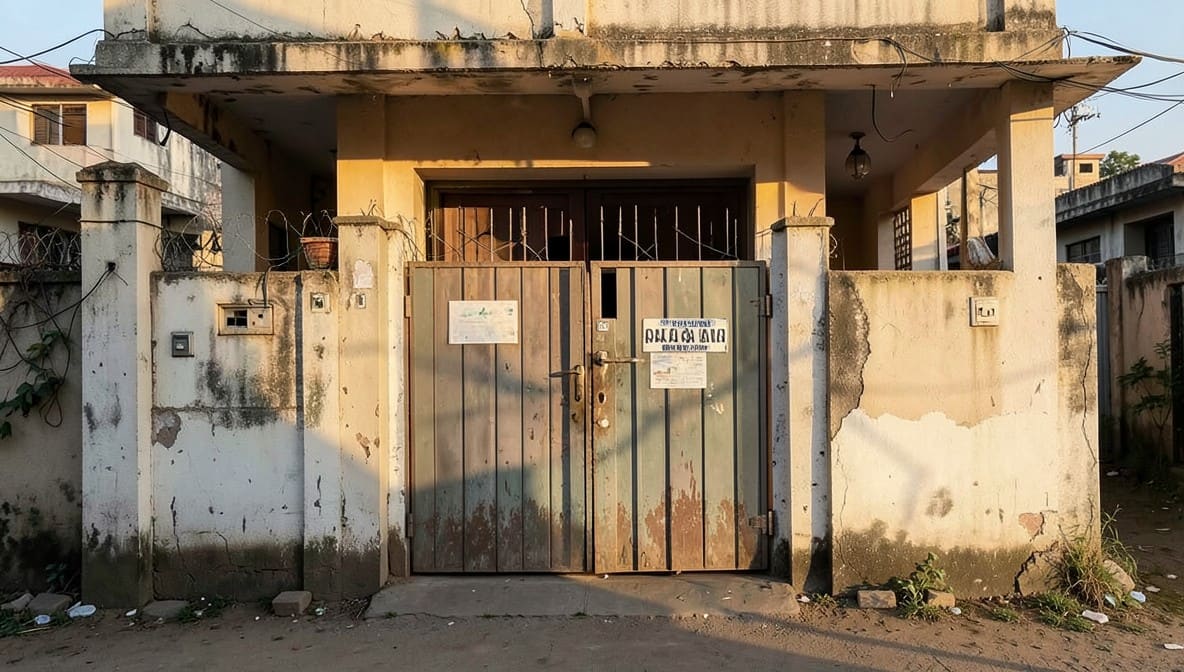
The Madhya Pradesh High Court has intervened to prevent the auction of a petitioners' residential property under the SARFAESI Act, emphasizing that procedural fairness and the functional incapacity of the Debts Recovery Tribunal must override aggressive recovery tactics by financial institutions. This order reinforces the principle that courts must act as a check against institutional arbitrariness, particularly when borrowers have demonstrated substantial compliance and the adjudicatory forum is incapacitated.
Background & Facts
The Dispute
The petitioners, Shri Murali Das and others, availed a housing loan of Rs. 7,50,000 from Respondent No. 2, a financial institution, for the purchase of a residential property. They made regular Equated Monthly Installment (EMI) payments until the outbreak of the COVID-19 pandemic in early 2020, which triggered nationwide lockdowns and severe financial hardship. This led to a temporary default on a few installments.
Key Facts
- The loan was disbursed in 2018, with EMIs scheduled to be paid monthly until full repayment
- The loan account was declared a Non-Performing Asset (NPA) by the bank in 2021
- The bank issued notices under Section 13(2) and Section 13(4) of the SARFAESI Act in 2021
- On 18/05/2022, the Debts Recovery Tribunal (DRT), Jabalpur, passed an interim order directing the petitioners to deposit Rs. 2,00,000 as a condition to maintain the status quo
- The petitioners deposited Rs. 1,99,990 on 20/05/2022, nearly the full amount directed
- The bank, despite this compliance, filed a fresh application under Section 14 of the SARFAESI Act before the Additional District Magistrate (ADM), Dewas
- The ADM passed an ex-parte order on 11/11/2025, authorizing possession
- Physical possession of the property was taken by the bank on 09/01/2026
- An auction notice was issued, scheduling the sale of the property for 26/06/2026, at a claimed demand of Rs. 13,60,373
- The petitioners had already repaid approximately 75% of the outstanding loan amount
- The DRT at Jabalpur has been non-functional since late 2024 due to the absence of a Presiding Officer
Procedural History
- 2021: Loan declared NPA; Section 13(2) and 13(4) notices issued
- 18/05/2022: DRT Jabalpur passes interim order directing deposit of Rs. 2,00,000 and restraining possession
- 20/05/2022: Petitioners deposit Rs. 1,99,990 in compliance
- 11/11/2025: ADM Dewas passes ex-parte order under Section 14 of SARFAESI Act
- 09/01/2026: Bank takes physical possession of the residential property
- 15/01/2026: Auction notice issued for 26/06/2026
- 22/01/2026: Petitioners file Writ Petition No. 2932/2026 before Madhya Pradesh High Court
- 06/02/2026: High Court stays auction and directs petitioners to approach DRT within seven days
- 24/03/2026: DRT Lucknow (holding charge) directs that no action be taken pending final adjudication
- 25/06/2026: Present writ petition (WP No. 22342 of 2026) heard and decided by Division Bench
The Parties' Positions
Petitioners: Argued that they acted in good faith, complied with the DRT’s order, and that the bank concealed material facts when approaching the ADM. They emphasized that the property is their only residence and that the auction demand is inflated. They contended that the bank exploited the DRT’s non-functioning to bypass judicial oversight.
Respondent Bank: Did not file a detailed counter-affidavit. The Government Advocate merely submitted that the bank had followed the SARFAESI Act’s procedural requirements and that the ADM’s order was valid.
Relief Sought
The petitioners sought:
- Quashing of the ADM’s order dated 11/11/2025
- Setting aside of the possession notice dated 09/01/2026
- Stay of the scheduled auction on 26/06/2026
- Restraint on alienation or third-party transfer of the property
- Direction to the bank to resume negotiations or proceed only before the DRT
The Legal Issue
The central question was whether a secured creditor may proceed under Section 14 of the SARFAESI Act to obtain possession and auction a residential property, after a Debts Recovery Tribunal has already issued a protective interim order and the borrower has fully complied with it, particularly when the Tribunal is non-functional and the creditor conceals these facts from the executing authority.
Arguments Presented
For the Petitioner
The petitioners relied on the principle of bona fide conduct and the doctrine of equitable estoppel. They cited M/s. Muthoot Finance Ltd. v. M/s. Sree Lakshmi Enterprises to argue that courts must consider the borrower’s conduct and repayment history before permitting enforcement. They emphasized that the DRT’s order was binding and that the bank’s failure to disclose its existence to the ADM rendered the Section 14 proceeding vitiated by fraud on the court. They further invoked Sarvesh Kumar v. Union of India to assert that residential property cannot be treated as a mere asset for auction without considering the human impact.
For the Respondent
The Respondent, through the Government Advocate, did not contest the factual assertions regarding the DRT’s order or the petitioners’ compliance. The submission was limited to a procedural defense that the bank had followed the statutory steps under SARFAESI Act and that the ADM’s order was valid on its face. No affidavit or evidence was filed to rebut the petitioners’ claims of concealment.
The Court's Analysis
The Court undertook a rigorous examination of the procedural sequence and the conduct of the secured creditor. It noted that the petitioners had not merely made partial payments but had complied with a specific, binding direction of the DRT, which was issued after a full hearing and on the basis of the petitioners’ demonstrated repayment capacity.
"The secured creditor, by suppressing the existence of the DRT’s protective order and the petitioners’ compliance, has effectively misled the ADM into exercising jurisdiction under Section 14 without full knowledge of the pending adjudication. This constitutes a clear abuse of process."
The Court held that the SARFAESI Act is not a tool for circumventing the DRT’s jurisdiction. The Act’s procedural safeguards, including the requirement of notice and opportunity to be heard, are not mere formalities but essential to prevent oppression. The Court emphasized that the DRT’s non-functioning cannot be weaponized by creditors to bypass judicial oversight.
It further observed that the property in question is a residential dwelling, and the auction of such property under these circumstances would violate the principle of proportionality and the right to shelter under Article 21 of the Constitution. The Court rejected the notion that a creditor’s right to recover must prevail over a borrower’s right to housing, especially when 75% of the debt has been discharged and a further Rs. 2 lakh has been deposited as directed.
The Court also noted that the bank’s demand of Rs. 13,60,373 appeared inflated, as the original loan was Rs. 7,50,000 and over 75% had been repaid. The absence of any detailed statement of account or reconciliation further undermined the bank’s claim.
The Verdict
The petitioners succeeded. The Court stayed the operation of the ADM’s order dated 11/11/2025 and the possession notice dated 09/01/2026. The scheduled auction on 26/06/2026 is permanently stayed. The bank is restrained from creating any third-party rights, alienating, or transferring the property. This stay remains in force until the DRT at Jabalpur resumes physical or virtual functioning. Upon resumption, the petitioners must immediately pursue their pending application before the DRT, which shall adjudicate the matter on its merits without being influenced by this Court’s observations.
What This Means For Similar Cases
DRT Non-Functioning Cannot Justify Bypassing Judicial Oversight
- Practitioners must now argue that any SARFAESI enforcement initiated while the DRT is non-functional and a stay order exists is procedurally invalid
- Banks must disclose all pending DRT proceedings when filing Section 14 applications
- Courts may intervene even before the DRT resumes if the borrower’s rights are at imminent risk
Residential Property Warrants Greater Protection
- Courts will treat residential property differently from commercial assets under SARFAESI
- Repayment of 75% or more of the principal, coupled with compliance with DRT directions, creates a strong presumption against auction
- The human impact of eviction must be weighed in every enforcement proceeding
Concealment of Material Facts Vitiates Section 14 Proceedings
- Failure to disclose a DRT stay order to the ADM renders the Section 14 order voidable
- Courts will treat such concealment as fraud on the court, warranting quashing
- Banks must maintain full transparency in all filings under SARFAESI Act