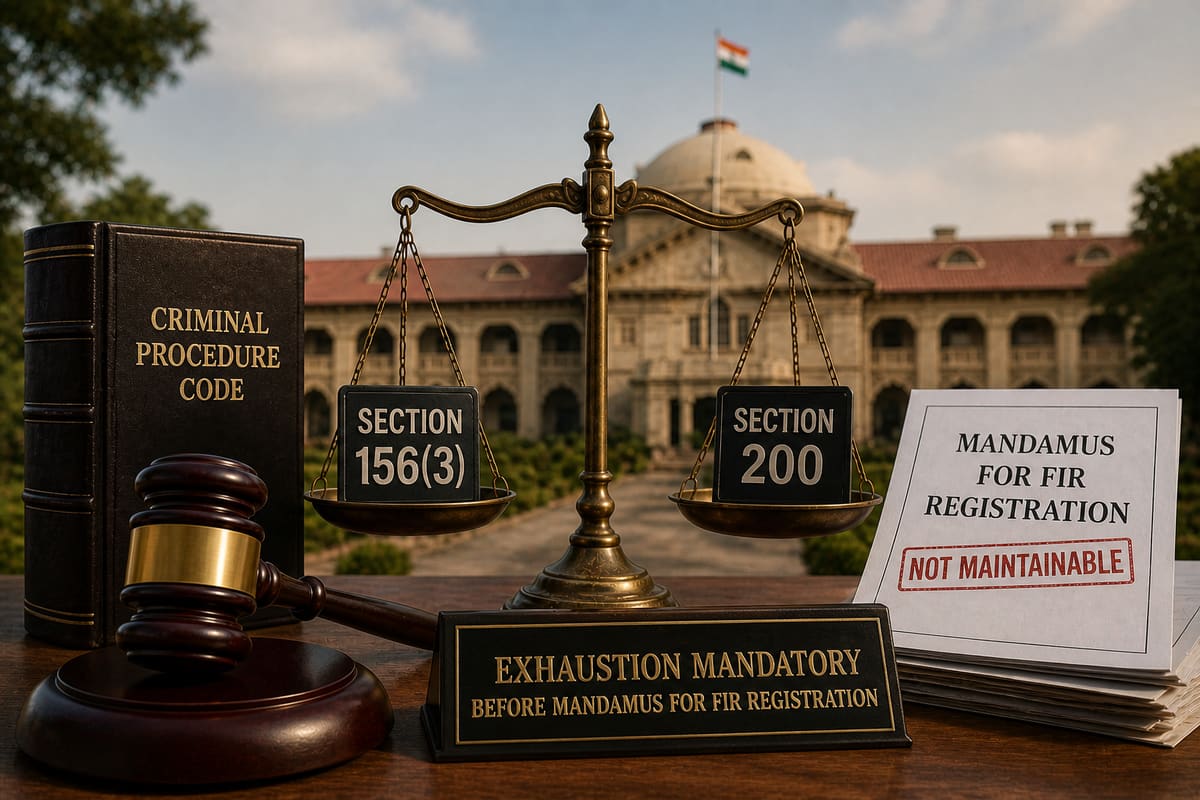
The Madhya Pradesh High Court has reaffirmed the principle that courts cannot interfere with the discretion of competent authorities to grant sanction for prosecution or direct registration of an FIR. The judgment underscores that aggrieved parties must exhaust alternative remedies under the Code of Criminal Procedure, 1973 (CrPC), such as approaching the Magistrate under Section 156(3), rather than invoking writ jurisdiction under Article 226 of the Constitution of India.
Background & Facts
The Dispute
The appellant, Amar Panjwani, filed a writ petition under Article 226 seeking a mandamus to direct the respondents - including the State of Madhya Pradesh and the Madhya Pradesh State Civil Supplies Corporation - to decide his complaint (Annexure P/3) and grant sanction for prosecuting Devendra Tiwari, the District Manager of the Corporation. The appellant alleged inaction on his complaint, which sought sanction for prosecution under unspecified provisions.
Key Facts
- The appellant’s complaint (Annexure P/3) sought sanction to prosecute Devendra Tiwari, an official of the Madhya Pradesh State Civil Supplies Corporation, Katni.
- The writ petition was initially tagged with WP (C) No. 530 of 2002 and WP (C) No. 221 of 2002 by order dated 24.02.2003, but was later delinked.
- The appellant’s grievance pertained to two distinct issues:
- Non-registration of an FIR by the police.
- Non-grant of sanction for prosecution by the competent authority.
Procedural History
- 21.01.2026: The learned Single Judge dismissed the writ petition, holding:
- For non-registration of FIR: The appellant had an efficacious alternative remedy under Section 175 of the Bharatiya Nagarik Suraksha Sanhita (BNSS) (formerly Section 154 CrPC), i.e., approaching the jurisdictional Magistrate.
- For grant of sanction: The decision lay within the domain of the competent authority, and no direction could be issued by the court to grant sanction.
- 2026: The appellant filed the present Writ Appeal No. 1071 of 2026 challenging the Single Judge’s order.
Relief Sought
The appellant sought:
- A direction to the respondents to decide his complaint (Annexure P/3) and pass a speaking order in accordance with law.
- Mandamus to compel the respondents to grant sanction for prosecution and register an FIR.
The Legal Issue
The central question before the Division Bench was whether a High Court, under Article 226, can:
- Direct a competent authority to grant sanction for prosecution, thereby overriding its discretion.
- Compel the police to register an FIR when an alternative remedy under the CrPC exists.
Arguments Presented
For the Appellant
- The appellant contended that he had merely sought a direction to the respondents to decide his application for sanction, not an order granting sanction itself.
- Reliance was placed on the principle that judicial review of administrative decisions is permissible to ensure fairness and non-arbitrariness.
For the Respondents
- The respondents argued that the appellant’s grievances - both regarding non-registration of FIR and non-grant of sanction - were not amenable to writ jurisdiction under Article 226.
- They relied on Supreme Court precedents, including Mansukhlal Vithaldas Chauhan v. State of Gujarat and Sakiri Vasu v. State of Uttar Pradesh, which emphasize that alternative remedies under the CrPC must be exhausted before approaching the High Court.
The Court's Analysis
The Division Bench conducted a detailed examination of judicial precedents and statutory provisions to determine the scope of writ jurisdiction in matters involving sanction for prosecution and FIR registration.
Discretion of Competent Authority to Grant Sanction
The Court relied on Mansukhlal Vithaldas Chauhan v. State of Gujarat, which held:
"Since the validity of 'Sanction' depends on the applicability of mind by the sanctioning authority to the facts of the case as also the material and evidence collected during investigation, it necessarily follows, that the sanctioning authority has to apply its own independent mind for the generation of genuine satisfaction whether prosecution has to be sanctioned or not. The mind of the sanctioning authority should not be under pressure from any quarter nor should any external force be acting upon it to take decision one way or the other. Since the discretion to grant or not to grant sanction vests absolutely in the sanctioning authority, its discretion should be shown to have not been affected by any extraneous consideration."
The Court concluded that granting or refusing sanction is a discretionary power vested in the competent authority, and no court can compel the authority to exercise its discretion in a particular manner. Any such direction would amount to usurping the authority’s independent judgment, which is impermissible under law.
Alternative Remedies for Non-Registration of FIR
The Court extensively cited Supreme Court judgments to establish that writ jurisdiction under Article 226 is not the appropriate remedy for compelling the police to register an FIR. Key precedents included:
-
Aleque Padamsee v. Union of India:
"Whenever any information is received by the police about the alleged commission of offence which is a cognizable one there is a duty to register the FIR. There can be no dispute on that score. The only question is whether a writ can be issued to the police authorities to register the same. The basic question is as to what course is to be adopted if the police does not do it. As was held in All India Institute of Medical Sciences Employees' Union v. Union of India, the remedy available is as set out above by filing a complaint before the Magistrate."
-
Sakiri Vasu v. State of Uttar Pradesh:
"If a person has a grievance that the police station is not registering his FIR under Section 154 CrPC, then he can approach the Superintendent of Police under Section 154(3) CrPC by an application in writing. Even if that does not yield any satisfactory result in the sense that either the FIR is still not registered, or that even after registering it no proper investigation is held, it is open to the aggrieved person to file an application under Section 156(3) CrPC before the learned Magistrate concerned. If such an application under Section 156(3) is filed before the Magistrate, the Magistrate can direct the FIR to be registered and also can direct a proper investigation to be made."
-
Sudhir Bhaskarrao Tambe v. Hemant Yashwant Dhage:
"The remedy of the aggrieved person is not to go to the High Court under Article 226 of the Constitution of India, but to approach the Magistrate concerned under Section 156(3) CrPC. If such an application under Section 156(3) CrPC is made and the Magistrate is, prima facie, satisfied, he can direct the FIR to be registered, or if it has already been registered, he can direct proper investigation to be done."
The Court emphasized that High Courts should not entertain writ petitions for such reliefs, as it would lead to flooding of writ petitions, diverting judicial resources from more pressing matters. Instead, the Magistrate is empowered to direct registration of FIR and monitor investigation under Section 156(3) CrPC.
Precedent from Madhya Pradesh High Court
The Court also relied on a Division Bench judgment of the Gwalior Bench in Shweta Bhadauria v. State of M.P., which held:
"(1) Writ of mandamus to compel the police to perform its statutory duty under Section 154 CrPC can be denied to the informant/victim for non-availing of alternative remedy under Sections 154(3), 156(3), 190, and 200 CrPC, unless the four exceptions enumerated in Whirlpool Corporation v. Registrar of Trade Marks come to the rescue of the informant/victim."
The Court reiterated that alternative remedies under the CrPC must be exhausted before invoking writ jurisdiction, unless exceptional circumstances exist.
The Verdict
The Division Bench dismissed the Writ Appeal No. 1071 of 2026, upholding the Single Judge’s order dated 21.01.2026. The Court clarified:
- No direction can be issued to the competent authority to grant sanction for prosecution, as it is a discretionary power vested in the authority.
- No mandamus can be issued to compel the police to register an FIR, as the appellant has an alternative remedy under Section 156(3) CrPC before the Magistrate.
- The Government was directed to decide the appellant’s prayer for sanction within three months from the date of receipt of the order, but no opinion was expressed on the merits of the case.
What This Means For Similar Cases
Courts Cannot Override Discretion of Competent Authorities
- Sanction for prosecution is a discretionary power vested in the competent authority. Courts cannot direct the authority to grant sanction, as it would amount to interfering with the authority’s independent judgment.
- Practitioners must argue on the merits of the case before the sanctioning authority, ensuring that all relevant material is placed before it for an informed decision.
- Judicial review is limited to ensuring that the authority’s decision is not arbitrary, mala fide, or influenced by extraneous considerations.
Alternative Remedies Must Be Exhausted Before Invoking Writ Jurisdiction
- Non-registration of FIR: Aggrieved parties must first approach the Superintendent of Police under Section 154(3) CrPC or the Magistrate under Section 156(3) CrPC.
- The Magistrate can direct registration of FIR and monitor investigation, including recommending a change of investigating officer if necessary.
- Writ petitions for such reliefs are not maintainable unless exceptional circumstances exist, such as mala fide action by the police.
- Non-grant of sanction: The Government must be given an opportunity to decide the matter independently, and courts can only direct timely disposal without expressing any opinion on the merits.
When Can Writ Jurisdiction Be Invoked?
- Rarest of rare cases: Writ jurisdiction under Article 226 can be invoked only if there is clear abuse of power or non-compliance with statutory provisions by the investigating agency.
- No direction on investigation: Even in such cases, the High Court cannot direct how the investigation should be conducted but can only insist on observance of due process.
- Exceptional circumstances: The four exceptions enumerated in Whirlpool Corporation v. Registrar of Trade Marks may allow invocation of writ jurisdiction, but these are narrowly construed.
Practitioners must advise clients to exhaust alternative remedies under the CrPC before approaching the High Court, as writ jurisdiction is not a substitute for statutory remedies.