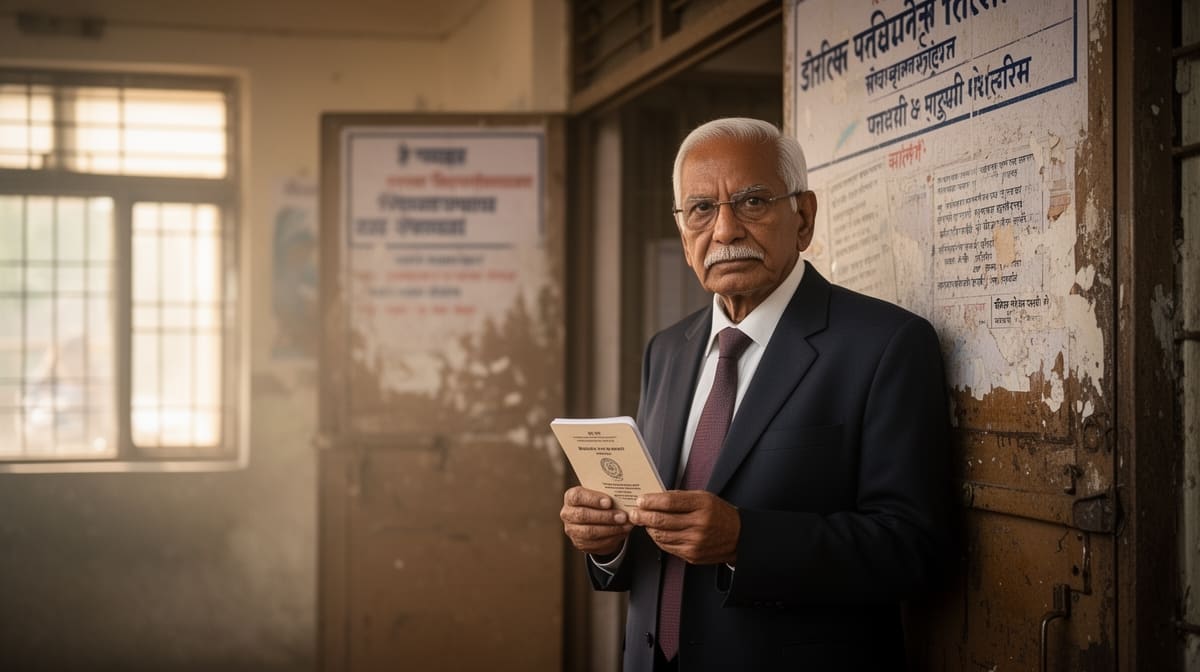
The Madhya Pradesh High Court has clarified that the mere pendency of a criminal case against a retired government servant, without any concurrent departmental proceedings or finding of misconduct, cannot justify the withholding of pensionary benefits. This ruling reinforces the principle that service benefits are statutory entitlements, not contingent on unproven criminal allegations.
Background & Facts
The Dispute
The petitioner, Vijay Kumar Punj, a retired government servant, sought the issuance of his full pension, gratuity, and other terminal dues, which had been withheld by the State of Madhya Pradesh on account of a pending criminal case registered against him during his tenure. The petitioner contended that no government dues were outstanding and that the criminal case did not warrant denial of statutory pensionary rights.
Key Facts
- The petitioner served in government service and retired on superannuation
- A criminal case was registered against him relating to actions taken during the course of his official duties
- The alleged conduct formed the basis of the criminal case, but no departmental enquiry was initiated
- The petitioner was permitted to retire without any suspension, show-cause notice, or departmental proceedings
- No government dues were pending against him as per his submission
- The State acknowledged the criminal case was pending but did not allege any proven misconduct or financial irregularity
- The petitioner relied on Section 197 of the CrPC, asserting his actions were protected as official duties performed in good faith
Procedural History
- The petitioner submitted representations for release of pensionary benefits, which remained unaddressed
- No departmental proceedings were initiated prior to or after retirement
- The petitioner filed this writ petition under Article 226 of the Constitution of India on an unspecified date in 2025
- The matter was heard by the High Court of Madhya Pradesh at Jabalpur on 01.04.2026
Relief Sought
The petitioner sought:
- Issuance of a Pension Payment Order (P.P.O.)
- Payment of full pension, gratuity, and other terminal dues
- Interest at 12% per annum on delayed payments
- Costs of litigation
The Parties' Positions
For the Petitioner:
- No government dues are outstanding
- Section 197 CrPC protects official acts done in good faith
- No departmental enquiry was conducted, and retirement was permitted without conditions
- Withholding pension violates Article 14 and Article 300A of the Constitution
- Pension and gratuity are statutory rights, not privileges subject to criminal outcome
For the Respondent (State):
- A criminal case is pending against the petitioner arising from his official duties
- The outcome of the criminal case may lead to conviction
- Therefore, gratuity and pensionary benefits are being withheld as a precautionary measure
Relief Sought
The petitioner seeks issuance of a Pension Payment Order, payment of full pension, gratuity, and terminal dues with 12% interest per annum, and litigation costs.
The Legal Issue
Can the State withhold pensionary benefits, including gratuity, solely on the ground of a pending criminal case against a retired government servant, in the absence of any departmental enquiry or finding of misconduct?
Arguments Presented
For the Petitioner
The petitioner’s counsel relied on the settled principle that pension and gratuity are statutory rights accrued upon completion of service, and cannot be denied merely because a criminal case is pending. He cited State of Punjab v. Baldev Singh and Union of India v. T.R. Sharma to argue that absence of departmental proceedings and the fact that the petitioner was permitted to retire without suspension or enquiry, negated any basis for withholding benefits. He emphasized that Section 197 CrPC provides statutory protection for acts done in official capacity in good faith, and the State cannot use the pendency of a criminal case as a proxy for proven guilt.
For the Respondent
The Government Advocate contended that since the criminal case arose from acts performed during official duty, and a conviction could potentially lead to forfeiture of benefits under relevant rules, the State was justified in withholding payment until the criminal outcome is determined. He argued that the State has a duty to safeguard public funds and that the petitioner’s conduct, even if protected under Section 197, remains under judicial scrutiny.
The Court's Analysis
The Court examined the procedural posture of the case and found that no departmental enquiry had been initiated against the petitioner, despite the registration of a criminal case. The petitioner was allowed to retire without any conditions, suspension, or inquiry, which indicated that the authorities did not consider his conduct to warrant administrative action. The Court noted that the State’s power to withhold pensionary benefits is not absolute and must be exercised only after due process under the applicable pension rules.
"The mere pendency of a criminal case, without any concurrent departmental proceedings or finding of misconduct, cannot be a ground to deny statutory pensionary benefits. The State cannot substitute judicial process for administrative due process."
The Court distinguished between criminal liability and service consequences. It held that while a conviction may lead to forfeiture under Rule 64 of the M.P. Civil Services (Pension) Rules, 1976, mere accusation or pendency cannot justify withholding benefits. The absence of departmental action, coupled with the petitioner’s unchallenged retirement, rendered the State’s refusal arbitrary and violative of Article 14 of the Constitution.
The Court further observed that the State’s reliance on potential future conviction was speculative and contrary to the presumption of innocence. The petitioner had not been found guilty, nor had any inquiry been conducted to establish misconduct. Therefore, the denial of benefits was legally unsustainable.
The Verdict
The writ petition is allowed. The State is directed to issue the Pension Payment Order and pay all pensionary benefits, including gratuity and terminal dues, to the petitioner within 120 days from the date of receipt of the certified copy of this order. Interest at 12% per annum shall be payable on the delayed amounts from the date of retirement until actual payment. Costs of litigation are awarded in favor of the petitioner.
What This Means For Similar Cases
Pension Rights Are Statutory, Not Conditional on Criminal Outcomes
- Practitioners must argue that pension and gratuity are accrued rights under service rules, not discretionary benefits
- Withholding benefits pending criminal trial, without departmental proceedings, is legally untenable
- The burden lies on the State to initiate departmental action if misconduct is alleged - not on the retiree to prove innocence
Absence of Departmental Action Is Fatal to Withholding Claims
- If a government servant is permitted to retire without suspension or enquiry, the State loses the right to later withhold benefits on the basis of a pending criminal case
- Any recovery of dues must follow Rule 64 of the M.P. Civil Services (Pension) Rules, 1976, which requires a formal order after due process
- This judgment reinforces that administrative due process cannot be bypassed by invoking criminal proceedings
Section 197 CrPC Protection Reinforces Service Entitlements
- Acts performed in good faith under official duty, protected under Section 197 CrPC, cannot be used to justify denial of service benefits
- The State cannot use the threat of criminal prosecution as leverage to delay statutory payments
- This precedent applies equally to police officers, revenue officials, and other public servants facing similar circumstances