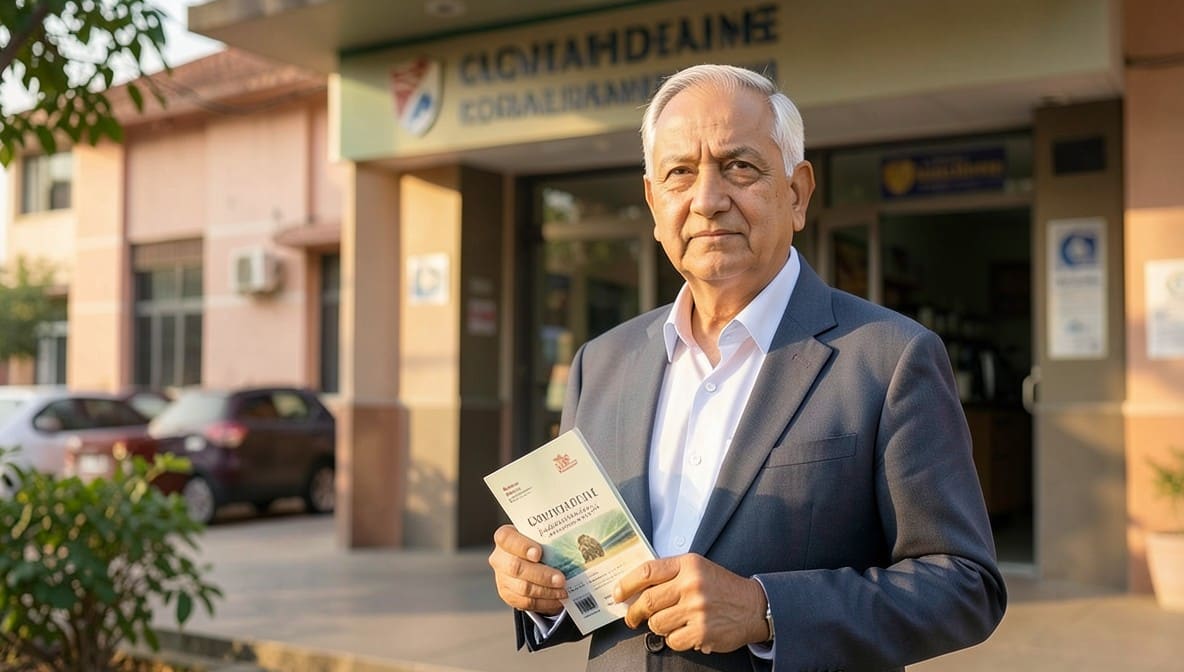
The Madhya Pradesh High Court has clarified that the mere registration of an FIR against a government servant, without any subsequent charge sheet or judicial proceeding, cannot justify the withholding of retiral benefits. This ruling reinforces the principle that administrative action must not preempt judicial outcomes, particularly when departmental proceedings have already exonerated the employee.
Background & Facts
The Dispute
The petitioner, Ram Avtar Singh Tomar, a retired employee of Jila Sahkari Kendriya Bank, was denied his full retiral dues - including pension, gratuity, leave encashment, GIS, and FBF - on the ground that an FIR had been registered against him by the Economic Offences Wing (EOW). Despite the completion of a departmental enquiry in which he was fully exonerated, and with no charge sheet filed before any court, the bank withheld his benefits.
Key Facts
- The petitioner retired on superannuation on 30.09.2017 (Annexure P-2)
- An FIR was registered against him by the EOW prior to retirement (Annexure P-6)
- A departmental enquiry was conducted and concluded with a finding of exoneration
- No charge sheet or challan was filed by the EOW before any court as of the date of retirement or at the time of the petition
- The petitioner’s retiral dues remained unpaid despite repeated representations
- The bank relied solely on the existence of the FIR to justify non-payment
Procedural History
- 30.09.2017: Petitioner retired on superannuation
- Post-retirement: Retiral dues withheld by respondent No. 1 (Bank)
- Before filing petition: Petitioner made representations to the bank and relevant authorities, all of which were ignored
- 2018: Writ Petition No. 29121 of 2018 filed before the High Court at Gwalior under Article 226 of the Constitution
- 06.05.2026: Judgment delivered by Hon’ble Justice Anand Singh Bahrawat
Relief Sought
The petitioner sought:
- Immediate release of all retiral dues including pension, gratuity, leave encashment, GIS, and FBF
- Interest at 18% per annum on the withheld amounts
- Any other relief deemed just by the Court
The Legal Issue
The central question was whether the withholding of pension and gratuity under Rule 9 and Rule 64 of the CCS (Pension) Rules, 1972 is legally permissible solely on the basis of an uncharged FIR, where the departmental enquiry has resulted in exoneration and no charge sheet has been filed.
Arguments Presented
For the Petitioner
The petitioner’s counsel relied on the precedent set in Arun Kumar Pandey v. State of M.P. (W.P. No. 8047/2016), where the Principal Seat at Jabalpur held that the registration of an FIR alone does not constitute a "judicial proceeding instituted" within the meaning of Rule 64. It was argued that judicial proceedings commence only upon the filing of a charge sheet and commencement of evidence on oath. The petitioner further cited Dhirendra Pal Singh, D.D. Tiwari, and Ramesh Chandra Gupta to establish that withholding benefits without a final conviction violates principles of natural justice and the spirit of pension rules.
For the Respondent
The respondents’ counsel defended the withholding of dues, asserting that the existence of an FIR justified administrative caution. They submitted that the impugned order was passed in accordance with established procedure and that the department was entitled to await the outcome of criminal proceedings before releasing benefits.
The Court's Analysis
The Court examined the distinction between an FIR and a judicial proceeding. It emphasized that "judicial proceeding" under Rule 64 requires the institution of formal proceedings before a court, which begins only with the filing of a charge sheet and the commencement of evidence on oath. The mere registration of an FIR, without any further judicial action, does not meet this threshold.
"The investigation and enquiry made by the Lokayukt would not come within the connotation 'judicial proceedings instituted' and 'judicial proceeding', therefore, the departmental head is not supposed to withhold pension or gratuity of the petitioner."
The Court noted that the departmental enquiry had already exonerated the petitioner, rendering the continued withholding of benefits arbitrary and violative of natural justice. It further relied on D.D. Tiwari and Union of India v. K.V. Jankiraman to affirm that pension and gratuity are deferred wages, not privileges, and cannot be denied on speculative grounds.
The Court also rejected the respondent’s attempt to distinguish Arun Kumar Pandey, observing that the facts were identical and the precedent was binding on coordinate benches. The Court held that the State’s reliance on an uncharged FIR to deny statutory benefits was contrary to Rule 9 and Rule 64 of the CCS (Pension) Rules, 1972.
The Verdict
The petition was allowed. The Court directed the respondents to pay all retiral dues - including pension, gratuity, leave encashment, GIS, and FBF - to the petitioner within three months from the date of the order. The arrears shall carry interest at 6% per annum from the date of receipt of the certified copy of this order. If payment is not made within the stipulated period, the amount shall bear interest at 12% per annum from the date of entitlement until actual payment.
What This Means For Similar Cases
Withholding Pension on FIR Alone Is Unlawful
- Practitioners must challenge any administrative order that withholds pension or gratuity based solely on an FIR without a charge sheet
- Departmental exoneration must be treated as conclusive for the purpose of retiral benefits unless a court convicts
- The burden shifts to the employer to prove that a judicial proceeding has been formally instituted
Rule 64 Requires Formal Judicial Initiation
- An FIR is investigative, not judicial; it cannot trigger the application of Rule 64
- Judicial proceedings commence only upon framing of charges and commencement of evidence on oath
- Employers must distinguish between administrative caution and legal authority
Precedent Binding Across Coordinate Benches
- Decisions of coordinate benches on identical facts are binding unless overruled by a larger bench
- Petitioners in similar cases may cite Arun Kumar Pandey and this judgment to enforce payment
- Delay in payment must attract interest as a matter of right, not discretion