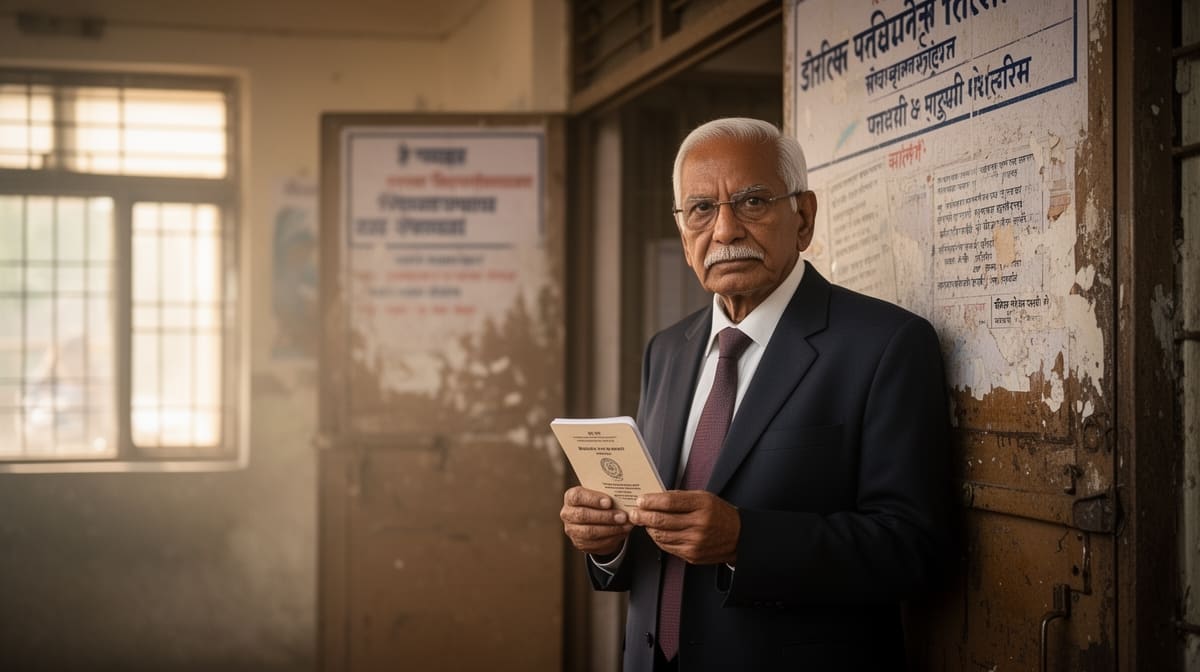
The Madhya Pradesh High Court has decisively affirmed that the right to provisional pension under amended Rule 64 of the M.P. Civil Services (Pension) Rules, 1976 is not contingent on the final outcome of pending departmental or judicial proceedings. This ruling reinforces the principle that pensionary benefits, once statutorily mandated, must be granted without undue delay, even when allegations against the employee remain unresolved.
Background & Facts
The Dispute
Ramesh Kumar Kachhwaha, a former government servant, sought provisional pension after his retirement, despite the pendency of a departmental enquiry and related judicial proceedings against him. The authorities refused to grant the pension, citing the ongoing proceedings as grounds for withholding benefits.
Procedural History
- The petitioner retired from government service in accordance with applicable rules.
- A departmental enquiry was initiated prior to retirement and remained pending at the time of application for pension.
- A criminal case, arising from the same allegations, was also under adjudication.
- Despite the amendment to Rule 64 effective 19 May 2023, the state authorities declined to grant provisional pension, asserting discretion to withhold benefits pending final disposal.
Relief Sought
The petitioner sought a writ under Article 226 of the Constitution directing the state to grant provisional pension in compliance with the amended Rule 64, arguing that the refusal was arbitrary and violative of statutory mandate.
The Legal Issue
The central question was whether Rule 64 of the M.P. Civil Services (Pension) Rules, 1976, as amended in 2023, requires the grant of provisional pension even when departmental or judicial proceedings against the retiree are still pending.
Arguments Presented
For the Petitioner
Counsel relied on the plain language of the amended Rule 64, which explicitly states that provisional pension shall be granted "even if departmental or judicial proceedings are continued." He argued that the amendment was introduced precisely to eliminate arbitrary delays and to uphold the dignity and financial security of retired employees. He cited State of U.P. v. Raj Kumar to support the proposition that statutory rights cannot be conditioned on the outcome of pending proceedings.
For the Respondent
The Government Advocate contended that the state retained discretionary power to withhold pension where serious allegations of misconduct were pending, citing older precedents that permitted such withholding as a measure of administrative prudence. He argued that the amendment was procedural and did not override the state’s inherent authority to protect public interest.
The Court's Analysis
The Court conducted a textual and purposive interpretation of the amended Rule 64. It emphasized that the amendment was not a mere technical change but a substantive shift in policy, designed to protect retired employees from financial hardship during prolonged proceedings. The Court noted that the phrase "even if departmental or judicial proceedings are continued" leaves no room for discretion. The state’s reliance on pre-amendment practices was rejected as inconsistent with the clear legislative intent.
"The amendment was introduced to ensure that a government servant, who has rendered service and retired in accordance with law, is not left in financial limbo due to proceedings that may or may not result in adverse findings."
The Court further held that the state’s argument of "public interest" could not override a specific statutory mandate. It distinguished State of M.P. v. Rameshwar Prasad on the ground that it predated the amendment and dealt with unamended rules. The Court concluded that the petitioner’s case squarely fell within the ambit of Rule 64 and that non-compliance amounted to a violation of statutory right.
The Verdict
The petitioner succeeded. The Court held that Rule 64 of the M.P. Civil Services (Pension) Rules, 1976, as amended, mandates the grant of provisional pension irrespective of pending departmental or judicial proceedings. The state was directed to grant provisional pension within 30 days of receipt of the certified order.
What This Means For Similar Cases
Provisional Pension Is a Statutory Right, Not a Privilege
- Practitioners must now treat provisional pension under Rule 64 as an enforceable statutory entitlement, not a discretionary benefit.
- Any refusal based on pending proceedings is legally unsustainable and subject to immediate writ remedy.
Amendments Override Precedent-Based Discretion
- Pre-amendment judicial practices permitting withholding of pension are no longer binding.
- Courts will prioritize the plain language of amended rules over administrative convenience.
Timely Compliance Is Mandatory
- Government departments must proactively identify eligible retirees and initiate provisional pension payments without awaiting final disposal of proceedings.
- Delay beyond 30 days of court order may attract contempt proceedings.