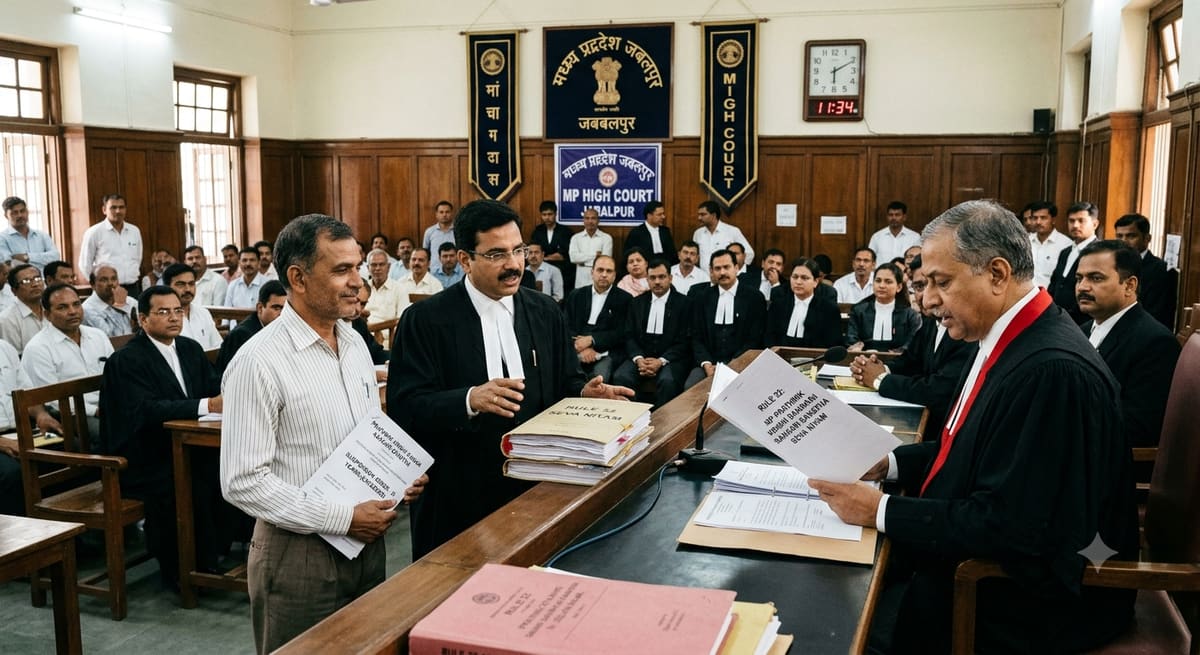
The Madhya Pradesh High Court has reaffirmed a critical safeguard for public employees: indefinite suspension without procedural closure violates established service rules. In a decisive order, the Court mandated the immediate revocation of a three-year suspension, holding that statutory caps on suspension periods are not discretionary but mandatory.
Background & Facts
The Dispute
The petitioner, Sateesh Kumar Awasthi, was appointed as a staff member of the Prathmik Krishi Sakha Sahkari Sanstha on 11.10.2023. Less than a year into service, he was suspended pending a departmental inquiry. More than three years later, the suspension remains in force without any final order being passed, nor has the inquiry concluded.
Key Facts
Appointment order dated: 11.10.2023
Suspension order issued: 2023 (exact date not specified in judgment)
Suspension period as of judgment date: Over 3 years
No charge sheet, inquiry report, or final order issued during this period
Petitioner has not been reinstated, nor has his service been terminated
No communication has been issued to the petitioner regarding the status of the inquiry
Procedural History
11.10.2023: Appointment to post
2023: Suspension imposed without specified duration
2024 - 2026: No progress in departmental proceedings
2026: Writ petition filed under Article 226 of the Constitution
29.06.2026: Judgment delivered by the High Court of Madhya Pradesh at Jabalpur
The Parties' Positions
Petitioner: Argued that his suspension has exceeded the maximum permissible period under Rule 32 of the Prathmik Krishi Sakha Sahkari Sanstha Ke Karmachari Seva Niyam, which limits suspension to one year, even with extensions. He contended that continued suspension without finalization of proceedings amounts to constructive termination of service and violates principles of natural justice.
Respondent (State): Did not file a detailed counter-affidavit. The Government Advocate merely opposed the prayer without disputing the duration of suspension or providing reasons for the delay in concluding the inquiry.
Relief Sought
The petitioner sought:
Immediate revocation of suspension
Reinstatement to service
Payment of back wages and suspension allowance for the period of unlawful suspension
The Legal Issue
The central question was whether Rule 32 of the Prathmik Krishi Sakha Sahkari Sanstha Ke Karmachari Seva Niyam imposes a mandatory one-year cap on suspension, and whether continued suspension beyond this period, without a final order, is legally sustainable.
Arguments Presented
For the Petitioner
The petitioner’s counsel relied on Rule 32 of the Service Rules, which provides that suspension shall not exceed three months, and any extension beyond that requires approval from the Board of Directors, with the total suspension period not exceeding one year. He argued that the State’s failure to conclude proceedings within this period renders the suspension illegal and violative of Article 14 and Article 21 of the Constitution. He cited State of U.P. v. Raj Narain to emphasize that prolonged suspension without trial amounts to punishment without due process.
For the Respondent
The Government Advocate offered no substantive legal or factual rebuttal. No affidavit was filed explaining the delay in inquiry, no reasons were given for non-compliance with Rule 32, and no evidence was produced to justify the continuation of suspension beyond one year.
The Court's Analysis
The Court examined the language of Rule 32 and found it unambiguous: suspension is strictly limited to one year, even with Board approval. The Court noted that the State has not produced any record of Board approval for extension beyond three months, nor has it demonstrated that the inquiry was conducted with due diligence.
"Suspension is a measure of administrative control, not a tool of indefinite detention. When the statutory ceiling is one year, continued suspension beyond that period, without finalization of proceedings, is legally unsustainable."
The Court emphasized that the State’s silence on the matter, coupled with the unchallenged duration of suspension, amounted to an admission of non-compliance. The Court rejected the notion that administrative delay could justify violation of statutory limits. It held that the petitioner’s right to livelihood under Article 21 was infringed by the prolonged, unexplained suspension.
The Court further observed that the absence of a charge sheet or inquiry report after three years indicated a complete breakdown in administrative procedure, rendering the suspension arbitrary and capricious.
The Verdict
The writ petition was allowed. The Court directed the State to revoke the suspension immediately and reinstate the petitioner to his post. The petitioner is at liberty to file a representation for payment of suspension allowance for the period of unlawful suspension. No specific monetary direction was issued, but reinstatement was made mandatory. Compliance is to be effected within four weeks from the date of judgment.
What This Means For Similar Cases
Suspension Cannot Exceed Statutory Limits
Practitioners must now challenge any suspension exceeding the period prescribed under service rules, even if no final order has been passed
Administrative delay cannot override clear statutory caps on suspension
Failure to comply with Rule 32 or equivalent provisions renders suspension illegal ab initio
Reinstatement Is the Default Remedy
Courts will not permit indefinite suspension as a punitive measure without trial
Reinstatement, not compensation, is the primary remedy for unlawful suspension
Representation for suspension allowance must be processed separately but cannot be delayed pending reinstatement
Procedural Compliance Is Non-Negotiable
Departments must maintain timelines for inquiry completion
Extensions beyond statutory limits require documented Board approval
Silence from the State in writ proceedings will be construed as admission of illegality