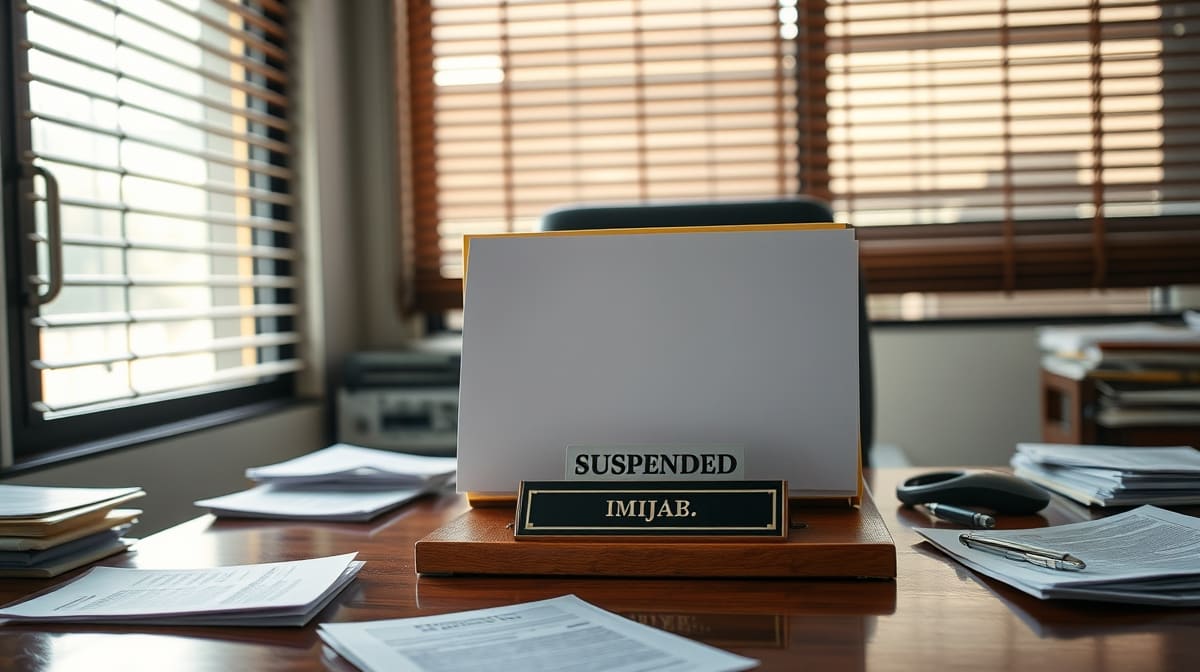
The Punjab and Haryana High Court has delivered a significant ruling affirming that indefinite suspension of a government employee without initiating or concluding disciplinary proceedings violates fundamental principles of natural justice and procedural fairness. This judgment reinforces the constitutional obligation of the state to balance administrative discipline with the rights of public servants.
Background & Facts
The Dispute
Lakhbir Singh, a Deputy Superintendent of Police (DSP), was suspended in July 2022 following his arrest in connection with multiple criminal cases under the Narcotic Drugs and Psychotropic Substances Act, 1985 and the Prevention of Corruption Act, 1988. The allegations included accepting bribes to shield drug peddlers and facilitating the destruction of evidence. He was formally charged in FIR No. 62/2022 and later arrested under the Prevention of Corruption Act.
Procedural History
The case progressed through the following stages:
- 30.06.2022: FIR registered against Surjit Singh; investigation revealed petitioner’s alleged involvement
- 06.07.2022: Petitioner arrested and placed under suspension
- 22.07.2022: Formal suspension order issued under Rule 4 of Punjab Civil Services (Punishment and Appeals) Rules, 1970
- 28.07.2023: Memorandum of charges served, initiating disciplinary proceedings
- 2025: Investigating agency filed final report against other accused and secured court order declaring petitioner as an approver
- 2026: Disciplinary inquiry still pending; no Inquiry Officer appointed despite over three years of suspension
Relief Sought
The petitioner sought quashing of the suspension order and reinstatement in service, relying on the Supreme Court’s judgment in Ajay Kumar Choudhary v. Union of India (2015) 7 SCC 291, which prohibits indefinite suspension without concluded proceedings.
The Legal Issue
The central question was whether a government servant can be kept under suspension for over three years without the appointment of an Inquiry Officer or completion of disciplinary proceedings, even after being declared an approver in the criminal case.
Arguments Presented
For the Petitioner
The petitioner’s counsel argued that once the petitioner was declared an approver in the criminal case, his status shifted from accused to prosecution witness, thereby undermining the basis for continued suspension. They relied on Ajay Kumar Choudhary v. Union of India to assert that indefinite suspension violates Article 14 and Article 21 of the Constitution. Further, they contended that the state’s failure to appoint an Inquiry Officer despite serving chargesheet constituted a violation of natural justice.
For the Respondent
The State conceded that no Inquiry Officer had been appointed since the chargesheet was served in 2023. However, it argued that suspension remained valid under Rule 4(5) of the 1970 Rules and the precedent in Ashish Kapoor v. State of Punjab, which holds that suspension continues until revoked by competent authority. The State did not dispute the delay but claimed administrative backlog as justification.
The Court's Analysis
The Court acknowledged the validity of Ashish Kapoor but distinguished its application in this case. While suspension may remain operative pending disciplinary action, the Court emphasized that such power cannot be exercised arbitrarily or indefinitely. The judgment in Ajay Kumar Choudhary was pivotal: "No employee can be kept under suspension for an indefinite period without any progress in the disciplinary proceedings."
"The state’s duty to conduct a fair and expeditious inquiry is not optional; it is a constitutional obligation flowing from the right to life and personal liberty under Article 21."
The Court noted that the petitioner’s transformation from accused to approver fundamentally altered the factual matrix. As a prosecution witness, he was no longer a party to the criminal case against him, and the state’s continued suspension lacked rational nexus with the original grounds. The prolonged inaction - over three years without appointing an Inquiry Officer - was deemed arbitrary and violative of the principle of proportionality.
The Court further held that Rule 4(5) does not confer unbridled power to suspend indefinitely. It must be read in harmony with the principles of fairness, reasonableness, and the right to livelihood.
The Verdict
The petitioner won. The Court held that indefinite suspension without progress in disciplinary proceedings violates constitutional rights, and directed the State to reinstate the petitioner within two weeks. The Court also emphasized that the disciplinary proceedings must now be concluded expeditiously.
What This Means For Similar Cases
Suspension Must Be Time-Bound and Justified
- Practitioners must challenge suspensions exceeding 18 - 24 months without an appointed Inquiry Officer or substantive progress
- The burden shifts to the employer to demonstrate reasonable cause for delay
- Suspension cannot be used as a punitive measure pending investigation
Approver Status Alters Suspension Rationale
- Once an employee is declared an approver, the basis for suspension as an accused is extinguished
- Employers must reassess suspension orders upon material change in criminal proceedings
- Continued suspension post-approver declaration requires fresh, independent justification
Procedural Compliance Is Non-Negotiable
- Service rules require strict adherence to timelines for appointing Inquiry Officers
- Delay in disciplinary proceedings, even if administrative, cannot override fundamental rights
- Courts will not tolerate bureaucratic inertia when fundamental rights are at stake