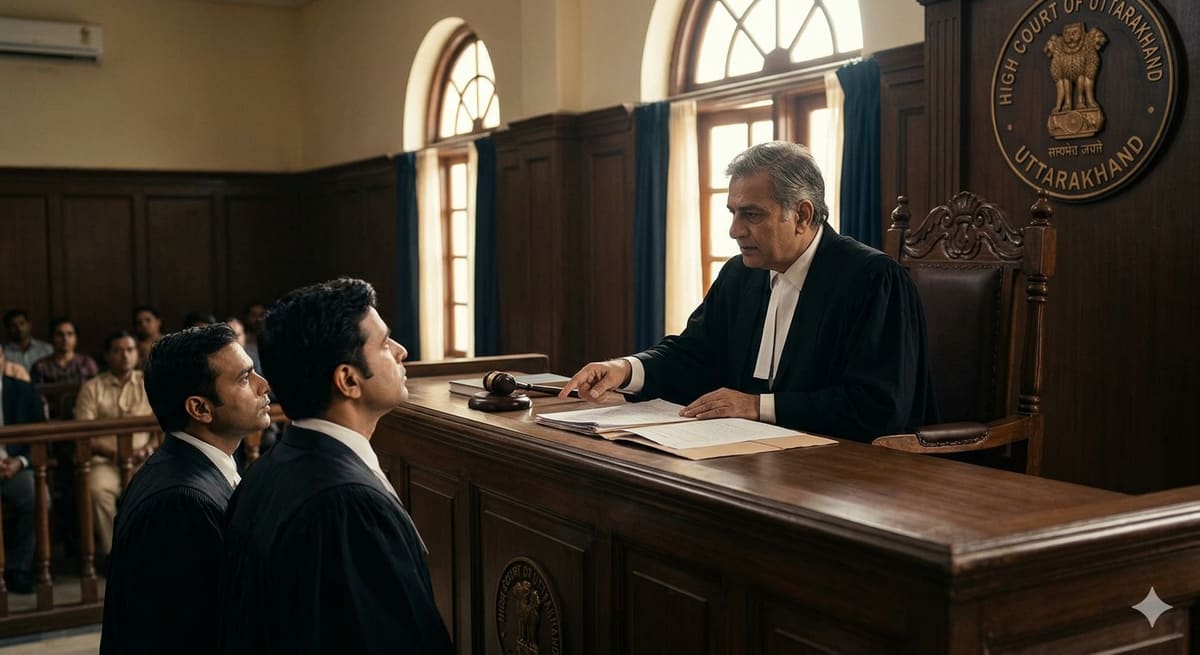
The Uttarakhand High Court has underscored the principle that a government servant cannot be placed under suspension for an indefinite period. In a significant ruling, the Court quashed a suspension order dating back nearly five years, directing the competent authority to issue a fresh posting order while permitting the disciplinary enquiry to proceed expeditiously. This judgment reaffirms the need for timely resolution of disciplinary proceedings and the rights of government employees to fair treatment under Rule 10 of the Central Civil Services (Classification, Control and Appeal) Rules, 1965.
Background & Facts
The Dispute
The petitioner, a government servant, was placed under suspension by an order dated 17.7.2021 passed by the Senior Superintendent of Police (SSP), Udham Singh Nagar. The suspension order cited a single allegation: the petitioner had remained unauthorisedly absent from duties after 13.6.2021. Subsequently, a charge sheet was issued on 31.10.2025, introducing an additional charge that the petitioner, belonging to the Other Backward Classes (OBC), had secured his appointment based on a forged Scheduled Tribe (ST) certificate.
Key Facts
The petitioner was suspended on 17.7.2021 for unauthorised absence from duties
A charge sheet was issued on 31.10.2025, alleging forgery of a caste certificate
The petitioner’s caste was recorded as ST in the forged certificate, whereas he belongs to OBC
The SSP, Udham Singh Nagar, issued a letter on 27.4.2026 to the District Magistrate, Gorakhpur, seeking a report from the Caste Scrutiny Committee regarding the petitioner’s ST certificate
Nearly five years had elapsed since the suspension order without conclusion of the disciplinary enquiry
Procedural History
17.7.2021: Suspension order passed by SSP, Udham Singh Nagar
31.10.2025: Charge sheet issued, adding the allegation of forged caste certificate
27.4.2026: SSP issues letter to District Magistrate, Gorakhpur, for Caste Scrutiny Committee report
29.4.2026: Present writ petition filed before the Uttarakhand High Court challenging the suspension order
The Parties' Positions
For the Petitioner
Contended that the suspension order was passed in a casual manner without ascertaining the charges
Argued that the initial charge of unauthorised absence was insufficient to impose a major penalty, necessitating the addition of another charge in the charge sheet
Submitted that indefinite suspension violates the principles of natural justice and Rule 10 of the CCS (CCA) Rules, 1965
For the State
Submitted that the SSP had sought a report from the Caste Scrutiny Committee to verify the petitioner’s caste certificate
Did not contest the delay in concluding the disciplinary enquiry
Relief Sought
The petitioner sought quashing of the suspension order dated 17.7.2021 and a direction for fresh posting within the State, while allowing the disciplinary authority to proceed with the enquiry expeditiously.
The Legal Issue
The central question before the Court was whether a government servant can be placed under suspension for an indefinite period, particularly when the disciplinary enquiry is delayed due to procedural lapses on the part of the authorities.
Arguments Presented
For the Petitioner
Learned Counsel for the petitioner argued that the suspension order was arbitrary and passed without proper application of mind. It was contended that the initial charge of unauthorised absence was minor and insufficient to warrant suspension, especially when another major charge was subsequently added in the charge sheet. The petitioner relied on the principle that indefinite suspension amounts to a violation of natural justice and the procedural safeguards under the CCS (CCA) Rules, 1965.
For the Respondent
Learned State Counsel submitted that the SSP had taken steps to verify the petitioner’s caste certificate by seeking a report from the Caste Scrutiny Committee. However, no justification was provided for the delay in concluding the disciplinary proceedings.
The Court's Analysis
The Court observed that the petitioner had been under suspension for nearly five years, a period deemed excessive and unjustifiable. The Court emphasised that suspension is not a penalty but a temporary measure to facilitate disciplinary proceedings. Prolonged suspension without conclusion of the enquiry violates the rights of the government servant and defeats the purpose of disciplinary action.
The Court noted that the SSP had only recently, on 27.4.2026, sought a report from the Caste Scrutiny Committee, indicating a lackadaisical approach in conducting the enquiry. The Court held that such indefinite suspension is contrary to the principles of natural justice and the provisions of the CCS (CCA) Rules, 1965, which mandate timely resolution of disciplinary matters.
"A government servant cannot be put under suspension for indefinite period. Petitioner was placed under suspension on 17.7.2021 and nearly five years have gone by since then. The disciplinary enquiry is not likely to be completed in near future, as SSP, Udham Singh Nagar has called report of the Caste Scrutiny Committee from District Magistrate, Gorakhpur, where petitioner belongs to."
The Court further observed that the addition of a new charge in the charge sheet, long after the suspension order, suggested a lack of due diligence at the time of passing the suspension order. This casual approach was held to be impermissible in service jurisprudence.
The Verdict
The writ petition was allowed. The impugned suspension order dated 17.7.2021 was quashed. The competent authority was directed to pass a fresh order of posting for the petitioner in any of the 13 districts within the State of Uttarakhand. The disciplinary authority was, however, permitted to proceed with and conclude the disciplinary enquiry as early as possible.
What This Means For Similar Cases
Indefinite Suspension Is Unlawful
Government servants cannot be placed under suspension for an indefinite period. Courts will intervene where disciplinary authorities fail to conclude proceedings within a reasonable timeframe
Suspension orders must be based on well-ascertained charges, and authorities cannot adopt a casual approach by adding charges retrospectively
Timely Disciplinary Proceedings Are Mandatory
Disciplinary authorities must adhere to the timelines prescribed under the CCS (CCA) Rules, 1965 and ensure that enquiries are concluded expeditiously
Delays in seeking reports from committees or other authorities will not be tolerated, and courts may quash suspension orders where such delays are evident
Fresh Posting Orders Do Not Preclude Disciplinary Action
The Court’s direction for fresh posting does not absolve the government servant of the charges. Disciplinary authorities retain the liberty to proceed with the enquiry and impose penalties if warranted
Practitioners should argue for fresh posting orders in cases of prolonged suspension while ensuring that disciplinary proceedings are not unduly delayed