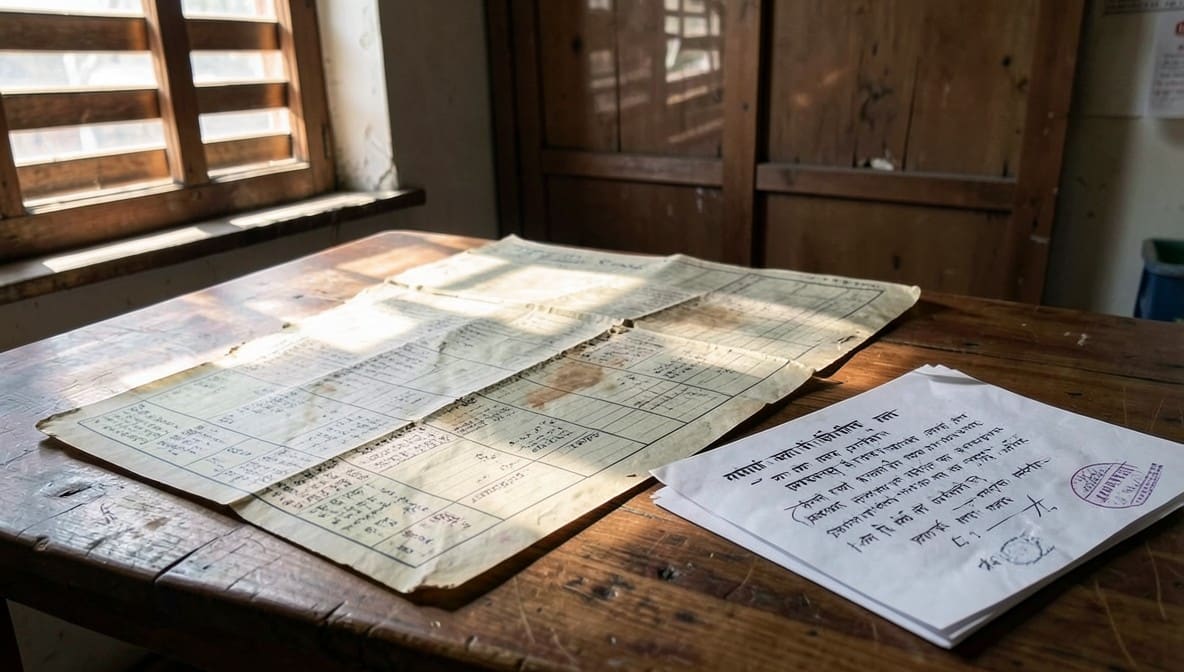
A landmark ruling by the Allahabad High Court has clarified that revenue entries alone, even if longstanding, cannot confer sirdari or adhivasi rights without proof of continuous, hostile, and open possession for the statutory period of twelve years. The judgment reinforces the foundational principles of adverse possession under the U.P. Consolidation of Holdings Act, 1953, and invalidates revisional interference that disregards concurrent findings on factual continuity.
Background & Facts
The Dispute
The dispute centers on ownership rights over five plots - Nos. 1100, 4643, 1072, 3275, and 883 - in village Haraiya, District Azamgarh, Uttar Pradesh. The petitioner, D.B. Upadhyaya, is the successor of Radhey Kishun Upadhyay and Shridhar Upadhyay, the original tenure holders recorded in the basic year revenue records. The contesting respondent, Kharbhan (son of Ram Gulam), claimed sirdari and adhivasi rights over three of these plots - Nos. 1072, 1100, and 3275 - based on entries in the revenue records from the fasli years 1356-F to 1362-F.
Key Facts
- The disputed land was originally recorded in the name of Radhey Kishun Upadhyay and Shridhar Upadhyay in the basic year records.
- Kharbhan’s name appeared in the remarks column of Khasra records for plots 1072, 1100, and 3275 in fasli years 1356-F, 1358-F, 1359-F, 1361-F, and 1362-F, with the notation "Batai Nisfi" indicating a share-cropping arrangement.
- In the subsequent fasli year 1365-F, entries in favor of Kharbhan on plots 1072 and 3275 were either struck off or absent entirely. No entry in his favor appeared on plot 1100 in 1365-F.
- The Consolidation Officer found that Kharbhan’s possession was permissive, not hostile, and that no documentary evidence proved continuous possession for more than ten years prior to consolidation.
- The Deputy Director of Consolidation (DDC), in revision, overturned these findings and declared Kharbhan as adhivasi and sirdar based solely on the earlier entries, ignoring the absence of entries in 1365-F and the nature of "Batai Nisfi".
- The petitioner filed a restoration application before the DDC, which was initially allowed on 03.10.1972, but later reversed on 17.09.1982 after remand by this Court.
Procedural History
- 1968: Notification under Section 41 of the U.P.C.H. Act issued for consolidation.
- 20.01.1969: Civil suit filed by Kharbhan under Section 229B of the Zamindari Abolition Act, decreed in his favor.
- 23.01.1971: Consolidation Officer rejected Kharbhan’s objections, upholding petitioner’s tenure.
- 07.05.1971: Settlement Officer of Consolidation dismissed appeals filed by Kharbhan, confirming the Consolidation Officer’s order.
- 26.10.1971: Deputy Director of Consolidation partly allowed revision petitions, granting sirdari rights over plots 1072, 1100, and 3275.
- 03.10.1972: DDC allowed petitioner’s restoration application, setting aside its own 1971 order.
- 25.08.1978: Allahabad High Court remanded the matter to DDC for fresh consideration.
- 17.09.1982: DDC again rejected the restoration application, reinstating its 1971 order.
- 09.11.1982: High Court issued interim order restraining dispossession pending final hearing.
- 02.04.2026: Present writ petition decided by the High Court.
The Parties' Positions
For the Petitioner
The petitioner contended that Kharbhan’s entries were merely those of a "sikmi tenant" with "Batai Nisfi" - a permissive, non-adverse tenancy. He emphasized that no entry in Kharbhan’s favor existed in 1365-F, the year immediately preceding consolidation, thereby breaking the continuity required for adverse possession. He relied on Supreme Court precedents holding that fictitious or non-genuine entries cannot confer rights under Section 20 of the U.P. Zamindari Abolition and Land Reforms Act, 1951.
For the Respondent
Kharbhan argued that his long-standing entries in revenue records from 1356-F to 1362-F established his claim as adhivasi and sirdar. He contended that the absence of entries in 1365-F was immaterial, and that the DDC’s revisional order correctly recognized his possession as hostile and continuous. He further claimed that the petitioner never took steps to evict him, thereby acquiescing to his possession.
Relief Sought
The petitioner sought quashing of the DDC’s order dated 17.09.1982, restoration of the Consolidation Officer’s order dated 23.01.1971, and confirmation of his title over plots 1072, 1100, and 3275.
The Legal Issue
The central question was whether mere revenue entries in the remarks column, even if spanning multiple fasli years, can establish adhivasi or sirdari rights under the U.P.C.H. Act, 1953, in the absence of continuous, hostile, open, and exclusive possession for twelve years prior to consolidation, and where subsequent entries are absent or struck off.
Arguments Presented
For the Petitioner
The petitioner’s counsel argued that the DDC’s revisional order was legally unsustainable because it ignored the foundational requirements of adverse possession under Section 20 of the U.P. Zamindari Abolition and Land Reforms Act, 1951 and the settled law in Bachan v. Kankar and Mata Din Singh. He emphasized that "Batai Nisfi" denotes permissive possession, not hostile claim, and that the absence of entries in 1365-F broke the continuity required for adverse possession. He cited Uttam Chand v. Nath Ram to underscore that adverse possession must be nec vi, nec clam, nec precario, and must be pleaded and proved with specificity.
For the Respondent
The respondent’s counsel contended that long-standing revenue entries, even in the remarks column, are sufficient to establish adverse possession and sirdari rights. He argued that the petitioner’s failure to evict Kharbhan over decades amounted to acquiescence, and that the DDC, as a revisional authority, was entitled to reassess the evidence and correct the errors of the lower authorities.
The Court's Analysis
The Court undertook a rigorous analysis of the nature of revenue entries and the legal requirements for adverse possession. It held that the DDC’s order was fundamentally flawed for three reasons: first, it ignored the absence of entries in 1365-F, which broke the continuity of possession; second, it mischaracterized "Batai Nisfi" entries as evidence of hostile possession, when they clearly indicate permissive tenancy; and third, it failed to apply the triple test for adverse possession - nec vi, nec clam, nec precario - as laid down in Uttam Chand v. Nath Ram and Annakili v. A. Vedanayagam.
"A plea of adverse possession is founded on the acceptance that ownership of the property vests in another, against whom the claimant asserts possession adverse to the title of the other. Possession is adverse in the sense that it is contrary to the acknowledged title in the other person against whom it is claimed."
The Court emphasized that the burden of proving adverse possession lies squarely on the claimant, and that mere entries in revenue records, especially those marked as "sikmi" or "Batai Nisfi," cannot substitute for proof of hostile intent and continuous possession. The Court further held that the DDC’s reliance on the assumption of a "partition or contract" to justify the entries was unsupported by any documentary evidence.
The Court also relied on Bachan v. Kankar and Chandrika Prasad v. Pullo, which hold that fictitious, fraudulent, or non-genuine entries cannot confer adhivasi rights. The Court noted that the Consolidation Officer had meticulously documented the absence of genuine possession after 1365-F, and that the Settlement Officer had correctly upheld this finding. The DDC’s revisional interference, therefore, was not only unsupported by evidence but also contrary to established precedent.
The Court concluded that the DDC’s order was legally unsustainable and that the concurrent findings of the Consolidation Officer and Settlement Officer, which were based on a detailed review of the revenue records and the absence of hostile possession, must prevail.
The Verdict
The writ petition is allowed. The order of the Deputy Director of Consolidation dated 26.10.1971 and 17.09.1982 is set aside. The orders of the Consolidation Officer dated 23.01.1971 and the Settlement Officer of Consolidation dated 07.05.1971 are restored. The petitioner is confirmed as the rightful tenure holder of plots 1072, 1100, and 3275. The respondent is directed to vacate possession of the said plots within eight weeks from the date of this judgment. Costs of Rs. 50,000 are imposed on the respondent.
What This Means For Similar Cases
Revenue Entries Must Be Genuine and Continuous
- Practitioners must now prove that revenue entries are not only longstanding but also genuine, uninterrupted, and free from fraud or error to support claims of adhivasi or sirdari rights.
- Entries marked "Batai Nisfi" or in the remarks column are prima facie permissive and cannot be presumed to indicate hostile possession.
Absence of Entry in Final Fasli Year Breaks Continuity
- A gap in revenue entries in the year immediately preceding consolidation (here, 1365-F) is fatal to claims of adverse possession, regardless of prior entries.
- Courts will not infer continuity from fragmented or discontinued records.
Revisional Authorities Cannot Override Concurrent Findings Without Substantial Reason
- Revisional authorities under the U.P.C.H. Act must not substitute their own view for that of two lower authorities unless there is a clear error of law or perversity.
- Mere disagreement with factual findings is insufficient to justify revisional interference.
Adverse Possession Requires Pleading and Proof of All Elements
- The claimant must plead and prove: (a) date of possession, (b) nature of possession, (c) knowledge of the true owner, (d) duration of possession, and (e) openness and exclusivity.
- Mere possession without animus possidendi is insufficient to ripen into title.