The Madras High Court has held that revenue authorities cannot cancel a patta on a representation raising succession disputes, as they lack jurisdiction to adjudicate title. Setting aside both the District Revenue Officer's order and the Single Judge's dismissal, the Division Bench directed the claimant to approach the civil court, following the Supreme Court's Edelweiss principle.
Background & Facts
The Dispute
The appellant Dhanalakshmi is the wife of late A. Ranganathan. A patta for the subject property was issued in Ranganathan's name on 19.11.1986 by the Tahsildar. The fourth respondent A. Chandra is Ranganathan's sister, and both are children of the original patta holder Anjooran. In 2022, Chandra made a representation to the revenue authorities seeking cancellation of Ranganathan's patta and restoration of the patta in Anjooran's name.
Key Facts
- Patta issued in Ranganathan's name on 19.11.1986
- Ranganathan and Chandra are brother and sister, children of Anjooran
- The mortgage deed for the subject property discloses Anjooran and Ranganathan as owners
- In 2022, Chandra gave a representation to revenue authorities
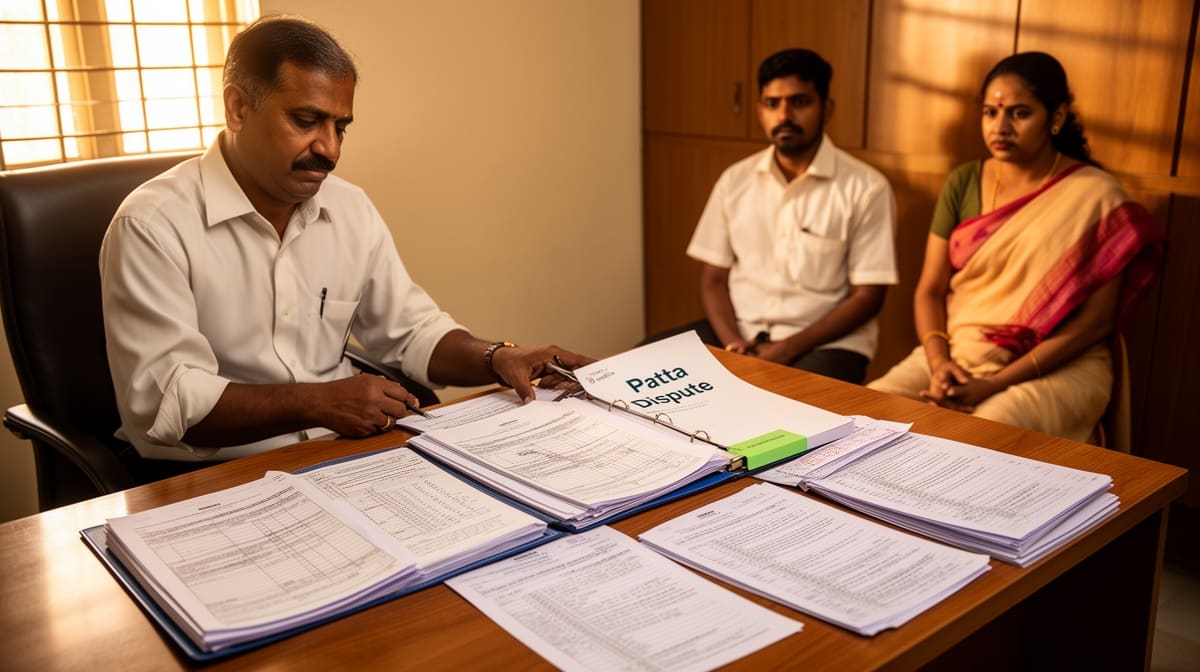
- On 12.07.2024, the District Revenue Officer passed order in Na.Ka.No.6845/2023/A4 cancelling Ranganathan's patta and restoring the original patta in Anjooran's name
- Ranganathan is deceased; the appellant is his widow
Procedural History
- 12.07.2024: DRO passed the impugned order cancelling the patta
- 11.09.2024: Single Judge dismissed WP No. 26289 of 2024, holding the appellant failed to establish title
- Present: Writ Appeal No. 1855 of 2025 filed before the Division Bench
Relief Sought
The appellant sought quashing of the DRO's order dated 12.07.2024 and the Single Judge's order dated 11.09.2024, and a direction to the fourth respondent to approach the civil court.
The Legal Issue
The central question was whether revenue authorities have jurisdiction to cancel a patta on a representation raising succession and title disputes, or whether they must direct the claimant to approach the civil court for adjudication of ownership.
Arguments Presented
For the Appellant
- Relied on M/s. Edelweiss Asset Construction Company Limited v. R. Perumalswamy and others (SC, 06.02.2020, Civil Appeal No. 1318 of 2017)
- The patta stood in the husband's name since 1986; the DRO erred in cancelling it after 35+ years
- The DRO ought to have directed the fourth respondent to approach the civil court
- The Single Judge erred in dismissing the writ petition
For the Respondents
- The Additional Government Pleader reiterated the contents of the impugned orders
- The fourth respondent was set exparte as no one appeared despite notice
The Court's Analysis
The Court observed that the patta was issued in Ranganathan's name in 1986, and cancellation was ordered only after a lapse of more than 35 years, based on a mere representation by his sister. The dispute involves succession between brother and sister, which requires oral and documentary evidence. Revenue authorities do not have the power to analyze such evidence.
The Court relied on the Edelweiss decision, which held that when a dispute concerning ownership of patta impinges on personal laws or laws of succession, and all parties do not agree on ownership in writing, the Tahsildar shall direct the parties to obtain an order on ownership from a competent civil court before changing entries in revenue records.
"The same can be adjudicated only by a civil court and not by the revenue authorities as they do not have power to analyse oral and documentary evidence."
The Court also noted that issues of limitation would arise, which cannot be adjudicated by revenue authorities through a mere representation.
The Verdict
The writ appeal was allowed. The impugned order of the second respondent dated 12.07.2024 and the Single Judge's order dated 11.09.2024 in WP No. 26289 of 2024 were quashed. Liberty was granted to the fourth respondent to approach the Civil Court to claim title over the subject property. The connected CMP was closed. No costs were awarded.
What This Means For Similar Cases
Revenue Authorities Cannot Adjudicate Title
Revenue authorities such as Tahsildars and District Revenue Officers lack jurisdiction to adjudicate title disputes, especially those involving succession and personal laws. They must direct claimants to civil courts.
Succession Disputes Belong in Civil Court
When a patta cancellation request raises questions of inheritance, limitation, or ownership, only a civil court can properly adjudicate after recording oral and documentary evidence.
Practical Takeaways for Practitioners
- Clients facing patta cancellation should challenge orders where revenue authorities adjudicate title
- The Edelweiss principle is a powerful tool to compel revenue officers to direct parties to civil court
- Mere representations to revenue authorities cannot substitute for civil suits in succession matters