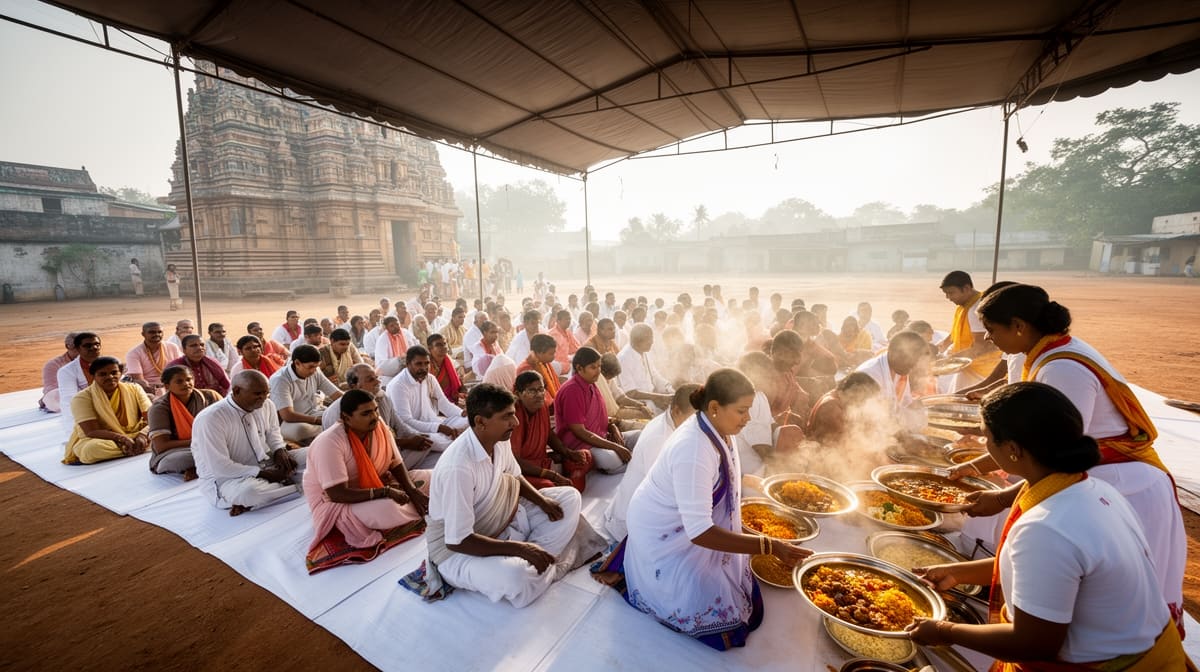
The Madras High Court has affirmed that the right to perform religious charity, such as annadhanam, cannot be extinguished merely because the designated premises are structurally unsound. In a pragmatic application of constitutional rights, the Court granted the petitioner liberty to conduct the service outside the temple complex, ensuring that public welfare during a major festival is not compromised by administrative inaction.
Background & Facts
The Dispute
The petitioner, V. Kasi, sought permission to conduct annadhanam - the ritual offering of free food to devotees - at the Annadhana Koodam of Arulmighu Seruvalinga Ayyanar Temple in Easanur, Sivagangai, during the Sivarathri festival on 18th and 19th February 2026. The petitioner had historically conducted this service for over a decade. However, the Hindu Religious and Charitable Endowment Department (HR&CE), through its officials, took possession of the Annadhana Koodam under a prior court order dated 28.01.2026 in WP.Crl(MD)No.408 of 2026, which the petitioner was not a party to. The petitioner was thus barred from accessing the facility.
Procedural History
- 28.01.2026: HR&CE officials seized control of the Annadhana Koodam under a separate criminal writ proceeding
- 02.02.2026: Petitioner filed W.P.(MD)No.4526 of 2026 seeking mandamus to restore access
- 17.02.2026: Matter taken up for final disposal at admission stage by consent of parties
- 17.02.2026: Respondents submitted photographs showing severe dilapidation of the structure
Relief Sought
The petitioner sought a writ of mandamus directing the HR&CE officials to permit him to conduct annadhanam within the temple’s Annadhana Koodam on the two final days of the Sivarathri festival.
The Legal Issue
The central question was whether the state, through the HR&CE Department, can deny access to a religious charity space on grounds of structural unsafety when the petitioner has a longstanding practice of conducting the service, and when alternative arrangements are feasible.
Arguments Presented
For the Petitioner
The petitioner’s counsel argued that annadhanam is an integral part of Sivarathri observance under Hindu religious tradition and constitutes a protected exercise of Article 25 rights. The petitioner was not a party to the prior order that led to the seizure of the premises, and therefore, the denial of access violated his right to perform a long-standing religious duty. The petitioner emphasized that the festival was imminent and that denying access would deprive thousands of devotees of a vital religious service.
For the Respondent
The Government Advocate contended that the Annadhana Koodam was in a state of severe disrepair, as evidenced by photographs, and posed safety risks to the public. Allowing food service in such a structure would violate public health and safety norms under the Tamil Nadu Public Eating Houses Act and the Prevention of Food Adulteration Act. The Advocate argued that the Department’s duty to ensure public safety overrides the petitioner’s claim, especially since the petitioner could conduct annadhanam elsewhere.
The Court's Analysis
The Court acknowledged the petitioner’s longstanding role in providing annadhanam and recognized the religious and social significance of the practice. However, it also accepted the photographic evidence demonstrating that the Annadhana Koodam was structurally unsound, with visible signs of decay, water seepage, and unstable flooring. The Court held that permitting food service in such a condition would violate the state’s duty under Article 21 to protect public health and safety.
"Unless and otherwise, renovation works are carried out in that premises, no Annadhanam can be provided there. Such renovation works would atleast take two months for completion."
The Court emphasized that the petitioner’s right to perform religious charity is not absolute and must be balanced against public safety. It noted that the Department had not provided any alternative venue or timeline for repairs, but this did not justify endangering devotees. The Court found that the petitioner’s right to practice religion was not extinguished, but merely required relocation to a safe location.
The Verdict
The petitioner’s writ petition was dismissed, but the Court granted him liberty to conduct annadhanam outside the dilapidated premises, provided he complies with all applicable public health and safety regulations. No costs were awarded.
What This Means For Similar Cases
Religious Charity Must Be Safe, Not Suppressed
- Practitioners cannot claim an absolute right to conduct religious services in unsafe structures, even if historically permitted
- Administrative denial must be grounded in objective safety concerns, not arbitrary control
- Courts will not permit religious practices that endanger public health, even during major festivals
Alternative Venues Are Legally Acceptable
- The right to perform religious charity is not tied to a specific physical location
- Relocation to a nearby, safe, and regulated space satisfies constitutional and statutory obligations
- Practitioners should document prior practice and seek prior approval for alternative venues to avoid litigation
Procedural Fairness in Temple Management
- HR&CE departments must act transparently when taking control of temple assets
- Non-parties to prior proceedings cannot be adversely affected without notice or hearing
- Courts expect proactive planning - delayed repairs cannot justify denial of essential religious services