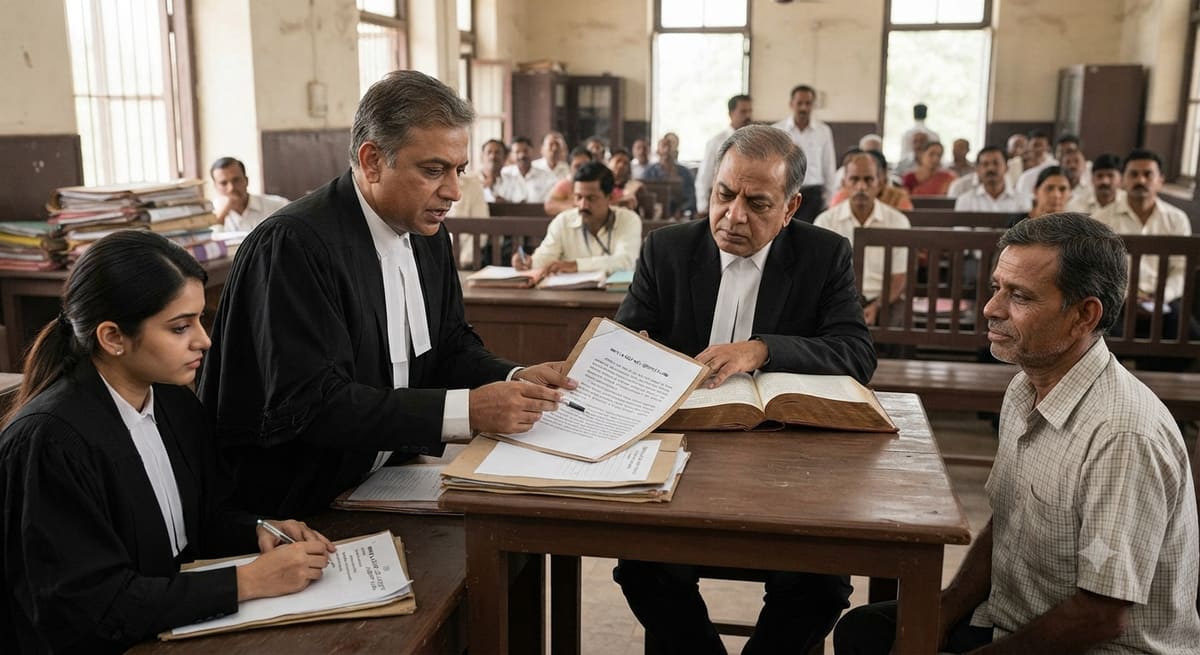
The Bombay High Court has clarified that while wrongful termination remains actionable under the MRTU and PULP Act, reinstatement is not a viable remedy when the employer’s establishment has permanently closed and the employee has passed away. The Court affirmed that the legal right to compensation for lost wages survives and must be enforced as monetary relief.
Background & Facts
The Dispute
The petitioner, a long-serving machine operator with over 18 years of unblemished service, was dismissed in 1992 following a domestic enquiry based on two charge sheets alleging minor technical misconduct. He contended that his dismissal was retaliatory due to his union activities and his belonging to a backward community. The employer alleged breaches of discipline, but the Labour Court found the acts to be trivial and not warranting termination.
Procedural History
- 1992: Petitioner dismissed after domestic enquiry
- 1992: Filed Complaint (ULP) No.391 of 1992 under Schedule IV of the MRTU and PULP Act
- 2005: Labour Court held dismissal constituted unfair labour practice under Items 1(b) and 1(g) of Schedule IV; ordered reinstatement with full back wages
- 2006: Industrial Court, in revision, set aside the Labour Court order and remanded for reconsideration of proportionality
- 2006: Writ petition filed under Article 227 challenging the Industrial Court’s order
- 2010: Employer’s establishment closed down
- Before judgment: Petitioner passed away; legal representatives substituted as parties
Relief Sought
The petitioner sought quashing of the Industrial Court’s order and restoration of the Labour Court’s award of reinstatement and back wages. In light of subsequent developments, the legal representatives sought monetary compensation in lieu of reinstatement.
The Legal Issue
The central question was whether the Industrial Court, in revision under Section 44 of the MRTU and PULP Act, could remand a case for reconsideration of punishment when the Labour Court had already conducted a detailed analysis of proportionality, and whether reinstatement remains enforceable when the employer’s establishment has closed and the employee is deceased.
Arguments Presented
For the Petitioner
Counsel argued that the Industrial Court exceeded its revisional jurisdiction by reappreciating evidence and substituting its view on proportionality. The Labour Court had meticulously examined the nature of misconduct, the employee’s clean record, and the disproportionate nature of dismissal. The revisional court’s remand was based on mere disagreement, not perversity or legal error. Reliance was placed on State of Maharashtra v. Rameshwar and Bharat Forge Ltd. v. Usha Rani to affirm that revisional jurisdiction cannot be used as a second appeal.
For the Respondent
The employer contended that the Labour Court erred in granting reinstatement without first determining whether the misconduct was serious enough to warrant dismissal. It argued that the Labour Court improperly re-evaluated the evidence on misconduct rather than limiting itself to proportionality. It also submitted that the Industrial Court rightly intervened to ensure compliance with statutory limits on judicial review.
The Court's Analysis
The Court emphasized that revisional jurisdiction under Section 44 is supervisory, not appellate. The Industrial Court’s role is not to substitute its opinion for that of the Labour Court merely because a different view is possible. The Court observed:
"Disagreement is not the same as perversity. Unless the order shows illegality, lack of jurisdiction, or findings unsupported by any evidence, the revisional court must refrain from unsettling a reasoned decision."
The Labour Court had followed the correct two-stage approach: first, it confirmed the fairness of the enquiry and the existence of misconduct; second, it assessed whether dismissal was proportionate given the nature of the acts and the employee’s long, unblemished service. Paragraph 24 of the Labour Court’s judgment explicitly balanced these factors and concluded that dismissal was shockingly disproportionate.
The Court held that the Industrial Court’s remand was legally unsustainable because it failed to identify any error in the Labour Court’s reasoning. The revisional court had no basis to reopen the matter on proportionality when it had already been fully adjudicated.
Regarding the closure of the establishment and the death of the employee, the Court held that while reinstatement is the preferred remedy under the Act, it is not mechanically enforceable where physical restoration is impossible. The Court relied on the principle that rights to back wages and continuity benefits are pecuniary in nature and survive the death of the employee.
"The consequence, however, does not mean the workman's rights vanish. The finding that the termination was improper still survives. What changes is only the method of enforcement."
The Court concluded that monetary compensation, representing the value of lost wages and service benefits, is the appropriate substitute.
The Verdict
The petitioner’s legal representatives won. The Court quashed the Industrial Court’s order, restored the Labour Court’s judgment, and substituted reinstatement with monetary compensation payable to the legal heirs. The employer was directed to pay full back wages from termination to closure, with interest for delay.
What This Means For Similar Cases
Reinstatement Is Not Automatic When Employment No Longer Exists
- Practitioners must assess whether the employer’s establishment is still operational before seeking reinstatement
- If the unit has closed, the claim must be framed as one for monetary compensation, not restoration of service
- Courts will not issue unenforceable orders; substitution with back wages is the settled legal position
Proportionality Assessment Is a Valid Part of Labour Court’s Function
- Labour Courts are empowered to examine whether punishment fits the misconduct, even after accepting the enquiry as fair
- A clean service record is a legally relevant factor in determining proportionality
- Revisional courts cannot interfere merely because they would have weighed the factors differently
Back Wages Survive Death of Employee and Pass to Legal Representatives
-
Back wages are not personal to the employee but constitute a pecuniary claim that forms part of the estate
-
Legal heirs may enforce the award even if the employee has passed away
-
The employer’s liability continues even after closure, subject to available assets or successor obligations
-
Always quantify back wages from termination to cessation of operations, not to date of judgment
-
File applications before the Labour Court for exact calculation within the stipulated time
-
Interest at 8% per annum applies from the date of judgment if payment is delayed