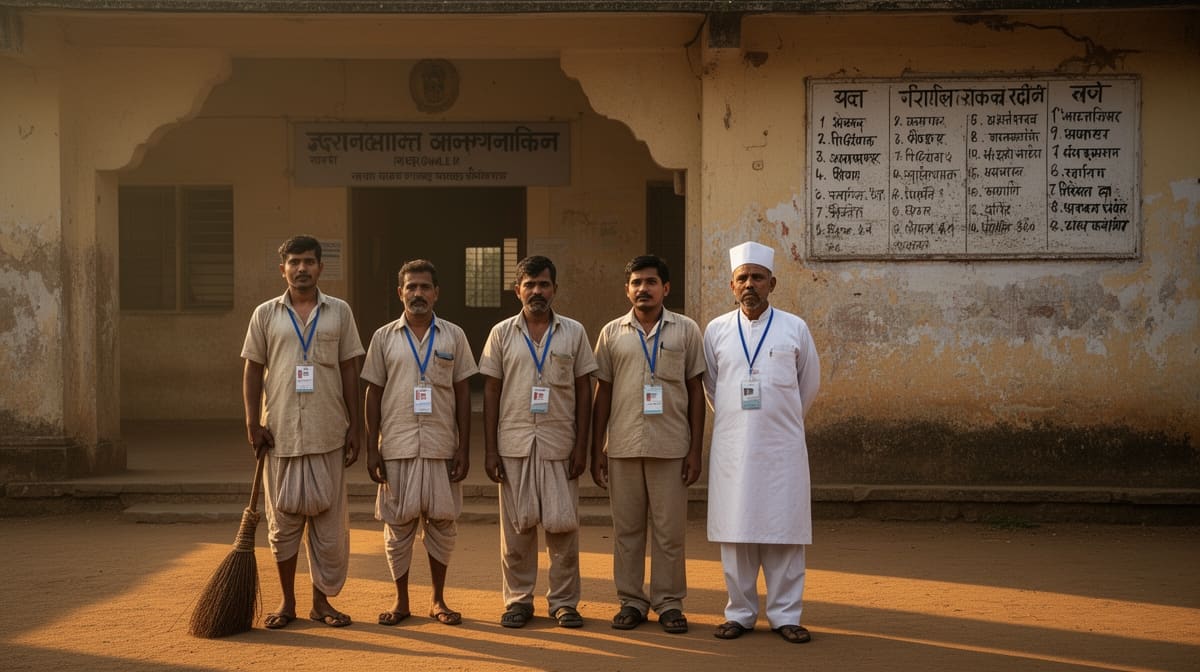
The Central Administrative Tribunal’s ruling in this case redefines the boundaries of administrative fairness for long-serving casual workers. While upholding the rejection of regularization on educational grounds, the Tribunal critically engaged with the Supreme Court’s jurisprudence on temporary employment, affirming that procedural rigidity must yield to substantive justice when service is continuous, indispensable, and sanctioned by the State.
Background & Facts
The Dispute
The four applicants, all engaged as casual labourers in Central GST and Central Excise offices across Jharkhand since the mid-1990s, sought regularization under the Central Board of Indirect Taxes and Customs (CBIC) Part-Time Casual Labourers (Regularization) Scheme, 2020. They had served continuously for over 25 years without break, performing duties integral to daily administrative functions. Their claims were rejected on the ground that they lacked the prescribed educational qualification - matriculation or equivalent - for Group-C posts, despite no such requirement being explicitly stated in the Scheme itself.
Procedural History
- 2020: CBIC issued the Part-Time Casual Labourers (Regularization) Scheme, incorporating eligibility criteria referencing Group-C Recruitment Rules.
- 2021: Applicants submitted documents; cadre controlling authority requested verification of educational qualifications.
- 2022: Board rejected regularization applications citing non-compliance with educational norms under Group-C Recruitment Rules.
- 2024: Applicants filed Original Application (OA) before CAT Ranchi seeking quashing of rejection order and direction for regularization.
- 2024: Two M.A.s filed: one for condonation of delay, another for stay against disengagement of applicant no. 3.
Relief Sought
The applicants sought: (i) quashing of the 14.07.2022 rejection order; (ii) direction for regularization under the CBIC 2020 Scheme; and (iii) consequential benefits including pay, pension, and seniority.
The Legal Issue
The central question was whether the denial of regularization under a one-time welfare scheme can be justified solely on the ground of non-compliance with educational qualifications prescribed for direct recruitment, when the employees have rendered continuous, long-term service in sanctioned positions without any finding of illegality in their initial appointment.
Arguments Presented
For the Petitioner
The applicants relied on Jaggo v. Union of India and State of Karnataka v. Uma Devi to argue that: (1) their appointments were not illegal but merely irregular; (2) they performed permanent, essential functions for over 25 years; (3) the CBIC 2020 Scheme did not explicitly mandate educational qualifications for Class-IV roles; and (4) denying regularization under these circumstances violates the spirit of Uma Devi, which distinguishes between illegal and irregular appointments. They contended that the Scheme was designed as a remedial measure for long-serving workers and should not be weaponized to exclude them on technical grounds.
For the Respondent
The Union argued that: (1) the CBIC 2020 Scheme explicitly incorporated eligibility criteria from Group-C Recruitment Rules, which require matriculation or ITI; (2) the merger of Group-D and Group-C posts made educational qualifications mandatory; (3) the applicants’ educational records (e.g., 9th pass for applicant no. 1) were verified and found deficient; (4) the Tribunal cannot override statutory recruitment rules even for long-serving employees; and (5) applicant no. 3 was employed through a private contractor, making his engagement non-direct and thus ineligible.
The Court's Analysis
The Tribunal acknowledged the applicants’ decades of service and the Supreme Court’s clear directive in Jaggo v. Union of India that long-serving temporary employees in sanctioned roles must not be denied regularization merely due to procedural lapses. The Court quoted the judgment directly:
"Government departments often cite the judgment in Uma Devi (supra) to argue that no vested right to regularization exists for temporary employees, overlooking the judgment's explicit acknowledgment of cases where regularization is appropriate. This selective application distorts the judgment's spirit and purpose, effectively weaponizing it against employees who have rendered indispensable services over decades."
Despite this, the Tribunal concluded that the applicants’ claims could not succeed because the CBIC 2020 Scheme, while framed as a remedial measure, explicitly tied eligibility to Recruitment Rules for Group-C posts, which are statutory in nature. The Tribunal emphasized that the Scheme was not a discretionary welfare policy but a structured mechanism governed by pre-existing rules. It distinguished between procedural irregularity and substantive non-compliance: while Uma Devi protects against arbitrary denial of regularization, it does not permit courts to override statutory qualifications.
The Tribunal further noted that the applicants had not challenged the validity of the Recruitment Rules themselves. The Court held that even if appointments were irregular, regularization under a scheme that explicitly incorporates statutory qualifications cannot be granted dehors those qualifications. The analogy drawn - comparing regularization to promotion - was accepted: just as a Group-C employee cannot be promoted to Group-B without meeting eligibility criteria, a casual labourer cannot be regularized into a Group-C post without fulfilling its statutory educational requirements.
The Verdict
The applicants lost. The Tribunal held that the CBIC 2020 Scheme’s incorporation of statutory recruitment rules for Group-C posts is binding, and denial of regularization on educational grounds, though harsh, is legally valid where the qualifications are prescribed by rule and not challenged. The OA was dismissed, and all pending applications were disposed of.
What This Means For Similar Cases
Educational Qualifications Are Not Optional Under Statutory Schemes
- Practitioners must assess whether a regularization scheme explicitly incorporates statutory recruitment rules - if yes, educational or technical qualifications cannot be waived, even for 25-year service.
- A claimant’s long service alone is insufficient if the scheme’s eligibility criteria are tied to statutory norms.
Uma Devi and Jaggo Do Not Override Statutory Rules
- The judgments in Jaggo and Uma Devi protect against arbitrary denial of regularization for irregular appointments, but do not empower tribunals to ignore mandatory statutory qualifications.
- Courts will not treat a scheme as a blanket entitlement if its terms are clearly conditioned on recruitment rules.
Procedural Compliance Is Non-Negotiable in Public Employment Schemes
- Applicants must challenge the validity of recruitment rules separately if they believe them to be discriminatory or ultra vires.
- Merely pleading equity or long service will not override a scheme’s express conditions.
- Practitioners should advise clients to file writ petitions challenging the legality of recruitment rules, not just the rejection order, to preserve substantive rights.