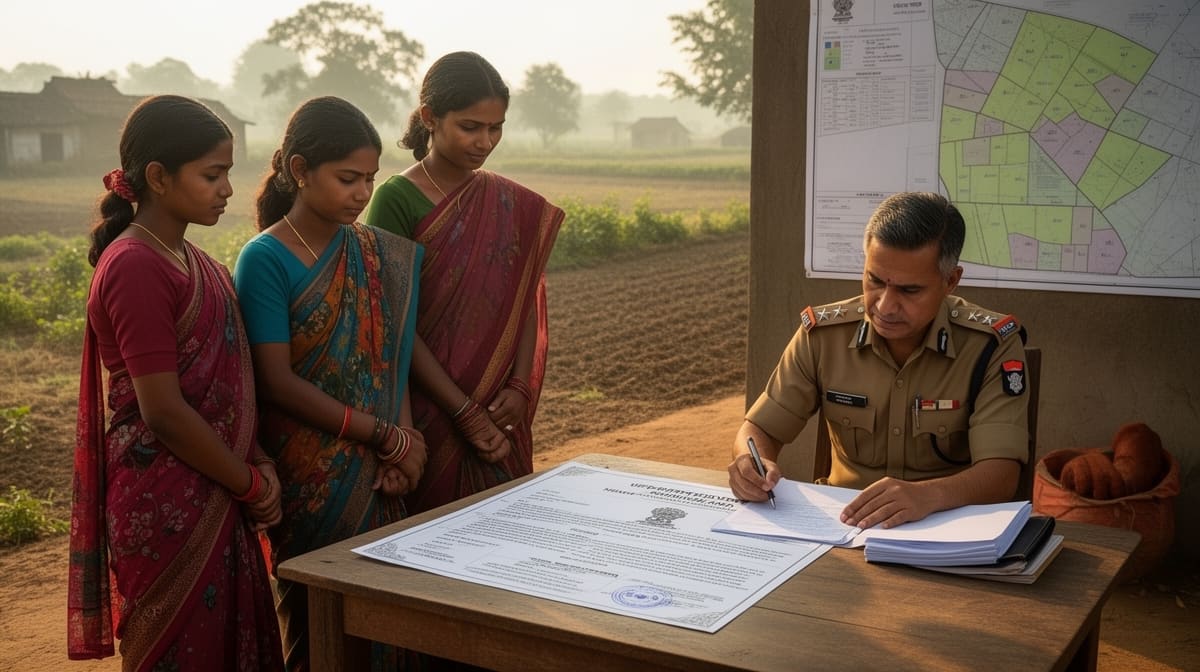
The Madhya Pradesh High Court has issued a decisive directive affirming that unregistered land allotment letters issued to displaced families under the Sardar Sarovar Project cannot confer legal title, regardless of their administrative issuance. This judgment underscores the non-negotiable requirement of registration under the Indian Registration Act, 1908, to secure fundamental property rights for rehabilitation beneficiaries.
Background & Facts
The Dispute
The petition, filed by Ms. Medha Patkar on behalf of project-affected families (PAFs) displaced by the Sardar Sarovar Project (SSP), challenges the State’s failure to register land allotment letters issued since 2002. These letters, though issued by the Rehabilitation Officer, lack registration under the Indian Registration Act, 1908, rendering them legally ineffective for sale, mortgage, mutation, or inheritance. Over 22 years have passed without formal title documentation, leaving thousands of PAFs vulnerable to land disputes and exclusion from financial systems.
Procedural History
- 2002: Land allotment letters issued to PAFs in Dhar, Barwani, Khargone, and Alirajpur districts.
- 2024: Writ petition filed seeking registration of allotment letters and completion of title documentation.
- 25.09.2025: Court observed that unregistered letters cannot serve as title documents and directed the Additional Chief Secretary to propose a registration plan.
- 14.10.2025: Court rejected vague assurances and issued binding directions for committee formation and registration.
- 05.01.2026: Court noted minimal progress and extended deadline.
- 17.02.2026: Court found compliance delayed and ordered senior official to explain delay.
Relief Sought
The petitioners sought: (i) mandatory registration of allotment letters without stamp duty or registration fees; (ii) survey and demarcation of allotted plots; (iii) action against illegal transfers; (iv) monitoring of rehabilitation sites; and (v) time-bound reporting to the Court.
The Legal Issue
The central question was whether Section 17 of the Indian Registration Act, 1908 mandates the registration of land allotment letters issued to displaced persons under a statutory rehabilitation policy, and whether administrative issuance alone can confer a legally enforceable title.
Arguments Presented
For the Petitioner
The petitioner argued that unregistered allotment letters, despite being issued under the Narmada Water Disputes Tribunal and Supreme Court directives, are not title documents under Section 17. Citing State of Maharashtra v. Chandrakant and S. R. Batliboi v. S. R. Patel, she contended that without registration, PAFs cannot legally transfer, mortgage, or inherit land, violating their Right to Life under Article 21. She emphasized that the State’s failure to register constitutes a continuing violation of constitutional obligations.
For the Respondent
The State conceded non-registration but argued that the allotment letters conferred "bhumiswami rights" and that a comprehensive state-wide land survey was underway. It claimed that registration would follow as part of the broader land digitization initiative, and that prioritizing PAFs within this process was sufficient. No statutory or policy exception for PAFs was cited.
The Court's Analysis
The Court rejected the State’s argument that administrative issuance equates to legal title. It held that Section 17 of the Registration Act is mandatory for instruments transferring immovable property of value exceeding ₹100, and that allotment letters clearly fall within this ambit. The Court emphasized that "bhumiswami right" is a colloquial term with no legal standing under the Act.
"If this document is destroyed or misplaced, it would be very difficult to get a fresh allotment letter. Therefore, these cases are liable to be taken on a priority basis by the Collector of each District."
The Court distinguished between administrative convenience and constitutional obligation. It noted that the State’s delay of over two months to frame an SOP and another six months to complete registration demonstrated a lack of urgency, despite the vulnerability of the affected population. The Court applied the doctrine of effective remedy under Article 21, holding that procedural delays in securing land title directly impair the right to housing and livelihood.
The Court further held that the State cannot defer statutory obligations under the guise of broader reforms. It mandated immediate, localized action through district-level committees comprising Sub-Divisional Officer, Tehsildar, and Sub-Registrar, with NVDA and Narmada Control Authority officials as members.
The Verdict
The petitioners succeeded. The Court held that Section 17 of the Indian Registration Act, 1908 requires mandatory registration of all SSP land allotment letters to confer legal title. It directed immediate registration without stamp duty or registration fees, formation of district committees, and personal accountability of the Additional Chief Secretary for compliance.
What This Means For Similar Cases
Registration Is Not Optional for Rehabilitation Land
- Practitioners must now treat all government-issued land allotment letters under rehabilitation schemes as instruments requiring mandatory registration under Section 17.
- Failure to register renders such documents legally inert for sale, inheritance, or mortgage - regardless of administrative intent.
- Legal heirs of deceased PAFs must initiate registration immediately to avoid title disputes.
State’s Administrative Delays Cannot Override Constitutional Rights
- Courts will not accept "future surveys" or "state-wide digitization" as substitutes for immediate statutory compliance.
- Delay in registering land titles for displaced persons constitutes a violation of Article 21 and may attract contempt proceedings.
- Senior officials must be personally named in compliance orders to ensure accountability.
Committees Must Include Statutory Officers
- Any committee formed for registration must include the Sub-Registrar (Stamps), as only they have statutory authority to register documents.
- Non-statutory officers cannot substitute for registered authorities under the Registration Act.
- Panchayats and municipalities may update records only after registration is complete.