The Rajasthan High Court has affirmed that when monetary compensation for acquired land remains unpaid, the state’s policy entitling landowners to 15% developed land in lieu of compensation remains enforceable, regardless of the passage of time or the finality of acquisition proceedings.
Background & Facts
The Dispute
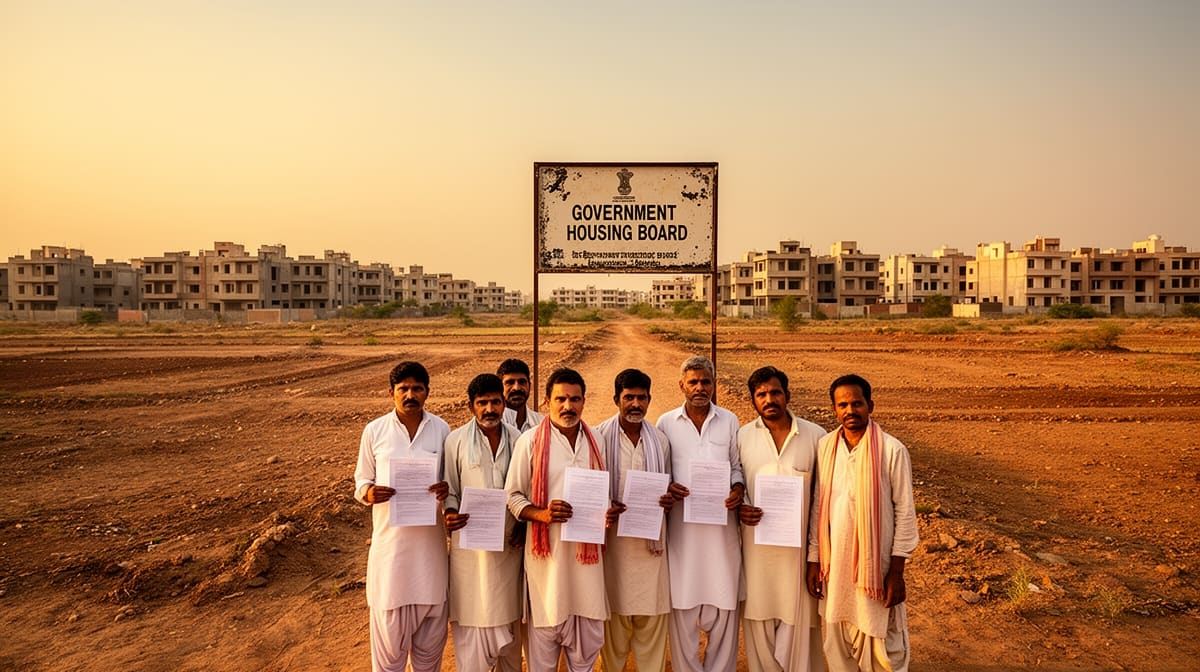
The Jaipur Development Authority (JDA) challenged the order of a Single Judge quashing the State Government’s decision to keep in abeyance an allotment of 9,000 square meters of developed land to Sai Darshan Hotels and Motels Private Limited. The land in question - 23 Bigha 16.5 Biswa in Khasra Nos. 35 to 43, 43/222, 43/223, and 43/224 of Village Chainpura, Tehsil Sanganer - was acquired under the Rajasthan Land Acquisition Act, 1953. The original khatedars, Adyodhya Prasad and Daulat Babu, were awarded Rs. 1,38,180 each in compensation on 09.04.1981. Despite the JDA taking possession on 22.10.1983, the compensation was never paid to the khatedars or their successors.
Key Facts
- Notification under Section 4 of the Rajasthan Land Acquisition Act, 1953: 21.08.1969
- Section 6 notification issued: 12.04.1973
- Final award passed by Land Acquisition Officer: 09.04.1981 (Rs. 1,38,180 each to two khatedars)
- Cheque for Rs. 2,76,360 issued by UIT (predecessor of JDA) to LAO: 04.05.1981
- Reference petition for enhanced compensation filed: 06.06.1981
- Enhanced compensation awarded by Civil Court: 24.03.1990 (Rs. 24,000 per bigha, up from Rs. 6,000)
- Enhanced compensation never deposited or paid
- Fresh cheques issued in name of Civil Judge, Jaipur: 08.01.1997 (Cheque Nos. 169876 and 169877)
- Civil Judge’s office confirmed receipt of cheques but no payment recorded: Letter dated 30.01.2026
- JDA took possession of remaining 9 Kothadi and 1 Chabutra: 27.12.2002
- State Government issued policy circular dated 13.12.2001: 15% developed land in lieu of compensation for unpaid cases
- Respondent filed applications for allotment: 29.03.2003 and 01.05.2003
- State Government ordered allotment of Plot No. 7, Airport Plaza, Jaipur (9,000 sq. m): 12.05.2003 and 19.05.2003
- Respondent withdrew all pending litigation, including SLP before Supreme Court
- State Government kept allotment order in abeyance: 23.06.2009
- Writ petition filed by respondent: 2003
- Single Judge quashed abeyance order: 06.08.2009
- JDA’s appeal dismissed by Division Bench: 14.09.2018
- Supreme Court dismissed SLP (C) No. 6212/2019 on merits, but clarified no merger or res judicata
Procedural History
- 21.08.1969: Section 4 notification issued
- 12.04.1973: Section 6 notification issued
- 09.04.1981: Final award passed
- 04.05.1981: Compensation cheque issued to LAO
- 06.06.1981: Reference petition filed
- 22.10.1983: JDA takes possession of majority land
- 24.03.1990: Enhanced compensation awarded
- 08.01.1997: Cheques reissued to Civil Judge, Jaipur
- 13.12.2001: State issues policy for 15% developed land
- 29.03.2003: Respondent applies for 15% land
- 01.05.2003: Second application filed
- 12.05.2003: State orders JDA to allot Plot No. 7
- 19.05.2003: State directs respondent to withdraw litigation
- 23.06.2009: State keeps allotment order in abeyance
- 2003: Writ Petition No. 3857/2003 filed by respondent
- 06.08.2009: Single Judge quashes abeyance order
- 14.09.2018: Division Bench dismisses JDA’s appeal
- 14.05.2024: Supreme Court dismisses SLP (C) No. 6212/2019, leaves merits open
- 16.03.2026: Present judgment pronounced
The Parties' Positions
For the Appellant (JDA): Argued that the allotment order was illegal, tainted by corruption, and that JDA had already acquired and possessed the land. Claimed no right to 15% land since compensation was deposited (though not paid). Asserted that the State’s policy did not apply retroactively.
For the Respondent (Sai Darshan Hotels): Contended that compensation was never paid, enhanced compensation was never deposited, and it had fulfilled all conditions under the State’s policy by withdrawing litigation. Invoked promissory estoppel and legitimate expectation.
Relief Sought
The respondent sought enforcement of the State Government’s orders dated 12.05.2003 and 19.05.2003, directing JDA to allot Plot No. 7, Airport Plaza, Jaipur, measuring 9,000 square meters. The JDA sought to set aside the Single Judge’s order and uphold the State’s abeyance decision.
The Legal Issue
The central question was whether the State’s policy entitling landowners to 15% developed land in lieu of unpaid compensation remains enforceable when the original compensation has been deposited but not paid, and the landowners have fulfilled all conditions under the policy, including withdrawal of litigation?
Arguments Presented
For the Appellant
JDA argued that since the compensation amount was deposited with the Land Acquisition Officer and later with the Civil Judge, the obligation under Section 31 of the Land Acquisition Act, 1894 was fulfilled. It claimed the policy was discretionary and could be revoked. It further alleged the allotment orders were procured through bribery and that the respondent had no locus standi, as prior litigants had been dismissed. It contended that the doctrine of merger applied due to the Supreme Court’s dismissal of the State’s SLP.
For the Respondent
The respondent relied on the State’s circular dated 13.12.2001 and its amendment dated 26.07.2002, which explicitly provided that where compensation remains unpaid despite notification, landowners are entitled to 15% developed land. It cited the affidavit of the Principal Secretary, UDH, confirming non-payment of both original and enhanced compensation. It invoked promissory estoppel and legitimate expectation, noting it had withdrawn all pending litigation in reliance on the State’s orders. It distinguished Indore Development Authority v. Manoharlal to show that deposit ≠ payment.
The Court's Analysis
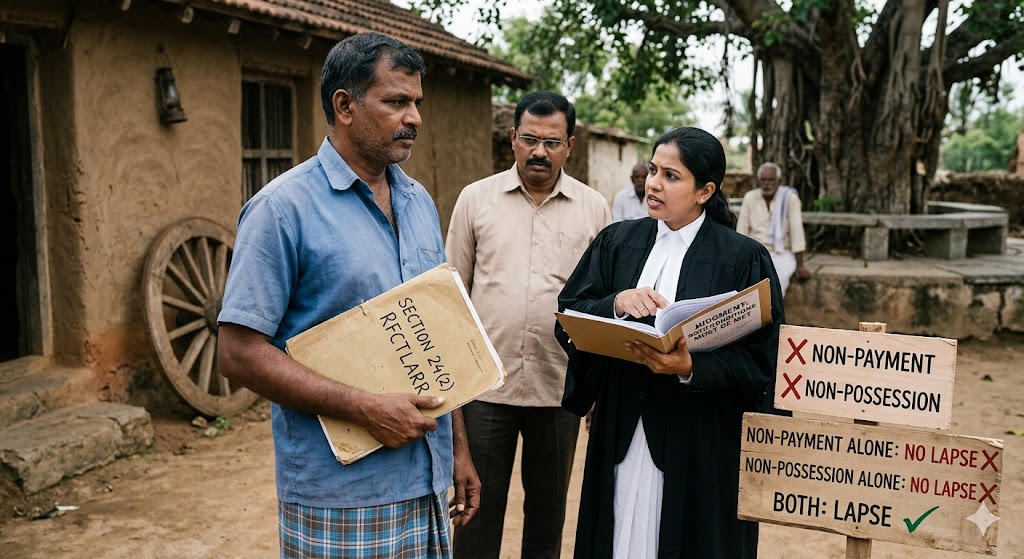
The Court examined the distinction between deposit and payment under Section 31 of the Land Acquisition Act, 1894, and relied on Indore Development Authority v. Manoharlal (2020) 8 SCC 129, which held that deposit in court does not constitute payment. The Court noted that the cheques issued in 1997 were never encashed, and the Civil Judge’s office confirmed no payment had been made. The Court observed:
"The original amount, as assessed by way of compensation, was also deposited, but has not been paid."
It further held that the State’s policy dated 13.12.2001, as amended, was not merely discretionary but a binding administrative commitment to landowners in cases of non-payment. The Court emphasized that the respondent had fully complied with the policy’s condition - withdrawal of all pending litigation - and had done so in good faith. The State’s subsequent decision to keep the allotment order in abeyance was held to be arbitrary and violative of the doctrine of legitimate expectation.
The Court rejected JDA’s claim of corruption, noting that while allegations were made against former ministers, no conviction or formal finding had been recorded, and the respondent, as a successor-in-interest, could not be penalized for alleged malfeasance by third parties. The Court also held that the orders dated 12.05.2003 and 19.05.2003, passed under Section 19(3) of the JDA Act, had attained finality and could not be unilaterally suspended.
The Court affirmed the Supreme Court’s observation that dismissal of an appeal on limitation grounds does not trigger res judicata or merger, and therefore, the merits of the case remained open for adjudication.
The Verdict
The Special Appeal was dismissed. The Court upheld the Single Judge’s order dated 06.08.2009 quashing the State’s order dated 23.06.2009. The JDA was directed to immediately implement the State Government’s orders dated 12.05.2003 and 19.05.2003 and issue an allotment order for Plot No. 7, Airport Plaza, Jaipur, measuring 9,000 square meters, to the respondent. All pending applications were disposed of.
What This Means For Similar Cases
Non-Payment of Compensation Preserves Entitlement to In-Kind Relief
- Practitioners must now argue that deposit of compensation in court does not extinguish the right to in-kind relief under state policy if the amount remains unclaimed or unpaid.
- Where landowners have withdrawn litigation in reliance on policy assurances, courts will enforce the promise under promissory estoppel, even decades after acquisition.
Policy Circulars Bind Government Entities Even When Issued by Other Departments
- Administrative policies issued by the State Government bind implementing agencies like JDA, even if the policy was not directly issued by them.
- The finality of policy-based allotment orders cannot be revoked arbitrarily; suspension without reason violates principles of natural justice.
Corruption Allegations Cannot Void Third-Party Rights Without Conviction
- Mere allegations of bribery against public officials do not invalidate rights acquired by innocent successors-in-interest.
- Courts require conclusive evidence or conviction to set aside administrative decisions; suspicion alone is insufficient.
When Delay Is Not the Issue, Merits Must Be Heard
- If a higher court dismisses an appeal on limitation grounds, the doctrine of merger does not apply, and the merits remain open for adjudication in subsequent proceedings.
- Practitioners should cite Indore Development Authority to argue that non-payment triggers statutory entitlements, regardless of the age of the acquisition.