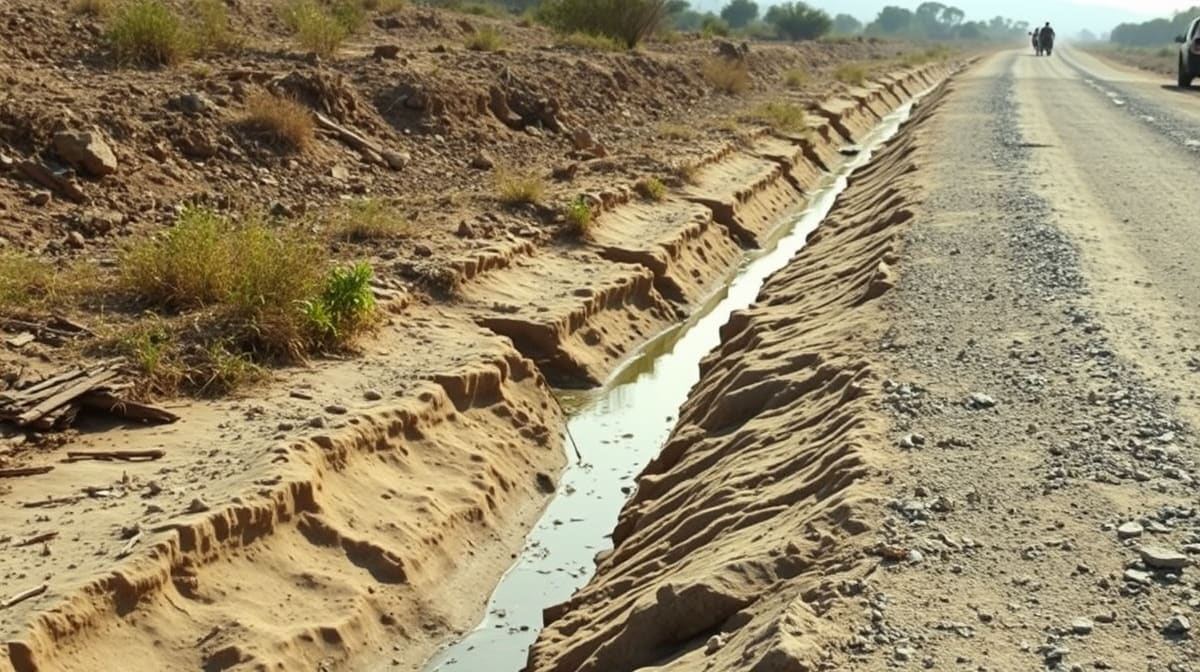
The Rajasthan High Court has reaffirmed the constitutional obligation of the State to preserve natural water channels, holding that land recorded as 'Gair Mumkin Nala' cannot be lawfully altered for infrastructure or public utility projects. This judgment reinforces the public trust doctrine and the inviolability of ecologically sensitive land under Articles 48-A and 51-A(g) of the Constitution.
Background & Facts
The Dispute
The petitioner, a resident of Village Khatwa in District Dausa, filed a Public Interest Litigation challenging the construction of a gravel road and a crematorium on land recorded in revenue records as 'Gair Mumkin Nala' - a natural drainage channel. The respondents, including the State of Rajasthan and local revenue and panchayat authorities, had permitted and executed these constructions despite the land’s legally protected status.
Key Facts
- The land in question bears Khasra No. 717/444 and measures 2.03 bigha (approximately 0.81 hectares).
- Revenue records and Jamabandi consistently classify the land as 'Gair Mumkin Nala', indicating it is a natural, non-cultivable water channel.
- The respondents admitted in their reply that a road and crematorium canopies exist on parts of the land, with the remainder used as a kachcha way.
- No evidence was presented to show that the land was legally reclassified or that any statutory procedure under the Rajasthan Land Revenue Act or environmental laws was followed.
- The construction was undertaken without environmental clearance, public consultation, or approval from the Jal Shakti Department or Forest Department.
Procedural History
- 2021: Writ Petition No. 6614/2021 filed before the Rajasthan High Court, Jaipur Bench.
- 07.05.2026: Hearing concluded and judgment delivered by a Division Bench.
- No prior litigation or administrative appeal was recorded in the judgment.
The Parties' Positions
For the Petitioner: Argued that the land, being a natural nala, is part of the ecological hydrological system and cannot be diverted for any non-conforming use. Relied on Abdul Rehman v. State of Rajasthan and Gulab Kothari v. State of Rajasthan to invoke the public trust doctrine and constitutional duties under Articles 21, 48-A, and 51-A(g).
For the Respondents: Contended that the road and crematorium served public utility purposes and that no private encroachment had occurred. Argued that judicial intervention was unwarranted in matters of administrative development.
Relief Sought
The petitioner sought:
- Removal of all constructions - including the gravel road and crematorium structures - on Khasra No. 717/444.
- Restoration of the land to its original natural state as a water channel.
- A direction prohibiting future use of the land or any adjoining 'Gair Mumkin Nala' land for incompatible purposes.
- Costs of the petition.
The Legal Issue
Can the State lawfully construct a road or crematorium on land officially recorded as 'Gair Mumkin Nala' on the ground of public utility, despite constitutional mandates to protect natural water bodies?
Arguments Presented
For the Petitioner
The petitioner’s counsel relied on two binding precedents of the Rajasthan High Court: Abdul Rehman v. State of Rajasthan and Gulab Kothari v. State of Rajasthan. He argued that:
- The doctrine of public trust, as affirmed by the Supreme Court in Karnataka Industrial Areas Development Board v. C.K. Thakker, holds that natural resources like nalas, rivers, and lakes cannot be privatized or alienated.
- Articles 48-A and 51-A(g) impose a non-negotiable duty on the State and citizens to protect the environment.
- The right to a clean environment under Article 21 includes protection of natural drainage systems.
- Administrative convenience cannot override constitutional obligations.
For the Respondent/State
The State, through the Additional Advocate General, conceded that the land was recorded as 'Gair Mumkin Nala' but argued that:
- The constructions served public purposes (transport and funeral rites).
- No private encroachment had occurred, so judicial interference was unnecessary.
- The State, as trustee, has discretion to balance development and conservation.
The Court's Analysis
The Court began by noting the respondents’ own admission in their reply that the land in question is recorded as 'Gair Mumkin Nala'. This admission, the Court held, was decisive: once the nature of the land is established in revenue records, no subsequent administrative action can override its legal character.
"Once the nature of the land as a natural water channel stands admitted, the consequential legal position becomes self-evident."
The Court then examined the constitutional framework. It emphasized that Article 48-A obligates the State to protect the environment, while Article 51-A(g) imposes a fundamental duty on every citizen to preserve natural resources. The Court cited Maneka Gandhi v. Union of India to affirm that the right to life under Article 21 encompasses the right to a healthy environment.
The Court further invoked the public trust doctrine, as articulated in Gulab Kothari, holding that natural water channels are held in trust by the State for the benefit of the public and future generations. The State cannot act as a trustee while simultaneously violating the trust’s core purpose.
The Court rejected the State’s argument that public utility justifies the alteration of natural land. It observed:
"Public utility cannot be achieved at the cost of destruction or impairment of natural resources which the State is constitutionally and legally bound to preserve. Administrative convenience or developmental pressures cannot legitimise an action otherwise impermissible in law."
The Court also noted the ecological vulnerability of Rajasthan, where water scarcity makes every natural drainage channel critical for groundwater recharge and flood control. Any obstruction of a nala disrupts hydrological balance and endangers long-term sustainability.
Finally, the Court found that the respondents had ignored two prior judgments of the same Bench - Abdul Rehman and Gulab Kothari - which had explicitly directed removal of encroachments on water bodies. This disregard amounted to a failure of constitutional duty.
The Verdict
The writ petition was allowed. The Court directed:
- Immediate removal of all constructions - including the gravel road and crematorium structures - on Khasra No. 717/444 (and 718/444), measuring 2.03 bigha.
- Restoration of the land to its original recorded nature as a natural water channel.
- A prohibition on any future use of the land or adjoining 'Gair Mumkin Nala' land for incompatible purposes.
- Due compliance within three months from the date of judgment.
- All pending applications stood disposed of.
What This Means For Similar Cases
Public Trust Overrides Administrative Convenience
- Practitioners must now argue that any state-led construction on recorded natural water bodies - nalas, rivulets, ponds, or catchment areas - is prima facie illegal, regardless of claimed public benefit.
- Municipalities and development authorities cannot rely on 'public purpose' to justify environmental degradation.
Revenue Records Are Conclusive
- Land classification in Jamabandi or revenue records is binding in environmental litigation.
- No subsequent order, notification, or development plan can override the recorded nature of land without a formal, legally valid reclassification process.
Judicial Enforcement of Environmental Duties Is Non-Negotiable
-
Courts will not hesitate to issue mandatory injunctions against state agencies violating environmental constitutional duties.
-
Failure to comply with prior judicial orders on environmental protection may attract contempt proceedings.
-
Always verify land classification in revenue records before advising on infrastructure projects.
-
Challenge any development on 'Gair Mumkin' land as a violation of Articles 21, 48-A, and 51-A(g).
-
Cite Abdul Rehman and Gulab Kothari as binding precedents in Rajasthan.