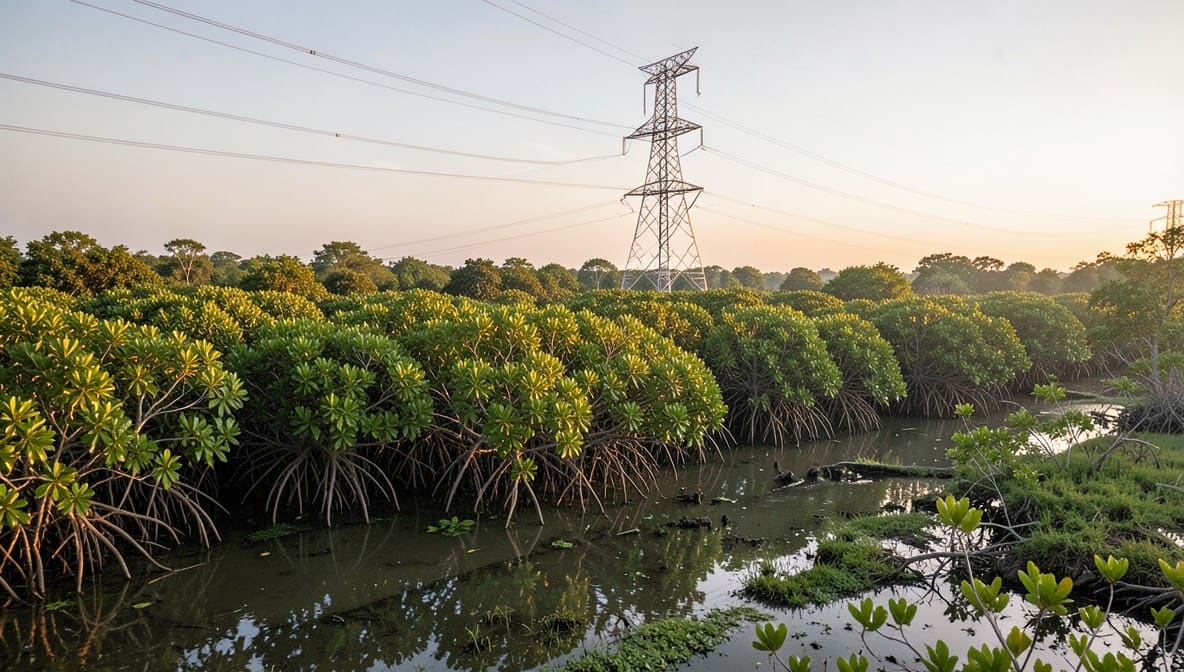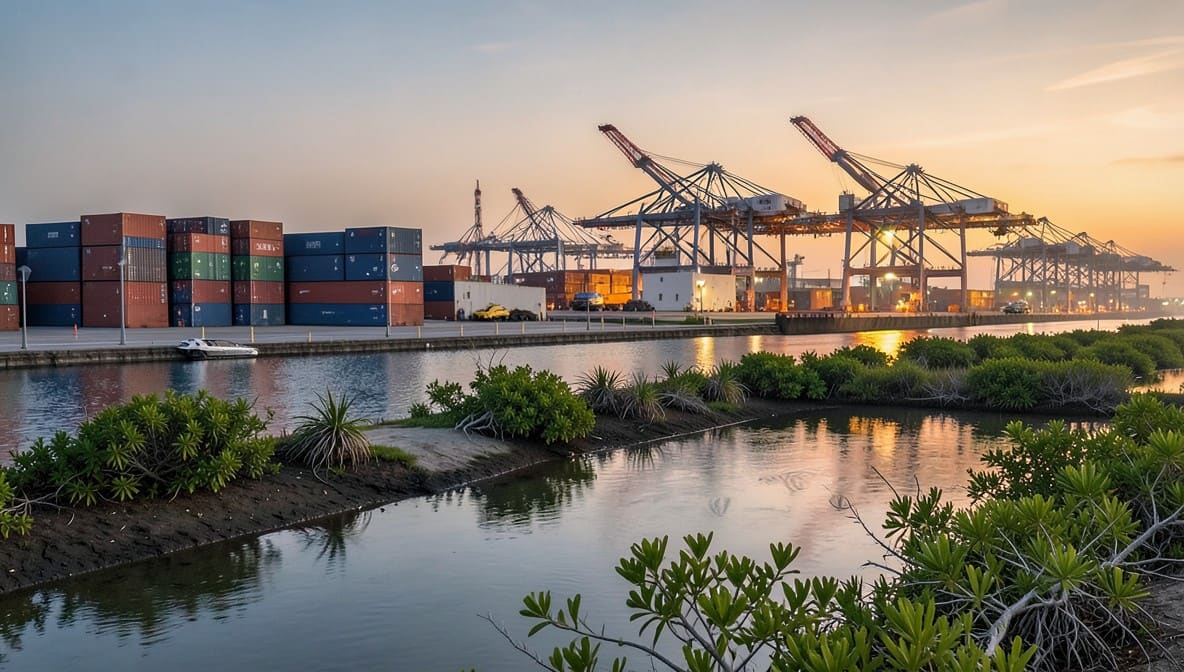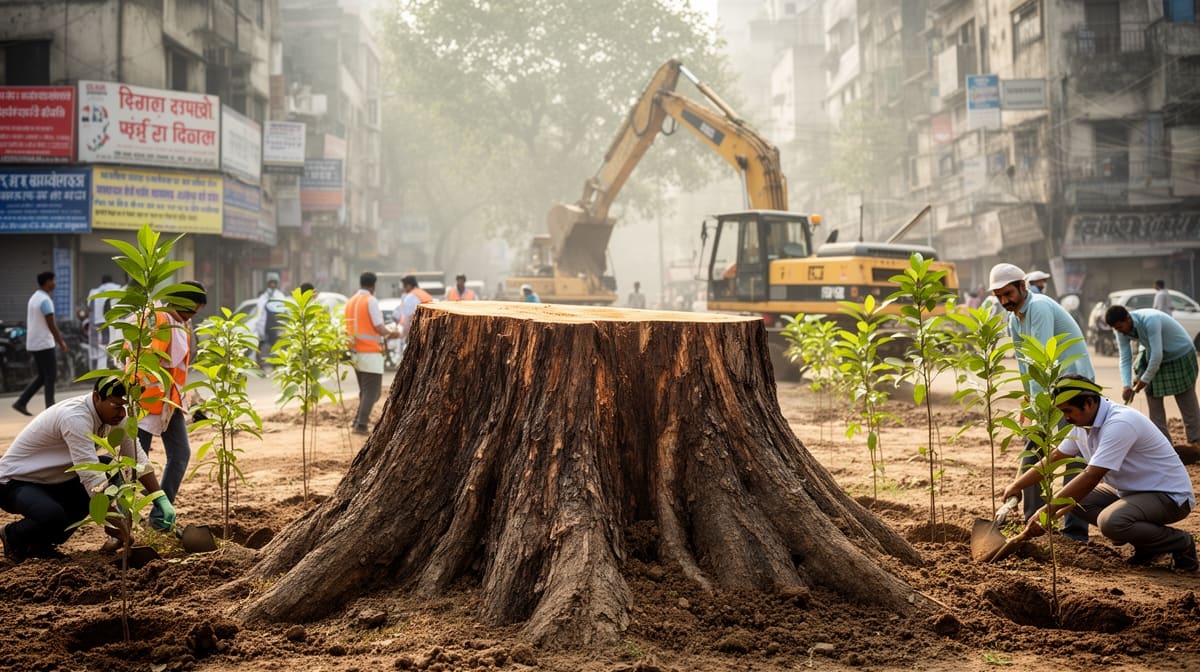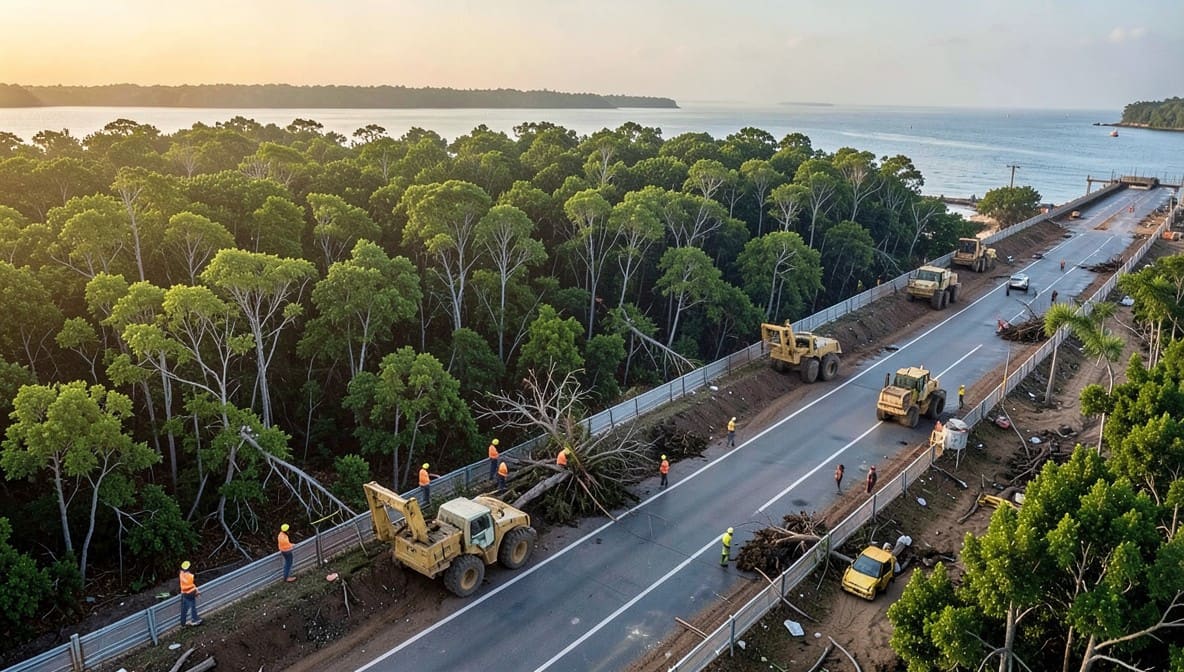
The Bombay High Court has delivered a significant judgment balancing environmental protection with public infrastructure development. In a writ petition filed by the National Highways Authority of India (NHAI), the Court permitted the diversion of 9.2498 hectares of mangrove forest and felling of 208 mangrove trees for the construction of an 8-lane access-controlled highway connecting Vadhavan Port to NH-48. The decision underscores the application of the public trust doctrine, where public utility projects may override environmental preservation mandates if stringent compliance and compensatory measures are ensured.
Background & Facts
The Genesis: Vadhavan Port Project
The case arises from the ambitious Vadhavan Port Project, a greenfield port development in Dahanu Taluka, Palghar District, Maharashtra. The project is a joint venture between the Jawaharlal Nehru Port Authority (JNPA) and the Maharashtra Maritime Board (MMB), conceived to address India’s growing container cargo demand due to the saturation of existing ports like JNPA. The port, with a capacity of 298 million tons per annum, is designed to handle vessels of 24,000 TEU and above, making it a nationally important infrastructure project.
Key milestones in the project’s approval process include:
- 07.10.2020: Terms of Reference (ToR) granted by the Ministry of Environment, Forests & Climate Change (MoEF&CC) for preparation of the Environmental Impact Assessment (EIA) Report.
- 02.06.2023: Amended ToR granted to accommodate evolving project scope.
- 31.07.2023: Dahanu Taluka Environment Protection Authority (DTEPA) granted permission for the port’s establishment, subject to conditions.
- 16.02.2024: MoEF&CC granted Environmental Clearance (EC) and Coastal Regulation Zone (CRZ) Clearance under the EIA Notification 2006 and CRZ Notification 2019, with specific conditions, including Condition (xxiv): "No mangroves shall be cut or affected due to Port construction."
The Dispute: Mangrove Diversion for Road Connectivity
The National Highways Authority of India (NHAI), tasked with constructing road connectivity to Vadhavan Port, submitted a proposal for the diversion of 237.086 hectares of forest land, including 9.2498 hectares of mangrove forest and felling of 208 mangrove trees, for the construction of an 8-lane access-controlled highway. The proposal was scrutinized by the Additional Principal Chief Conservator of Forest (Mangrove Cell), which conducted a site inspection on 16.12.2025 and confirmed the presence of mangroves in the proposed alignment.
Procedural History
The timeline of approvals and legal challenges is as follows:
- 16.12.2025: Site inspection by Divisional Forest Officer, Mangrove Division, confirming 208 mangroves and 1375 non-mangrove trees for felling.
- 31.12.2025: Additional Principal Chief Conservator of Forest (APCCF) recommended diversion, calculating Net Present Value (NPV) of Rs. 1,32,88,910 for the diverted area.
- 06.02.2024: Maharashtra Coastal Zone Management Authority (MCZMA) recommended the proposal to MoEF&CC, imposing 23 specific conditions, including prior High Court approval for mangrove cutting.
- 24.02.2026: Revenue and Forest Department, Maharashtra, recommended diversion under Section 2(ii) of the Van (Sanrakshan Evam Samvardhan) Act, 1980.
- 20.03.2026: MoEF&CC granted In-Principle (Stage-I) Forest Clearance for diversion of 237.086 hectares, subject to conditions, including:
- Compensatory afforestation of 475 hectares at a cost of Rs. 56,49,15,564.
- Deposit of NPV of Rs. 4,83,03,145 for mangrove diversion.
- Prior High Court approval for mangrove felling.
- 01.04.2026: NHAI deposited Rs. 4,83,03,145 towards compensatory plantation for mangroves.
- 17.04.2026: NHAI deposited Rs. 134,52,27,915 (including Rs. 74,22,51,176) for compensatory afforestation of 475 hectares.
- 16.05.2026: MoEF&CC granted Final Forest Clearance under Section 2(1) of the Van Adhiniyam, 1980.
- 23.06.2026: Present writ petition filed seeking High Court approval for mangrove diversion.
Opposition by Bombay Environment Action Group (BEAG)
Respondent No. 5 (BEAG) raised two primary objections:
- Misrepresentation in Environmental Clearance: BEAG contended that the Environmental Clearance (EC) granted on 16.02.2024 was based on the representation that no mangroves would be cut, as reflected in the EIA Report and ToR. The EC included Condition (xxiv), explicitly prohibiting mangrove cutting. BEAG argued that the subsequent discovery of mangroves in the road alignment constituted a violation of the EC.
- Pendency of Legal Challenge: BEAG highlighted that the legality of the Vadhavan Port Project was sub-judice before the Supreme Court in a Special Leave Petition (SLP) filed by the National Fishworkers’ Forum. The Supreme Court, on 28.02.2025, had refused interim relief but made all acquisition proceedings subject to further orders.
Relief Sought
The petitioner (NHAI) sought:
- Approval for diversion of 9.2498 hectares of mangrove forest.
- Permission to fell 208 mangrove trees for the construction of the 8-lane highway.
- Directions to respondent authorities to permit the diversion in light of the public trust doctrine and public utility of the project.
The Legal Issue
The central legal question was: Whether the diversion of mangrove forest and felling of mangrove trees for a public infrastructure project, despite prior environmental clearance prohibiting such diversion, can be permitted under the doctrine of public trust, given the project’s public utility and compliance with compensatory measures?
Arguments Presented
For the Petitioner (NHAI)
- Public Utility and Compliance: Dr. Milind Sathe, Advocate General, argued that the Vadhavan Port Project was of national importance, approved by the Union Cabinet, and essential for maritime connectivity and economic growth. The project had secured all requisite approvals, including Environmental Clearance, CRZ Clearance, and Forest Clearance, with strict compliance of conditions.
- Discovery of Mangroves Post-Clearance: The petitioner contended that the presence of mangroves in the road alignment was not anticipated during the EIA studies, as the Institute of Remote Sensing (IRS) had not identified mangroves in the approved Coastal Zone Management Plan (CZMP). The mangroves were discovered only during a joint field measurement in December 2025, necessitating the diversion application.
- Compensatory Measures: The petitioner highlighted compensatory afforestation of 1,33,320 mangroves on 30 hectares (20 ha at Vadkun village and 10 ha at Agawan village) and the deposit of Rs. 4,83,03,145 for mangrove compensatory plantation. Additionally, Rs. 134,52,27,915 was deposited for compensatory afforestation of 475 hectares.
- Clarification by Forest Authorities: The Additional Principal Chief Conservator of Forest (Mangrove Cell), in a communication dated 24.04.2026, clarified that no mangrove felling was required for Port construction and that the road/rail alignment areas were distinct. The communication advised compliance with Stage-I Forest Clearance conditions without amending the EC.
- Public Trust Doctrine: The petitioner relied on the doctrine of public trust, as articulated in PIL No. 87/2006, which mandates that environmental protection must be balanced with public good. The project’s socio-economic benefits, including employment generation and skill development, were emphasized.
For the Respondent (BEAG)
- Violation of Environmental Clearance: Mr. Aditya Mehta argued that the Environmental Clearance (EC) was obtained on the express representation that no mangroves would be cut. The EIA Report and ToR did not disclose mangrove presence, and the EC explicitly prohibited mangrove cutting (Condition xxiv). The subsequent discovery of mangroves and the application for diversion constituted a breach of the EC.
- Misleading Representations: BEAG contended that the Project Proponent misled authorities by initially representing that no mangroves were involved, only to later seek permission for mangrove felling. This was alleged to be a deliberate omission to secure clearance.
- Pendency of SLP: The legality of the Vadhavan Port Project was under challenge before the Supreme Court, and all proceedings were subject to further orders. Granting approval for mangrove diversion would prejudice the outcome of the SLP.
- Environmental Precedents: BEAG relied on the precautionary principle and judicial precedents (e.g., PIL No. 87/2006) that prioritize environmental protection over commercial or infrastructural projects unless overwhelming public interest is demonstrated.
The Court's Analysis
The Court undertook a multi-faceted analysis of the rival contentions, focusing on the following key aspects:
1. Public Trust Doctrine and Public Utility
The Court reaffirmed the doctrine of public trust, as established in PIL No. 87/2006, which holds that the State is duty-bound to protect and preserve mangroves unless public good or public interest necessitates their diversion. The Court observed:
"The direction issued in the Public Interest Litigation made it mandatory for the State and its agencies and instrumentality to anticipate and attack causes and consequences of degradation of mangroves by applying precautionary principle."
However, the Court distinguished the present case on the grounds of public utility. The Vadhavan Port Project was deemed a nationally important infrastructure project, approved by the Union Cabinet, with the potential to enhance India’s maritime connectivity and economic growth. The Court noted:
"The project of construction of Vadhavan Port being conceived in the background fact that maritime transport is economical and the only means to transport larger volumes of cargo across oceans, Ports and harbors etc. with the capability of handling larger volumes of cargo through puts of both raw material as well as products."
The Court emphasized that the project would create employment, uplift the socio-economic scenario of the region, and strengthen India’s position as a global trade hub. These factors tilted the balance in favor of public utility over environmental preservation.
2. Compliance with Legal and Procedural Requirements
The Court meticulously examined the procedural compliance by NHAI and JNPA, noting that:
- The Environmental Clearance (EC) and CRZ Clearance were granted after thorough scrutiny by the Expert Appraisal Committee (EAC) and MoEF&CC, with 23 specific conditions and general conditions imposed.
- The EIA Report was prepared by M/s. ENKAY ENVIRO SERVICES PVT. LTD. and included 16 annexures covering studies on marine biodiversity, socio-economic impact, coastal fisheries, and hydrological aspects. The report was deliberated by DTEPA and MCZMA before recommending clearance.
- The Forest Clearance process was followed in entirety, with Stage-I (In-Principle) approval granted on 20.03.2026 and Final Forest Clearance on 16.05.2026. The Net Present Value (NPV) of Rs. 1,32,88,910 was calculated and deposited, along with compensatory afforestation costs of Rs. 134,52,27,915.
- The compensatory measures included planting 1,33,320 mangroves on 30 hectares and afforestation of 475 hectares of degraded forest land.
The Court held that the Project Proponent had adhered to all statutory and judicial mandates, including the conditions imposed by MoEF&CC and the directions of the High Court in PIL No. 87/2006. The discovery of mangroves post-clearance was deemed an unforeseen circumstance, and the subsequent application for diversion was a bona fide compliance measure.
3. Addressing BEAG’s Objections
a. Alleged Violation of Environmental Clearance
The Court rejected BEAG’s argument that the Environmental Clearance was violated by the subsequent discovery of mangroves. It noted:
"After the Environmental Clearance and CRZ clearance was granted on 16/2/2024, to the proposed Vadhavan Port by MoEF&CC by including the condition (xxiv) that ‘no mangroves shall be cut, a Joint field measurement was conducted in December 2025, as a part of the land acquisition for construction of 8 lane access controlled highway and during this inspection, the growth of mangroves in certain areas of the road and rail connectivity of the project was noted."
The Court observed that the mangroves were discovered during the road alignment inspection, not during the Port construction. The Additional Principal Chief Conservator of Forest clarified in a communication dated 24.04.2026 that no mangrove felling was required for Port construction and that the road/rail areas were distinct. Thus, the EC was not violated, and there was no need to amend it.
b. Pendency of SLP Before the Supreme Court
The Court dismissed BEAG’s reliance on the pendency of the SLP before the Supreme Court. It noted that the Division Bench of the High Court had already dismissed the challenge to the DTEPA’s approval for the Vadhavan Port in PIL No. 87/2006 and WP No. 15320/2023. The Supreme Court’s order dated 28.02.2025 had refused interim relief but made proceedings subject to further orders. The Court held:
"We are not ready to accept the contention that the order of the Apex Court dated 28/2/2025 amount to grant of stay to the development of the Vadhavan Port and all the steps taken towards its development are made subject to the outcome of the proceedings before the Apex Court."
The Court concluded that the SLP did not operate as a stay, and the project’s development could proceed subject to compliance with conditions.
4. Balancing Environmental Protection and Public Interest
The Court acknowledged the judicial mandate to protect mangroves, as articulated in PIL No. 87/2006, which held that destruction of mangroves offended Article 21 of the Constitution. However, it emphasized that public utility projects could override environmental concerns if adequate compensatory measures were ensured. The Court observed:
"In our view, the said project being of public utility, would provide connectivity to the Vadhavan Port which is being developed as a major Port on landlord Port development model, which would open an opportunity for India to make into the countries with top 10 container Ports in the world."
The Court was satisfied that the compensatory measures - including afforestation of 475 hectares, planting of 1,33,320 mangroves, and deposit of NPV and afforestation costs - were sufficient to mitigate environmental harm. Thus, the public interest in developing the Vadhavan Port and its connectivity infrastructure outweighed the environmental concerns.
The Verdict
The Bombay High Court allowed the writ petition and granted approval for:
- Diversion of 9.2498 hectares of mangrove forest land.
- Felling of 208 mangrove trees for the construction of the 8-lane access-controlled highway connecting Vadhavan Port to NH-48.
- Compliance with all conditions imposed by MoEF&CC, MCZMA, and Forest Clearance authorities, including:
- Compensatory afforestation of 475 hectares of degraded forest land.
- Planting of 1,33,320 mangroves on 30 hectares (20 ha at Vadkun village and 10 ha at Agawan village).
- Deposit of Rs. 4,83,03,145 towards mangrove compensatory plantation.
- Deposit of Rs. 134,52,27,915 (including Rs. 74,22,51,176) for compensatory afforestation.
The Court directed that the project proponent (NHAI) must strictly adhere to all environmental and forest clearance conditions to ensure minimal environmental impact.
What This Means For Similar Cases
1. Public Trust Doctrine: Public Utility Trumps Environmental Preservation
This judgment reaffirms that public utility projects of national importance can override environmental preservation mandates under the public trust doctrine, provided:
- Stringent compensatory measures are ensured (e.g., afforestation, NPV deposits).
- All statutory and judicial conditions are strictly complied with.
- The project’s socio-economic benefits (e.g., employment, trade, connectivity) are substantial and demonstrable.
Practical Takeaways:
- Infrastructure developers must anticipate environmental contingencies and secure all clearances before commencing work.
- Environmental clearances may be challenged if post-clearance discoveries (e.g., mangroves) are not promptly addressed with additional approvals.
- Courts may permit diversion if the project’s public utility is clearly established and compensatory measures are robust.
2. Procedural Compliance is Non-Negotiable
The Court placed heavy emphasis on procedural compliance, including:
- Thorough EIA studies covering marine biodiversity, socio-economic impact, and hydrological aspects.
- Public hearings and stakeholder consultations (e.g., fisherfolk, local communities).
- Expert committee recommendations (e.g., EAC, MCZMA, DTEPA).
- Deposit of NPV and afforestation costs as per forest clearance conditions.
Practical Takeaways:
- Project proponents must document every step of the clearance process to defend against legal challenges.
- Non-compliance with conditions (e.g., delayed deposits, inadequate afforestation) can jeopardize approvals.
- Judicial scrutiny will focus on whether all statutory authorities (e.g., MoEF&CC, Forest Department) followed due process.
3. Judicial Deference to Executive Decisions on National Projects
The Court exhibited deference to executive decisions approving nationally important projects, provided:
- The project is approved by the Union Cabinet (e.g., Vadhavan Port).
- Multiple expert agencies (e.g., EAC, MCZMA, DTEPA) have recommended clearance.
- The project aligns with national priorities (e.g., maritime trade, economic growth).
Practical Takeaways:
- Legal challenges to Cabinet-approved projects face high thresholds for success.
- Courts are reluctant to interfere if expert committees have thoroughly scrutinized the project.
- Environmental NGOs must demonstrate procedural lapses or misrepresentations to successfully challenge clearances.
4. Compensatory Measures as a Condition for Approval
The judgment underscores that compensatory measures (e.g., afforestation, NPV deposits) are not mere formalities but mandatory conditions for approval. The Court noted:
"The Project Proponent has fulfilled the demand towards compensatory afforestation as well as the NPV as it made the requisite payment of Rs.4,83,03,145/- on 1/4/2026 and on 17/4/2026, an amount of Rs.134,52,27,915/- (inclusive of Rs.74,22,51,176/-) is deposited towards compensatory afforestation of 475 ha land."
Practical Takeaways:
- Project proponents must budget for compensatory measures at the planning stage.
- Failure to comply with afforestation or NPV conditions can lead to revocation of clearances.
- Courts may impose additional conditions if initial compensatory measures are inadequate.
5. Distinction Between Port Construction and Connectivity Infrastructure
The Court distinguished between Port construction and road/rail connectivity, holding that:
- Port construction did not require mangrove diversion (as clarified by the APCCF).
- Road/rail alignment (outside Port limits) required mangrove felling, necessitating separate approval.
Practical Takeaways:
- Infrastructure projects must clearly demarcate between core project areas and connectivity infrastructure.
- Separate clearances may be required for different components of a project (e.g., Port vs. road).
- Misrepresentations in one component (e.g., road alignment) do not invalidate clearances for another (e.g., Port) if distinct.